Browsed by
Category: Reddit

Software Is Chewing the World into a Uniform Pablum

Software Is Chewing the World into a Uniform Pablum

Do you remember when the Internet was good? When it was a fun and creative space for individual expression, and not the wasteland of tedious memes, unsolicited ads, and crappy AI-generated images, endlessly scrolling by on our feeds, that it has become today?

If you used the Internet in the late 90s/early 00s timeframe and think that in that time period, it was a more enjoyable place than it is today, then you are not alone. Here’s a reddit thread where a user shares that same viewpoint: I miss the 90s/2000s internet.

The gist of it is that in the first decade or so of the World Wide Web, with the Internet growing but not as pervasive as it is today, the interfaces had a more stark and raw quality which invited individual creativity and control. As a user back then, you were exploring an evolving digital space and helping to create it. Today, with most of the planet online and a small number of digital platforms dominant, you are inhabiting an established digital space that was created by others.

For example, one of the earlier social media sites, MySpace (still around, BTW), allowed you to customize your user profile with your choice of backgrounds and styles – it even let you do this directly in HTML code. People’s choices were often garish and confusing – it wasn’t necessarily the most elegant of sites, but it was glorious in its embrace of individuality. Then Facebook took over, with its common profile format, where all you get to pick is two different images: a cover photo and a profile picture.

Similarly, in the early 2000s, there was all this excitement surrounding the “blogosphere,” which was a loose network of individual commentators, each with their own “web log,” or “blog” for short. Here random people of dubious authority would pontificate about the state of the world, and there was serious talk about how they were supplanting the “mainstream media” – that is, the old familiar sources of print and television news. I remember because I was one of those bloggers!

The blogosphere is mostly forgotten (says a guy on his blog), but the mainstream media is still on its way out, now being replaced by everyone’s favored source of news – that’s right, social media! This is possibly the worst way for you to discover what is going on in the world, as your feed is completely curated by algorithms designed to serve you palpable content in an information echo chamber. You will never learn anything new, only have your prejudices repeatedly reaffirmed.

These are just a couple of examples of how there has been a kind of homogenization of Internet content as the Internet has grown over the past few decades. This trend is connected to the way that big apps have become the primary source of content for Internet users, who find it convenient to go to one site (or maybe just a few sites) when browsing online. These sites are designed to engage users with satisfying content, since keeping users engaged is how they make their money. The trend is thus driven by both supply and demand, in a cozy little feedback loop that keeps users locked into their boring and predictable feeds.

Much has been made of this evolution (or devolution) of the Internet in online commentary. Writer and activist Cory Doctorow decries the “enshittification” of sites that lure users in with supportive features, only to pull the rug out once their user base was captured. Journalist Ken Klippenstein warns of the rise of an oligarchy of “appistocrats” with unprecedented social and political power. Meanwhile, writer and researcher Molly White acknowledges this degradation of online content, but reminds us that we still have the power to use the Internet creatively, if we choose.

I agree with her; despite the online space being taken over by corporate monoliths and becoming more of a curated and passive experience, it is still a place for individual expression and empowerment. There are plenty of people publishing independent writing online, such as on blogs like this one, and also on new platforms like Medium and Substack. The audio podcast is a new format which encourages individual creative effort, facilitated by the Internet.

Sure, Facebook sucks in general, but it’s also useful for staying connected with extended social groups, for sharing hobbies, and for organizing people – whether for a get together, or for a protest march. YouTube’s recommendation algorithms might be sketchy, but the site is a treasure trove of content in another new format: the video essay. This innovative art form has been so successful that many creators have been able to make a living producing it.

A video essay on YouTube about how the Internet used to be a better place.

Maybe it’s just the nerd in me, but in my mind the Internet remains a huge boon for us as individuals. But I also acknowledge why one might think of the late 90s and early 2000’s as the Internet’s Golden Age, as it was more of an exciting and exploratory time in the evolution of globalized digitization. It was a time when the practice of going online was still developing, and so could be likened to a “Wild West” period of frontier development. Now the frontier is fully settled, everyone is online, and the young generation are “digital natives” – that is, they have no life experience in the pre-Internet age.

Back in 2011, billionaire broligarch Marc Andreesen wrote an article about how “software is eating the world.” His piece was really just promoting tech stocks, but in it he made a point that the ubiquitous presence of the Internet, what with everyone on Earth accessing it via smartphones and broadband, meant that online solutions to any conceivable consumer demand could now be readily implemented. Hence, software companies were replacing older companies: for example, Amazon had taken over the book business, and Netflix was taking over TV and film.

I just love his expression, “software is eating the world.” It suggests how all human knowledge has been sucked up – devoured, if you will – by online platforms. All geographic locations of interest are stored in maps programs for navigating, all scientific and historical knowledge is in online encyclopedias and archives, all audio and visual entertainment (music, film, TV) is available in some streaming service or other.

The marketplace has been devoured by the Internet as well. Since merchants and consumers can easily share information and transact online, everything a citizen-consumer needs to thrive in the modern world – transport, accomodations, dining, goods, services – can be accessed through a pocket device. Thus, software companies have taken over these spaces as well, offering near-instant gratification of all these demands, supplanting the older ways of doing things with a new “sharing economy” that leverages the global digital networking of humanity.

I’ve posted before, under the tag “Ruling the Waves,” about how technologies develop in phases, starting with more exploratory and risky periods, and ending with dominant players establishing the rules by which the technology will finally be adopted. We are clearly in this latter phase with regard to the Internet, with the rise of monolithic “Big Tech” corporations with huge captured user bases, and founders and executive officers who are among the wealthiest humans in history.

In the process of consuming all human knowledge and enterprise, these software giants have standardized and regulated it to conform to both their desire for profits, and to Internet users’ desire for convenience and reliability. Interfaces have become more streamlined and content more predictable – but that also means, well, that the Internet has become more boring. Hence the nostalgia for the Internet of the past, and the perception that those were the good old days when there was more fun, excitement, and freedom to be had online.

In this boring new Internet, information gets distilled down to just what is barely needed. Content becomes predictable, repetitive, tedious – everything just a copy or mashup of something else. Knowledge, such as it is, is reduced to the least common denominator. Software didn’t so much eat the world as chew it up and digest it into a uniform pablum, which it now spoon feeds to an addicted user base. Generative AI, feeding off all of this ingested data, only makes things worse.

A video essay explaining how convenience leads to mediocrity in the information realm.

This is a somewhat bleak and dystopian assessment, to be sure: the Internet as tool of corporate control, pacifying rather than edifying the masses. But it’s not like we can stop using it; it’s become part of the basic infrastructure of civilization, like roads and the electical grid. Truly, it remains an incredibly useful and empowering tool. We just have to be aware as we use it that it is not necessarily designed with our best interest in mind, that the vast amount information it makes available includes much that is untrustworthy, and that it many ways it is a waste of our time. The Internet ate the world, but the real world is still there – the Internet can simply help us to make the most of it.
Subreddit of the Week: LeopardsAteMyFace

Subreddit of the Week: LeopardsAteMyFace

The LeopardsAteMyFace subreddit has a simple purpose, which I repeat verbatim from its description:

‘I never thought leopards would eat MY face,’ sobs woman who voted for the Leopards Eating People’s Faces Party. Revel in the schadenfreude anytime someone has a sad because they’re suffering consequences from something they voted for or supported or wanted to impose on other people.

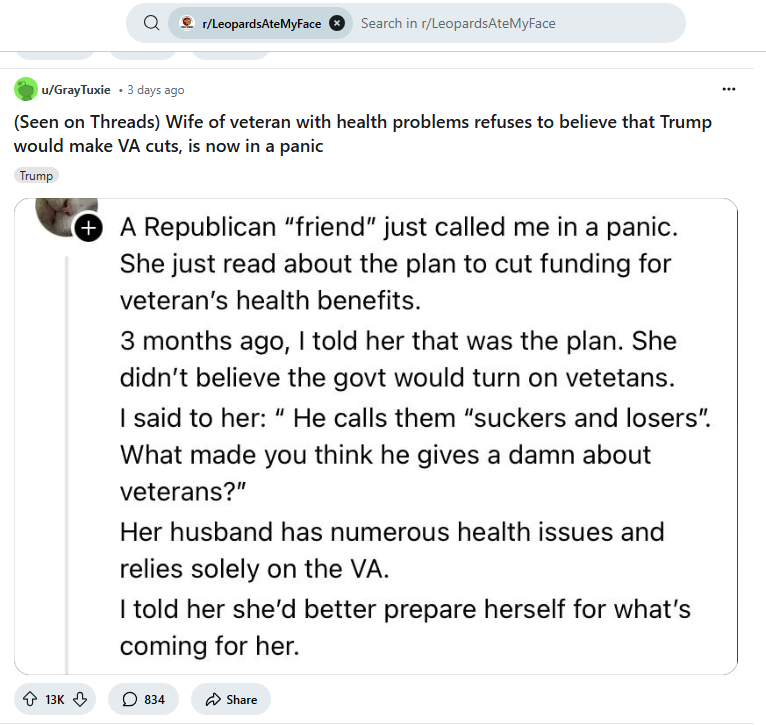
As you can imagine, the subreddit is now filled with posts exulting in the shock of Trump voters who suddenly realize the consequences of what they’ve done.

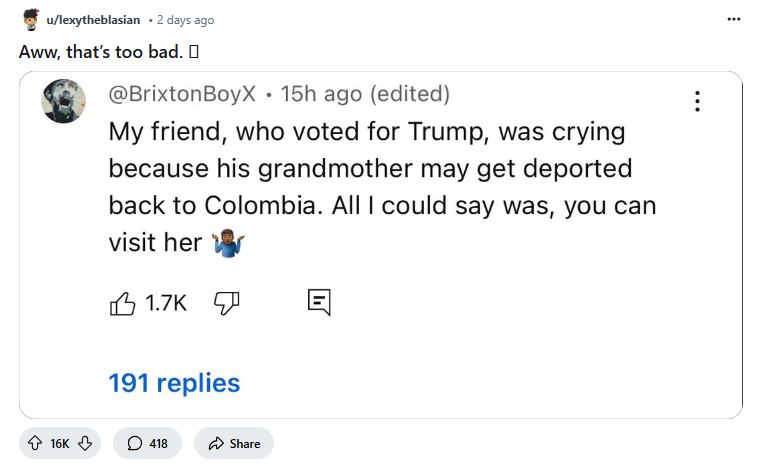
Wait – you voted for Trump and now you’re worried about a relative being deported?

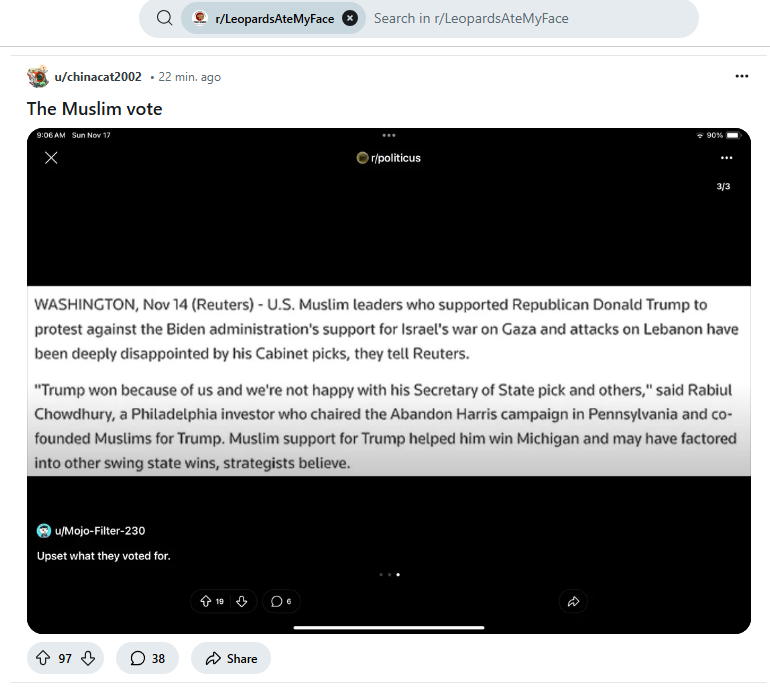
Muslims who voted for Trump really thought they were going to improve the lot of Palestinians??

Maybe research a candidate’s policy proposals before voting for them???

It’s almost like people were voting to make a statement, but didn’t think he would actually win. Like we’re in a real life version of Putney Swope.

Well, probably not. But the schadenfreude is running thick in this subreddit these days.

Subreddit of the Week: Overemployed

Subreddit of the Week: Overemployed

I have a confession to make: I am overemployed.

This is the opposite of underemployed, a state in which a person works fewer hours than they have available and makes insufficient income to meet their needs. Instead, as an overemployed person, I work long hours at the expense of my free time, and am doing well financially. I do worry a little that we may be in for a recessium, which could conceivably cost me my one job which actually pays well. But that’s just all the more reason to keep nose to grindstone.

I said I’m “overemployed” but that’s kind of an exaggeration. Really, I’ve just taken on a couple of gigs beyond my full time Information Technology job. And I shouldn’t complain (though that is my brand), because these are great opportunities for me to develop myself more broadly, and to contribute something to society beyond simply slogging bits for an investment company (yeah, I’m in FinTech).

One of the gigs I’ve already blogged about – Aileen and I are adjudicators for the Philadelphia Independence Awards. This job involves going to see high school theater productions, then judging the performances and technical aspects of the shows, and providing constructive feedback. It takes up some time, since we have to drive to the show, and then it might last a couple of hours, plus the time writing up the feedback. The only compensation is a stipend to cover fuel costs, but every bit helps, as they say. We see about 16 shows over the course of the school year.

The other gig is one that I’m super-excited about; it’s really a dream come true. I’m working for none other than Neil Howe, generations expert and co-author of The Fourth Turning. When he advertised for a research assistant to help with his new book, I submitted an application and a short resume highlighting my generations studies (including this blog). Imagine my excitement when he responded! He took on both Aileen and me as research assistants.

At first, we did research on pandemics throughout history. This was during the early days of Covid, so it felt very in the zeitgeist. Not much of this research, if any of it, will actually be incorporated into the book. But now what we are working on, as a deadline fast approaches, is the end notes. This is very time consuming, and I sincerely hope that with all the work we’re putting into it, the notes will be comprehensive and useful, even more so than they were in the first book.

So that’s the sense in which I’m “overemployed.” We are being compensated for working on the notes, but the rate is much less than what I make in my IT job. But like I said, this is more an opportunity to be a part of something big, to contribute to an important project which I have been following for the better part of my adult life. It’s obviously very exciting for me to be working with Neil Howe.

But I’m not going to make an insane amount of money, like some people who are overemployed. Now what do I mean by that? Well, that’s where the title of this post comes in. Check out the subreddit /r/overemployed, a community that invites you to work two remote jobs, earn extra income, and reach financial freedom. Yes, there are folks out there who are working multiple full-time salaried remote jobs and making huge incomes – possibly as part of a FIRE strategy. Or possibly simply because they see an easy way to exploit the circumstances of remote work.

If you drill down into the subreddit, you can learn what it’s like for people who have chosen this path. Usually, none of their multiple employers know about the other ones. So they have to make sure to hide the fact of their overemployment (except anonymously on reddit, of course). It’s definitely a shady deal. But it’s doable because with a lot of “email laptop” jobs, there isn’t actually a lot of work to do. You just have to invest in a mouse jiggler, and learn to avoid being expected to attend too many meetings.

There are other considerations, like which job to put on your social media profile, and how to handle health insurance and taxes. You can learn all the tricks of the trade, and the lingo associated with it, over on /r/overemployed. There are users claiming to hold as many as 7 jobs at once! It’s not something I could do, mostly because it seems like enough work as it is to manipulate that many employers. I mean, it just doesn’t seem right to deceive your boss like that. But can I really talk? It’s not like I tell my full time employer about my side gigs, or even this blog (though they could find out).

And if someone is able to fulfill the job requirements of multiple jobs at once, then why shouldn’t they? If they could do it while being up front about it with their various employers, then it should be perfectly legit, right? Never mind what this means for income inequality, and how unfair it is for people who aren’t in lines of work where you can get your job done sitting at a desk at home. It just goes to show how varied outcomes can be in our “land of opportunity,” where everything depends on individual ambition and achievement. And, no doubt, on the luck of the draw.

I’ve certainly been lucky in my circumstances, that let me find the extra time to work on other projects, even while keeping my fin tech employers happy. I’m not so much overemployed as employed to the fullest.

Subreddit of the Week: antiwork

Subreddit of the Week: antiwork

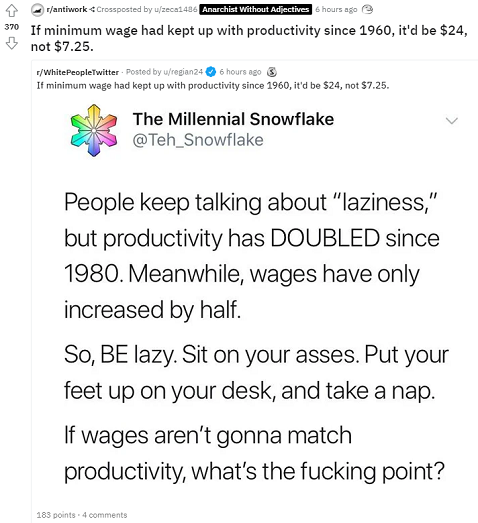
You may have seen a chart like the one on the right, which I took from Wikipedia’s page on workforce productivity. It shows labor productivity growth compared to wage growth since the end of the Second World War. What’s remarkable about it is how the two statistics track one another for a period of two decades or so, but then suddenly veer off, dramatically so for non-managerial workers. Workforce productivity starts growing much faster than nonsupervisory workforce compensation, as the latter curve flattens out.

What this means is that for a good couple of decades (the length of a generation), after 1948, as output per hour of work improved, so did the compensation for that work. The improvement in the value of labor was transferred to the workers themselves. But suddenly, in the early 1970s, gains in output were no longer matched by gains in wages. The improvement in the value of labor benefitted only those managing or employing the labor. This trend continues to this day, and is at the root of what is wrong with the economy, with its massive income and wealth inequality, and lack of economic opportunity for the working class.

There are actually a slew of economic indicators that shifted dramatically in the early 1970s, along with political and social indicators. They are all captured on a site here. This shift can be seen as the start of a new economic regime.

So what caused this shift to a new regime? Arguably, a shift in social priorities and the rise of a new generation into the workforce. In the early 1970s, that generation would have been the Baby Boomers. They brought a new inner-world, moralistic focus into American life. For Boomers, work was a personal mission, a matter of defining the self, not a matter of bargaining for rights and responsibilities as part of a collective.

Consequently, union membership declined as this generation entered the workforce, yet another indicator shift to join the ones on the site I linked above. Boomers were pursuing their own individual agendas through their work, not participating in building any kind of functioning system, as their union-joining forefathers had done. Boomers gave us the concept of the workaholic, someone for whom the work itself was the reward. Success in work became a status symbol for the inner-driven, wealth-obsessed yuppies of the 1980s – a sign of individual merit and self-worth.

By the time Generation X started working, labor rights had become completely passé. Gen Xers entered the workforce with an attitude of self-determination, as free agents, always looking out for the best deal for themselves. They gave us the concept of the perma-temp, the employee with no benefits or safety net, who drifts from employer to employer. As a Gen Xer might have put it, “it’s just a job.”

Gen Xers were the young adults of the boom times in the 1990s, when economic growth was high and productivity growth was on the rise. But in the new opportunistic economic regime, economic growth no longer acted as a rising tide to lift all boats. Instead, it was like a wave that some successfully rode, and others did not. Workers separated into economic winners and losers, with far more of the latter. Today, Gen Xers are middle aged, and one has become the richest person in the world. Many others have utterly washed out.

Now Millennials are the young adults in the workforce, doing much of the nonsupervisory production work which has experienced so little gain in compensation compared to the actual value it provides to employers. The “slackers” of Generation X, raised with low expectations, may have been willing to tolerate these circumstances. They may even, like Kevin in 1984’s Repo Man, have seen opportunity in them (see the video clip below). But not so Millennials.

Raised with high expectations, in a structured environment that rewarded following the rules, Millennials have not taken well to the free-for-all job market they have inherited from Boomers and Xers. Many Millennials have gone into massive debt for a college degree, only to discover that the jobs which a college degree opens up don’t pay well enough to justify the cost. Milestones of financial and personal success, such as buying a first home or starting a family, are elusively out of reach for Millennials, given the economic disparities that have grown over the course of the meritocratic, “neoliberal” regime established by Boomers and Xers.

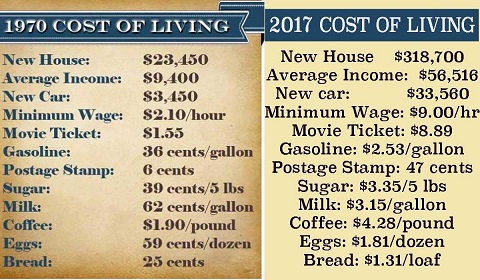
Millennial disappointment with this state of affairs is visible in the many memes that fill social media feeds, comparing the economic circumstances of their generation with those of past generations and highlighting their disadvantages. Talk of “late stage capitalism” and enthusiasm for progressive politicians such as Bernie Sanders and Alexandria Ocasio-Cortez point to disillusionment with the current economic system. Could Millennials even be willing to embrace – gasp! – socialism? Red zone pundits would certainly like you to think so.

This brings me to my subreddit of the week, /r/antiwork. This subreddit has taken off in 2021, in concert with all the news stories about the “Great Resignation” and the labor shortage.

On /r/antiwork, the workers of reddit unite to commiserate over the awful conditions and abuses suffered by workers today. They post about the absurdities of our system, like costly health insurance that provides almost no benefit, and low salaries for jobs with high education requirement. They proudly tell stories about how they quit their last position, and encourage and praise union efforts.

Do reddittors really think we can reach a state where no one needs to work? Or is this subreddit simply a forum for venting about the miseries of living on the flattened curve of low compensation employment, where so many are stuck today?

I think that what this subreddit is really bringing to light is the pent-up demand for significant structural economic reform. A new generation with new priorities is in the workforce, and a new regime is required to meet their needs for an economy that provides fair rewards for work, and fosters financial security and not merely the opportunity for personal achievement.

Unfortunately, the only policy the U.S. government can come up with is to borrow and spend to keep the economy hot. While that might relieve the pain for some in the short term, it’s doubtful it will change all those economic indicators for the better in the long term, or quiet the dissenting voices of /r/antiwork. For that, major economic reforms would be needed, to transfer the value of labor back to the workers themselves. Maybe then they won’t mind coming to work so much.

Young Gen Xers bullshitting about work in the mid-1980s.
Subreddit of the Week: insaneparents

Subreddit of the Week: insaneparents

WARNING: This post contains spoilers for the movie The Shining.

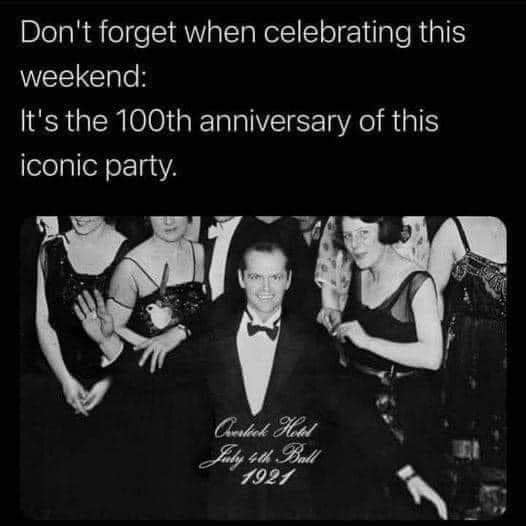
You may have seen the meme that Independence Day 2021 was the 100th anniversary of a famous fictional event: the 1921 July 4th Ball pictured at the end of The Shining. The event is depicted in a photograph that mysteriously features a younger version of Jack Nicholson’s character, Jack Torrance. In celebration of this anniversary, our family decided to watch the movie on the night of July 4th, even though we’ve all seen it multiple times, it being an excellent and iconic example of the horror genre.

The highlights of the film are Nicholson’s creepy, expressive performance, and the tense, suspense-building score which is artfully synchronized to the action. The camera work is great, too, and the film shows how much emotion can be generated just from pacing and music, with slow buildups to cathartic release. The strings slowly rise, and then the axe suddenly falls, and the viewer’s heart skips a beat. But frankly, the film is a little light on story, of which there is much more in Stephen King’s book. The sequel movie from 2019, Dr. Sleep, drawing more story from the novel which it adapts, is a supernatural horror action adventure with a much richer plot.

In The Shining, Jack’s son Danny is played by Danny Lloyd, who does a decent enough job of portraying a harried Gen X kid dealing with less than ideal parenting, not to mention bizarre otherworldly events. Here’s the scene from the end of the film where he escapes his deranged father. Note his inventive survival skills. That really marks him as a Gen Xer.

When I watched this scene, I couldn’t help but imagine how it would look as a post on the subreddit /r/insaneparents. Something like, “when I was a kid, maybe about 10, my Dad chased me through a snow-covered hedge maze with an axe – he really wanted to kill me, I’m not joking – but through some misdirection and careful hiding I managed to escape him. Never saw him again after that, I actually think he might have died that night. Can’t say that I miss him, but I will say that the experience really made me who I am today…”

If you don’t know about this subreddit, it is basically a place where people go to share the bizarre and unwholesome parenting behavior they have experienced. I imagine that most of it is Millennials calling out their Boomer and Gen-X parents; one can never be sure since reddit is mostly people posting anonymously. It is possible that older posters are bringing up their long ago childhood experiences, or that Homelanders (the post-Millennials currently in their early teens) are already sharing their own victim of parenting horror stories.

I imagine that this is mostly a subreddit for Millennials not only because reddit itself was founded by Millennials, but also because Millennials are champions of Internet reviews. It all ties into Millennials’ collective peer personality, which seeks rational consensus on the best choice. Here’s a post on LinkedIn that shows what I mean. More and more, choice in the marketplace is driven by communal decision making, rather than personal preference.

As this generation has risen into adulthood, they have helped drive the proliferation of reviews on commercial web sites like Amazon and on web directories which also function as review sites, such as Yelp. As students in higher education, they have access to resources to rate and review their educators – why shouldn’t they know ahead of time if a professor’s class is worth taking, or be able to give their feedback after taking a class? In a way, the subreddit /r/insaneparents is just a site for reviews – albeit anonymous ones – of parents.

Parenting, I believe, is the hardest job in the world. Everyone is expected to do it, but the only training anyone gets is a bad example. Since not everyone makes the strongest parenting choices, you get a subreddit like /r/insaneparents. So parents out there, do try to raise your children well, or you just might end up getting a bad review on the Internet.

An Emerging Values Consensus?

An Emerging Values Consensus?

You might look at that title – “An Emerging Values Consensus” – and think, are you kidding?? The Culture Wars and the partisan divide between liberals and conservatives (or the blue zone and the red zone) have been a fixture in our society for decades now. I’ve already written a series of blog posts on the topic, in which I concluded that we were experiencing a “Red-Blue” identity crisis as a society. Which way will we break? Or could we even break into two – split into two societies altogether, possibly violently? There is serious discussion of impending civil war out there.

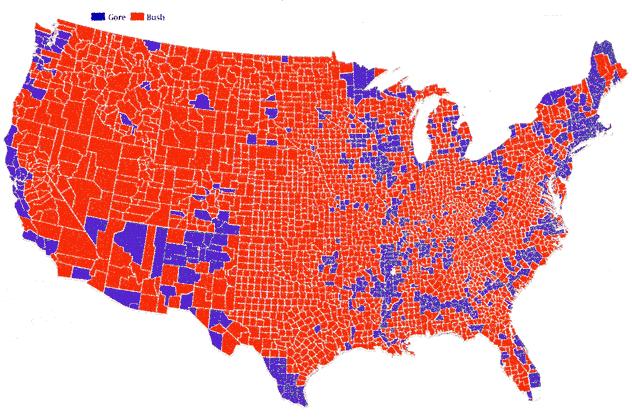
You’ve probably seen the above map before. It’s from the 2000 Presidential election, and shows the counties that voted for Bush in red and the counties that voted for Gore in blue. It’s around this time that the red zone-blue zone idea came about – the idea that there were two different “values camps” with competing visions of what America should be. Baby Boomers were in mid-life then, and their values-orientation dominated American culture. Their passion and moral zeal is what made the divide between the two camps so deep and so unbridgeable, damaging our political system to the point that many now wonder if it can be repaired. Just think of the events of January 6th this year to understand what I mean.

Back around that time, on an old fashioned web site that I built, I attempted to list out the differences between these two values camps. The list is a bit over-generalized, a bit stereotyped; I can’t deny it. I’m sure many people believe a little bit from column A, a little bit from column B. But to some extent these differences do define the partisan divide, and the thing is, as the partisanship has just worsened and worsened, it’s gotten to the point that it doesn’t really matter what your particular “nuanced” belief system is. The political struggle has become existential, and you have to pick a side and stick with it.

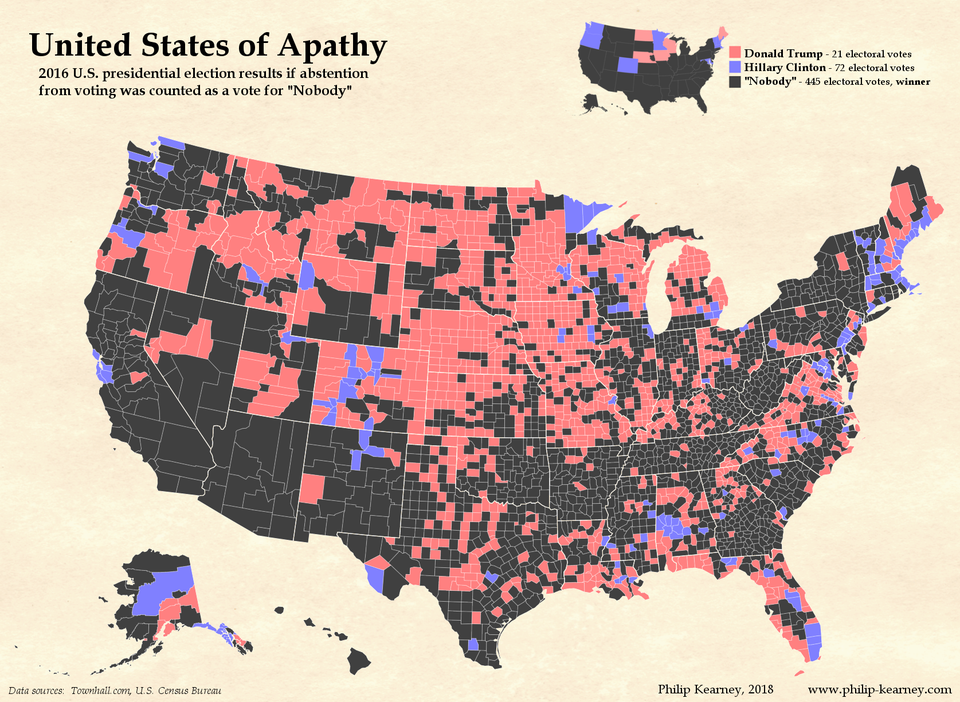
Or not, I suppose. You could just not belong to either side. I have a feeling that many of my generation, Generation X, are in that particular “values camp.” It’s the camp of people who mind their own business and just want to be left alone. As the map below show, if non-voters counted in the electoral college (I know, that makes no sense) then “Nobody” would have been elected President in 2016.

This isn’t to say that non-voters lack values or moral beliefs, just that they might be having trouble finding a political party to fit into. As I already suggested, most people probably take their beliefs a little from the red side, a little from the blue side. It’s even possible to show that the country isn’t so starkly divided geographically as the “red zone-blue zone” maps suggest, by measuring both Republican and Democratic votes per county and constructing a “purple” spectrum map like the one below.

Red v. Blue spectrum version from the 2016 Presidential election.

All I’m trying to say here is that the neat division of values into two columns doesn’t necessarily reflect how people think. And now that Boomers are aging out of mid-life, being replaced by Generation X, moral righteousness as a guiding principal of politics is losing its shine. As I already blogged, Boomer moralism has rendered politics dysfunctional. Younger generations yearn for a practical approach to politics, one that can solve the many thorny problems facing our society. It is perhaps unfortunate, then, that the current mid-life generation, Generation X, which is known for pragmatism, also eschews politics.

I’m just rehashing what I’ve already written about before, so back to the title of this post and the idea of a values consensus. Assuming America is not going to split into two societies, we’re eventually going to settle for some version of “a little bit of column A, a little bit of column B” that works for the majority of us. This will grow more and more apparent as the morally righteous Boomers, who pretty much can’t ever have their minds changed, age out of public life. Those who disagree with these values, who reasonably can claim that there is no “consensus” since they disagree, will be relegated to the sidelines of public life. In fact, you can already see this happening. Isn’t that exactly what hashtag movements, cancel culture, de-platforming are all about? Effectively, if unfairly, enforcing a majoritarian viewpoint?

So what exactly is the consensus that is emerging? I actually tried to predict what it might be way back in 2002 when I first created the red values v. blue values page. Then I tried again and again around the time of the 2016 election. How exactly am I doing this? Well, my admittedly non-scientific approach is simply to monitor discourse on major platforms on the Internet to see what’s going on. I check the reddit hivemind, since I really do think that is the premier site where Millennials are forging a consensus using the tools of social media.

Now maybe this puts me in a bit of blue zone bubble, since all the red zoners are moving to alternate sites like Gab and Parler (so I’ve heard). But doesn’t the fact that red zoners are shifting to less mainstream platforms tell you which way the consensus is going? Honestly, I think there are only two areas where the red zone’s view still has traction, and that is in the two most contentious points of the Culture Wars – gun control and abortion rights.

So here’s where I think we end up:

  • Pro-gun rights
  • Pro-marijuana legalization
  • Equal rights for LGBTQ
  • “Counter-culture” mainstreamed (everyone has a tattoo these days)
  • Pornography accepted
  • Continued restrictions on abortion, though it will never be fully banned
  • Justice and police reform
  • Reform to improve the lot of lower economic classes, even if it’s “socialism”
  • Pro-environmentalism policies to deal with climate change
  • A path to citizenship for “dreamers,” but immigration otherwise limited
  • Acceptance of a multicultural, multiracial, multi-religious society, to the chagrin of White Christian Nationalists

So now that this Culture Wars crap is out of the way, can we end the filibuster already and get some Universal Healthcare?

Subreddit of the week: murderedbyAOC

Subreddit of the week: murderedbyAOC

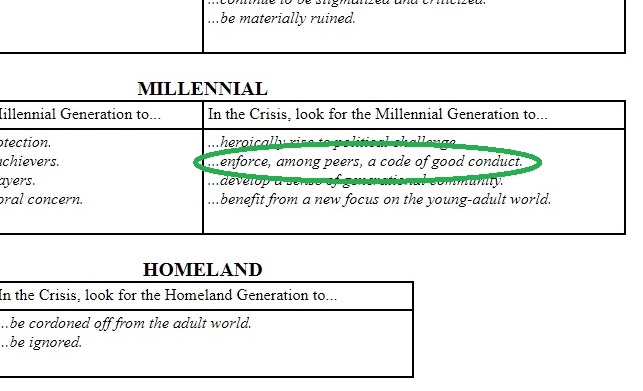
Years back, I wrote a blog post about how Millennials use social media for consensus building. I was tying into predictions based on Strauss & Howe generational theory on how the Millennial generation would behave as young adults in this era, the Crisis Era. One prediction is that they will enforce a code of good conduct.

Prediction about Millennials from The Fourth Turning.

Fast forward to today, and cancel culture is fully in place. Well, what is “cancel culture” if not an effort to enforce a code of conduct by ostracizing those who violate the code?

It seems that complaints about cancel culture come mostly from the political right. But before you call it a phenomenon of the left, I challenge you to go to a right-leaning site like parler and express support for President Biden. I’ll bet you get “cancelled” pretty fast.

Could the right’s problem with cancel culture just come from the fact that the left has been more successful at it? Perhaps that is because the left’s code of conduct better reflect’s the majoritarian view. Perhaps that is because the left didn’t choose a champion who is a criminal mountebank.

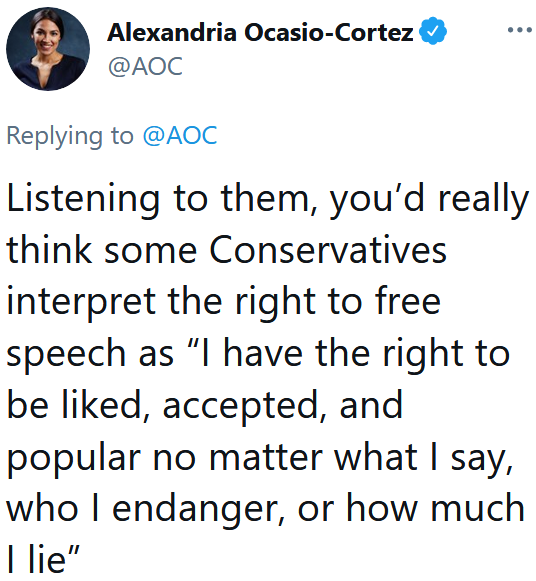
Or maybe the left really is just better at the culture game. We all know from reddit that the /r/TheRightCantMeme. And look no further than reddit to find a Millennial who excels at enforcing good conduct with her brilliant wit.

I mean Representative Alexandria Ocasio-Cortez, who has her own subreddit, dedicated to reposting the stinging comebacks to red zoners that she makes on social media. It’s a happy little bubble for a blue zoner to go and assure themselves of the superiority of their partisan viewpoint. And as a partisan blue zoner myself, I’m happy to declare /r/murderedbyAOC the subrreddit of the week.

Subreddit of the Week: enlightenedcentrism

Subreddit of the Week: enlightenedcentrism

There is a subreddit devoted to the idea that the claim “but both sides are doing it…” as some sort of above-the-fray stance of moderation is really aligning oneself with the extremist right. It’s called /r/enlightenedcentrism and it freely admits in a reminder on a pinned post that it is left-leaning.

An image taken from a post on /r/enlightenedcentrism.

I bring up this subreddit because I recently read the book “It’s Even Worse Than It Looks.” It’s authors argue that the Republican Party bears the greater responsibility for creating the partisan rift and for disrupting the functioning of government. It’s been their strategy since they started pushing against the New Deal coalition of the Democratic Party, way back when conservative Baby Boomers entered politics. It’s part of their Ayn Rand-ian “no government is good government” agenda. The authors also argue that the problem has been exacerbated by the professional media’s inclination to attempt to report objectively, to treat both sides of the partisan divide fairly. This has obfuscated the truth that one side is deliberately being disruptive and causing damage to the democractic process.

Doesn’t this make sense of recent events surrounding the election of the new President, a Democrat? Let’s face it, being an enlightened centrist isn’t a useful option any more. As Dr. Maggie Gravel says at the end of Death to 2020, “pick a side and hunker down.” Either get on your Russian-hosted social media site with the other red staters and plot against the United States, or join the blue state and the mission of restoring the nation.

Subreddit of the Week: aboringdystopia

Subreddit of the Week: aboringdystopia

I’m sure you’ve heard of the science fiction genre known as cyberpunk. I’m not talking about the recently released video game; I mean science fiction that is high-tech and futuristic in its setting, and politically and socially dystopian in its outlook.

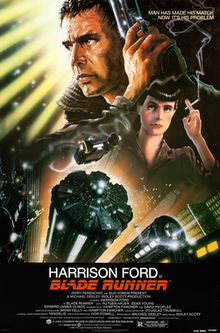
An early example in film was the 1982 movie Blade Runner, based on a Philip K. Dick novel from the 1960s. It was a real trendsetter for the cyberpunk aesthetic – bleak and dark, but also slick and stylish. Like how everybody dressed in the nineties. It promised a future of brutal corporate rule and film noir cool. Did it get that future right? Not really. But as I broke it down in a review of the film and its sequel, science fiction is just modern mythology. Most of it is fantastical and completely unrealistic in its extrapolations; the real point of it is to explore the human psyche and the meaning of life.

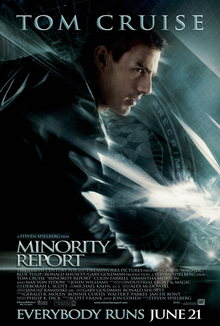
Cyberpunk took off in the late 1900s, but as the world turned and the real cyberworld evolved, it looked less and less like the jaded, punk settings of the fictional genre. Going into the twenty-first century, cyberreality was becoming helpful and consumer-oriented. A more accurate depiction in dystopian fiction of the world to come was captured in the 2002 movie Minority Report, also based on a Philip K. Dick story. It was quite prescient in its forecast of a society under continuous surveillance and evaluation. The world it envisions even includes targeted advertising, and self-driving cars. The big thing it gets wrong is that, instead of psychics, we use machine learning algorithms to predict human behavior.

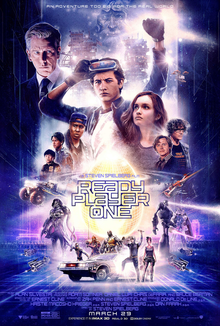
Now that we’re one-fifth of the way into the new century, and deep into the Crisis Era, the luster has come off of the consumer-oriented market society. Concerns about wealth and income inequality, and the plight of the underprivileged, have come to the forefront of popular dystopian science fiction. In the 2018 movie Ready Player One, a powerful tech company dominates society and a permanent underclass can only find respite in virtual reality. Sound anything like your life?

In the even higher stakes story of 2013’s Elysium, the Earth inhabited by the poor is almost unlivable, and the privileged middle class has taken to an orbital space habitat, where they enjoy vastly superior lives to those on the planet surface. Clearly this society has not dealt successfully with either climate change or the rising cost of healthcare. As far-fetched as the techonologies may be in the film, the allegory of an elite class that has completely abandoned any sense of social responsibility is unmistakeably relevant.

What kind of harrowing, high-tech dystopia do we actually live in today? That takes me to the title of this post and the subreddit /r/aboringdystopia. Here the teeming digital masses chronicle all the petty injustices and cruelties of the modern world, all the ways the megacorps keep us under their thumbs, all the ways that late stage capitalism is failing us. We did manage to get to a dystopia of oppressive corporate rule after all, it’s just not futuristic or cyberpunk.

Somehow we became an oppressed underclass without keeping any sense of style. We’re sitting in our sweatpants and binge-watching Amazon Prime video, not running around in cool leather jackets like Neo and Trinity. But in our own sad way, we’re jacked in to the Matrix and trapped in a dystopia.

World Views on the Web

World Views on the Web

This is to follow up on my last post, where I revisited some Boomer generation founded web sites that were arguably cutting edge “new media” a decade or so in the past, but by now are being submerged by the flood of traffic to social media sites where everyone hangs out today. These Boomer sites are quite clearly split between “red zone” (conservative / traditional / Republican) vs. “blue zone” (liberal / progressive / Democrat) values.

I ended the post by speculating whether the same stark difference would be evident in the web sites founded by younger generations. On the one hand, younger generations aren’t as values-driven as the Boomer generation. On the other hand, they primarily derive their Weltanschauung from the vision of the Boomers, and so that vision should be reflected in their own culture.

Revisiting the sites which I had linked to back in 2014, my impression is that the sites decidedly shift from red to blue as you go from Gen-X to Millennial. However, I would say that the Gen-X red zone sites are less hysterically partisan than the Boomer ones. I mean, Matt Drudge is really a muckraker at heart, not a partisan conservative.

Here’s the list roughly in order from the oldest founder (Newsmax’s Christopher Ruddy, born 1965) to the youngest. Only the founders of Reddit are Millennials; the rest are Gen-Xers. In my judgment there is a shift from the red zone world view to the blue zone world view as you go down the age ladder.

This is true even though the site at the bottom, reddit, accomodates people of all views, in assorted safe spaces called subreddits. They are safe spaces because the admins of the subreddits can ban people who express opposing viewpoints. But, in my judgment at least, the majoritarian perspective on reddit is the blue zone perspective. You can judge for yourself by visiting the sites.