Browsed by
Month: April 2026

TV Show Review: When We Were Younger
TV Show Review: When We Were Younger

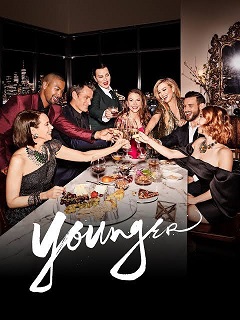
We’ve been watching and enjoying a show called Younger, which ran from 2015 to 2021, and is now available on Netflix.

Succintly put, it’s like a Millennial generation version of Sex and the City. The latter show was based on the writing of Boomer Candace Bushnell (b. 1958), and was about a group of professional women in New York City, played mostly by Gen Xers, who remain fast friends throughout the trials and tribulations of playing the dating game. It was set roughly in the 1990s. The former, from the same Gen X creator and producer (Darren Star, b. 1961), has a similar vibe, is set in the same city in the late 2010s, and is about a group of mostly Millennials.

Which isn’t even quite true, as the characters in the show are an even mix of Millennials and Gen Xers. But the premise is that a 42-year old divorced woman named Liza, played by Broadway star Sutton Foster (b. 1975), wants to get back into the publishing industry after a long hiatus while she raised her daughter. She finds that it is impossible to get hired because of her age, so she pretends to be 26 years old, and then lands a position as an assistant to a marketing executive, a fellow Gen X woman who believes she has hired a Millennial.

It’s a sketchy premise, but if we suspend our disbelief and let the show run with it, there is plenty of fun tension and humor generated by the main character attempting to lead her double life. She ends up befriending a Millennial book editor at the company, played by former teen idol Hilary Duff (b. 1987), and running with her circle of Millennial friends. She hangs out with them at clubs and bars, and starts dating a hunky Millennial hipster guy.

I particularly enjoyed the show’s savvy with regard to markers of generational belonging. When you are born in a certain time period, you experience subsequent history at specific ages, and your memory of time is specifc to how the world looked, throughout time, to everyone in your age group. So Liza is constantly having to check herself while hanging with her Millennial friends, because she is supposed to recall the 90s and 00s as if she were 16 years younger than she really is, and doesn’t want to blow her cover and consequently her career.

The show ends up depicting a Millennial-Gen X generation gap, though notably Generation X is never called out by name. The term Millennial, however, is used frequently; in fact, the character played by Duff ends up becoming the head of her own publishing imprint called “Millennial Print,” targetting the younger generation. But the term “Generation X” never comes up, and at least once during the show, a Gen Xer is labelled as a Boomer. This is a common enough misrepresentation, and anyway we all know “Boomer” is just culture code for an older, out of touch person. My poor, forgotten generation!

That’s why I say this is a Millennial show, even though it isn’t. Like Sex and the City, it is racy, and has the characters rotating in and out of various romantic and sexual relationships. It is updated for the sensibilities of the current age, with more openness about being gay or bi or polyamorous. The Sex and the City sequel, And Just Like That…, tried to do that, too, but with less success (IMO).

Younger also ends up being a nostalgic look at life in the late 2010s. Can we really be nostalgic for the years of the first Trump administration? Well yeah, considering all that’s happened since. It was a time when Twitter was still respectable, and hashtags still had the power to cancel the un-woke. It was a time when it was conceivable that a young up-and-coming professional could live in New York City and make it in a still relevant web-based publishing industry. That doesn’t seem so possible now, as this article by a Millennial in New York reminds us: Ten Years In A Crumbling Industry

Younger might not be a show for everyone. It’s not the most brilliant thing on TV, but you might like it if, as I do, you like it when the popular culture is consciously generational. This show is definitely consciously Millennial. And it reminds us of how different the zeitgeist – or vibe as the youngsters call it – was, just 10 years ago.
Why I Am a Toaster Democrat

Why I Am a Toaster Democrat

If you’re a long time reader of this blog, you know that I don’t hide my partisanship. I am squarely on the liberal/Democratic/blue zone side of the partisan divide.

I have voted Democratic since 2004. In 2000 I voted Libertarian (oops) but after the debacle of that election and the subsequent unfolding of the Bush era, I came to the realization that Libertarianism is not a viable political philosophy, and that since I was more aligned with the Democrats than the Republicans, I should vote for them. Nothing the Republicans have done since then has changed my mind. If anything, they’ve only gotten worse and hardened my resolve.

There is this term “yellow dog Democrat” to refer to someone who will always vote a straight Democratic party ticket in any election. The term has origins going back to the nineteenth century, but here is an example of its use in the 1950s:

 “We’re pretty much yellow-dog Democrats here,” said an Arkansan last week, explaining the state would vote Democratic even if the party nominates a “yellow dog.” – LIFE magazine, May 21, 1956.

The quote above was from a Southerner in a time when the Democratic party could still rely on the “Solid South” for votes. That would change with political realignment starting in the 1960s, when white Southerners started gravitating toward the Republican party. Arkansas did cast its electoral votes for the Democractic Presidential candidate as late as Clinton in 1996 (understandably), but hasn’t since then.

One of my online friends introduced me to the term “toaster Democrat,” which I believe he coined. He meant it in the same way: that he would vote for a toaster over the Republican candidate, if the Democrats nominated a toaster. It’s as if to say, “not only would I choose a quadruped over a Republican, I would even choose a lifeless kitchen appliance over a Republican.”

At this point I would say I am also a toaster Democract, and I feel vindicated in being so, because – here’s the thing – with the unhinged ways that the current Republican President is acting, it is literally the case that an actual toaster, a kitchen appliance useful only for making toast, would be a better President. This is not an exaggeration or a figure of speech: we would truly be better off as a nation if our President was a toaster, instead of the guy we have now.

With the complete devolution of the Republican party into a bizarre and disturbing cult dedicated to evil and destruction, I obviously could never vote for a Republican candidate for as long as I live. But here is the thing: I get why people are disillusioned with the Democratic party as well. They have delivered very little in the way of real change to help the common American. The truth is, it’s been relatively easy for me to support Democrats, because I am still (barely) middle class, and have done fairly well under neoliberalism, thanks mainly to getting into the field of Information Technology (this could change as AI takes over).

In my political alignment, I am pretty much a basic centrist Dad. I have been voting mainstream Democrat since I registered as a Democrat, with the only exception being voting for Bernie Sanders in the 2020 primary. I get that Democrats need a stronger platform, and think they would do better with an economically populist vision in line with traditional (pre-Reagan era New Deal) Democratic policies: stronger worker protections, better social safety nets, more progressive tax structures to force the ultra-wealthy to pay for better outcomes for everyone else. Populism is the current zeitgeist and Democrats need to ride that wave.

But for now we’re stuck in this terrifying and dangerous equilibrium of having a depraved supervillain for President, with no one able to do anything to stop him. This Substack post explains the dynamic: Why No One Acts.

It’s basically a game theory problem where no one is incentivized to act because the risks are too high. And I am stuck (all us hoi polloi voters are) in the same trap. I have to vote Democrat, even though nothing will change.

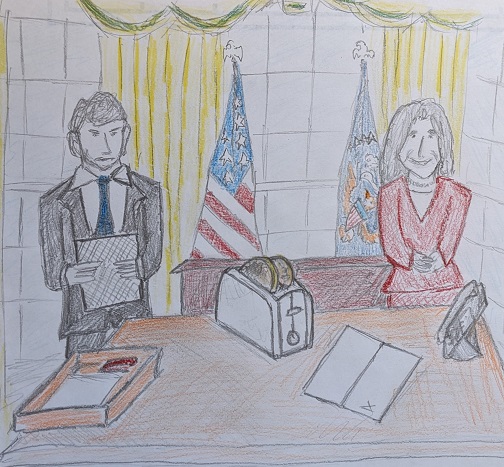
But I can dream of a better world. A world where our President is a toaster.

I even made a picture of what that President would be like. Since I got some flak for using AI-generated images in my last post, I drew this one myself, with pencils. It took me over an hour, I’ll have you know. ChatGPT would have done it in like a minute, and it probably would have looked nicer. But I went with the hard way, so as not to consume precious natural resources and enrich the billionaire oligarchs a smidgen more. You’re welcome.

The desk is orange because I couldn’t find a brown colored pencil. Better an orange desk than an orange President, amirite?

Cue “Hail to the Chief…”