Browsed by
Month: November 2025

Introducing Princess Potato

Introducing Princess Potato

We have a new kitty living with us!

As you may recall, if you follow my blog, we had a cat named Sashimi. When I introduced her, I mused on the moral implications of devotion to a pet. We humans, at least in the advanced economies, have achieved a high level of comfort and ease. This we readily extend to certain non-humans that we admit into our families. And why shouldn’t we?

In 2023, Sashimi passed away, as all living creatures must inna final analysis. That left a big hole in our household’s heart, and it was a while before we were able to accept a new cat into the house. But time heals all wounds, as they say, and this year turned out to be fortuitous for this sweet creature to move in with with us: Potato the Cat.

What happened was Gavin went to Alaska for a couple weeks, so she came over from next door, back to the house where she had been originally adopted by another family.

Wait, what?

Cue tape rewind sound, as some backstory are required.


So Sashimi had a brother named Sushi. The two sibling cats came into Aileen’s life when they were thrown in a box (yes, thrown) in front of her theatre, sometime around 2010 or so. They were neglected and abandoned kittens, lucky not to have perished. Sashimi had a dead tail, which eventually fell off, and she spent her life without a tail.

Sashimi and Sushi were living with Aileen and Gavin and their two sons at the time that I came along into their lives. Sadly, Sushi died after eating a piece of metal or something. He had this unfortunate habit of eating odd things, perhaps a cope coming out of his traumatic kittenhood. It was sad that Sashimi was now alone, so her humans thought of getting her a companion.

As it turned out, their next door neighbors had just adopted a stray kitten, but were planning to move away and needed to find her a new home. So Aileen and family adopted her, and named her Potato. She moved in with them to be Sashimi’s new pal, but unfortunately the two cats did not get along very well.

Maybe Potato, too, was traumatized; she had apparently been nearly starved to death when the neighbors found her. She started off as a very reclusive cat. She would hide away in the house for hours on end, and you would only see her for short periods when she surfaced for food. Eventually she would come out to look for attention, and could be very needy.

Anyway, when the neighbors moved away, Aileen and Gavin bought their house! The plan was to move in and renovate the other house. It didn’t really work out that way, what happened instead was a global pandemic, and I moved in to the new house. I have lived there ever since. Sashimi came over to live with us, so at that point each cat had her own house.

After Sashimi died, we tried bringing Potato over occasionally, but she did not like being in the new house. Maybe Sashimi’s spirit (or odors) still lingered. Potato would complain and stay near the door so we would just bring her back. But then this summer, after we got back from Europe, Gavin went off to Alaska for a trip of his own. We didn’t like the idea of Potato being alone in the old house for two weeks, so brought her over – and this time she was comfortable with it. She stayed!


So now she has officially moved in, returning to the first house she moved into as a kitten. She has bcome very content here, and very affectionate. She joins us for TV time, and sleeps in our laps. It’s nice to have a cat again.

The Decade of My Childhood

The Decade of My Childhood

I recently read The Seventies by Bruce J. Shulman, a history of the decade just after I was born, published in 2001. I call the 70s the decade of my childhood, not the decade of my youth, which I would say was the 80s. But my generation grew up fast, and I remember feeling all grown up in the late 70s, and picking up on the free-wheeling energy of the times. But possibly all teens feel this way.

Specific events of the Seventies that I remember include the Nixon Presidency – but only having a vague sense that he was strongly disliked. I was a very young child during his second term. I remember the Bicentennial and the Tall Ships, President Carter, the Three Mile Island disaster, the Soviet invasion of Afghanistan, and the Iran-Hostage crisis.

I remember disco, and even dancing to the contemporary disco hits when I was in junior high school. But I was really more into progressive rock, and nerdy stuff like Dungeons & Dragons (I started playing in 1979, even before the kids on Stranger Things). And I remember being infected by the rebellious, free-thinking spirit of the age.

Which takes me to what I thought was the most remarkable thing about this history of the decade, which is how well it aligns with what Strauss-Howe generational theory says about the time period. Any long-time follower of this blog knows how much credence I give to the generational approach. Schulman doesn’t specifcally discuss generations, beyond acknowledging that the Baby Boomers were the young people during the 1970s. But a lot of his analysis fits with Strauss-Howe.

In Strauss-Howe theory, the 70s fit inside a social era they call an Awakening, whose dates they give as 1964-1984. Schulman also allows that the spirit of the 70s extended beyond the exact years of the decade, giving his boundaries as 1969-1984.

An Awakening era is characterized by spritual fervor, new movements that question existing values and institutions, and a shift in focus from the collective to the individual, and from the public to the private. All of this is captured by Schulman, including how the 1970s saw increasing distrust in and revolt against government, culminating in the Reagan Revolution of the 1980s.

This book came out not long after Strauss and Howe published Generations and The Fourth Turning, but Schulman doesn’t seem to be aware of their existence. Which makes it all the more fascinating that he comes to the same conclusions as them.

My goodreads review follows.


The Seventies: The Great Shift in American Culture, Society, and Politics by Bruce J. Schulman

My rating: 5 of 5 stars

A definitive look at the decade of my childhood, the 1970s. Author Bruce J. Schulman, a professor of American history, is older than me, but not by much, and would also have lived through this decade during his youth. The book covers developments in politics and culture, and how the transformations of the 1970s led to the social regime current at the time of the book’s publication in 2001, just at the eve of the next transformative era.

The key points that Schulman repeats throughout his book are that the 1970s mark a shift in priority from society to the individual, and in trust from the public sphere to the private sphere. What’s fascinating to me is that this observation aligns with the framework of Strauss and Howe generations theory, including the time range he gives to what might be called the “long seventies,” 1969-1984. Schulman doesn’t explicitly discuss generational effects, except to acknowledge the existence and importance of the baby boomers (his own generation).

The books has nine chapters, covering a variety of topics. Nixon gets his own chapter, as his Presidency marks two important political turning points: the beginning of the disempowerment of the New Deal liberal establishment, and the planting of the seeds of deep public distrust in government that would blossom ten years later during the Reagan Revolution. Schulman makes a great point about Watergate: that the lesson Americans learned from it was not that Nixon was corrupt, but that all government was corrupt. One can easily see that this belief haunts us to this very day (I write this in 2025).

Trends covered in other chapters include the dawn of identity politics and the end of the 1960s-era dreams of integrationism, the shift in political and cultural power from the Northeastern United States to the South and West, the emergence of new styles of film and music, and the rise of new religious movements. The 1970s saw a relaxation of norms and standards and a turning away from traditional values, and a corresponding new brand of conservatism that developed in opposition to these trends.

As already noted, running through this decade was a society-wide movement away from the public and collective and toward the private and individual. It culminated in the Reagan re-election in 1984 and “Morning in America.” At that point the young generations had completed the “hippie to yuppie” transition. Business had replaced government as the trusted engine of productive achievement, and entrepreneurship had replaced political activism as the preferred mode of personal expression and agent of social change.

I was fascinated by Schulman’s claim that the 1970s have a lowly reputation as a dull and meaningless decade. Perhaps, living through it at his age, he recalls the disillusionment coming out of the previous socially charged 1960s. His attitude may be common for his generation; as a slightly younger Gen Xer, I have a warm nostalgia for the era that I think is more typical of my age cohorts. Schulman clearly does have a personal relationship with the time period; this comes out the most in his write-up of the Punk and New Wave genres of rock music, which must have been his favorite growing up.

Overall, this is a nicely written and well-researched account of a social era, though I was a little annoyed that there was so much descriptive text in the end notes that I was constantly flipping back and forth between them and the main text. I suppose Schulman was trying to keep his narrative lean and on point, which he does achieve. A great read, and I do love how well this book aligns with my favorite generational theory.

View all my reviews


On Regret

On Regret

A wise man once said, “the funny thing about regret is that it’s better to regret something you have done than to regret something that you haven’t done.”

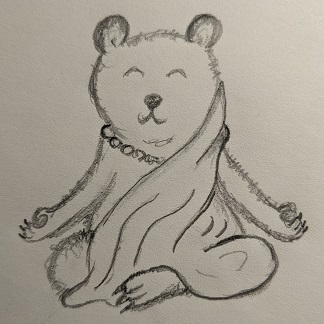
When the Buddha Bear thinks on regret, what comes to mind the most is regret in love. Who hasn’t looked back at their past and wondered at missed opportunities, or mistakes made, in the realm of romance and love?

I know, I know. The Buddha Bear has opined before about the difficulty of living in the past and how regret limits us in the present moment, the only moment we truly have. But certainly we can think about what regret means and how understanding it can inform our choices in the present.

That funny thing about regret holds true because action is what makes consequences knowable. Action allows us to discover ourselves and the nature of our circumstances, where inaction can only lead to us questioning, “what if…?”

Inaction can come from negative conditioning, from hesitancy and fear that result from previous bad experiences. We get burned in love once, and can never love again: it is a familiar story. But if we stop ourselves forever from acting on the impulses of love, we shut ourselves off from a whole world of possibilities.

Certainly there are prudent reasons to refrain from acting on romantic desire, one might say. The obvious one is that one might be romantically attached already, and not wish to betray one’s lover’s faith.

But even for those who are single, there are prudential concerns. Consider the scenario of finding one of your coworkers attractive. If you act on your desires, you might imperil your job. You might be accused of harassment.

There’s a reason there are prescribed methods for seeking romantic relationships – dating apps, for example. This makes it clear what the boundaries are and generally the workplace is not considered appropriate for seeking a romantic partner.

Even if a coworker reciprocated your feelings, and you were able to make something work out, there are problems with mixing work and romance. It could complicate your lives, and the ability to find work-life balance. It could be disruptive for your other coworkers, causing them to question your biases, or provoking jealousy.

But consider the other side of the coin. True love is a hard thing to find. If it comes to you, even in the workplace, you should seize it! Why should you let such nuances of social convention hinder you from finding happiness in this short life?

I hope you don’t think the Buddha Bear is advising you to recklessly pursue every love interest you encounter, like some blundering Casanova. He only means to say that when life presents you with possibilities, which is all that it does, the only way to manifest an outcome is to make a choice.

Even if the choice is a mistake, some good might come of it. And playing it safe and doing nothing isn’t necessarily the best option. There may be someone whom you think of as a dear friend, yet something more might be there, in possibility. How will you know if you don’t take a chance?

So take that chance – it might be the only way to avoid regret.

As a wise woman said, “my advice is always answer the question better that than to ask it all your life.”

This post was inspired in part by this sad and wistful song from Taylor Swift’s latest album. Yes, a Buddha Bear can listen to pop music; it is a treasure of trove of insights into the meaning of life.


Let the wisdom of the Buddha Bear guide you!