Browsed by
Category: Millennials

Subreddit of the Week: antiwork

Subreddit of the Week: antiwork

You may have seen a chart like the one on the right, which I took from Wikipedia’s page on workforce productivity. It shows labor productivity growth compared to wage growth since the end of the Second World War. What’s remarkable about it is how the two statistics track one another for a period of two decades or so, but then suddenly veer off, dramatically so for non-managerial workers. Workforce productivity starts growing much faster than nonsupervisory workforce compensation, as the latter curve flattens out.

What this means is that for a good couple of decades (the length of a generation), after 1948, as output per hour of work improved, so did the compensation for that work. The improvement in the value of labor was transferred to the workers themselves. But suddenly, in the early 1970s, gains in output were no longer matched by gains in wages. The improvement in the value of labor benefitted only those managing or employing the labor. This trend continues to this day, and is at the root of what is wrong with the economy, with its massive income and wealth inequality, and lack of economic opportunity for the working class.

There are actually a slew of economic indicators that shifted dramatically in the early 1970s, along with political and social indicators. They are all captured on a site here. This shift can be seen as the start of a new economic regime.

So what caused this shift to a new regime? Arguably, a shift in social priorities and the rise of a new generation into the workforce. In the early 1970s, that generation would have been the Baby Boomers. They brought a new inner-world, moralistic focus into American life. For Boomers, work was a personal mission, a matter of defining the self, not a matter of bargaining for rights and responsibilities as part of a collective.

Consequently, union membership declined as this generation entered the workforce, yet another indicator shift to join the ones on the site I linked above. Boomers were pursuing their own individual agendas through their work, not participating in building any kind of functioning system, as their union-joining forefathers had done. Boomers gave us the concept of the workaholic, someone for whom the work itself was the reward. Success in work became a status symbol for the inner-driven, wealth-obsessed yuppies of the 1980s – a sign of individual merit and self-worth.

By the time Generation X started working, labor rights had become completely passé. Gen Xers entered the workforce with an attitude of self-determination, as free agents, always looking out for the best deal for themselves. They gave us the concept of the perma-temp, the employee with no benefits or safety net, who drifts from employer to employer. As a Gen Xer might have put it, “it’s just a job.”

Gen Xers were the young adults of the boom times in the 1990s, when economic growth was high and productivity growth was on the rise. But in the new opportunistic economic regime, economic growth no longer acted as a rising tide to lift all boats. Instead, it was like a wave that some successfully rode, and others did not. Workers separated into economic winners and losers, with far more of the latter. Today, Gen Xers are middle aged, and one has become the richest person in the world. Many others have utterly washed out.

Now Millennials are the young adults in the workforce, doing much of the nonsupervisory production work which has experienced so little gain in compensation compared to the actual value it provides to employers. The “slackers” of Generation X, raised with low expectations, may have been willing to tolerate these circumstances. They may even, like Kevin in 1984’s Repo Man, have seen opportunity in them (see the video clip below). But not so Millennials.

Raised with high expectations, in a structured environment that rewarded following the rules, Millennials have not taken well to the free-for-all job market they have inherited from Boomers and Xers. Many Millennials have gone into massive debt for a college degree, only to discover that the jobs which a college degree opens up don’t pay well enough to justify the cost. Milestones of financial and personal success, such as buying a first home or starting a family, are elusively out of reach for Millennials, given the economic disparities that have grown over the course of the meritocratic, “neoliberal” regime established by Boomers and Xers.
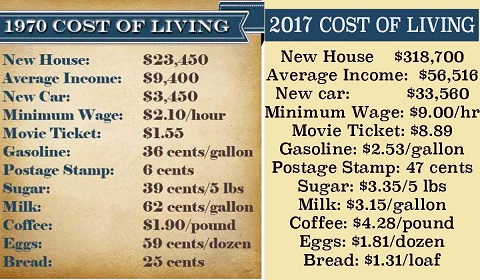
Millennial disappointment with this state of affairs is visible in the many memes that fill social media feeds, comparing the economic circumstances of their generation with those of past generations and highlighting their disadvantages. Talk of “late stage capitalism” and enthusiasm for progressive politicians such as Bernie Sanders and Alexandria Ocasio-Cortez point to disillusionment with the current economic system. Could Millennials even be willing to embrace – gasp! – socialism? Red zone pundits would certainly like you to think so.
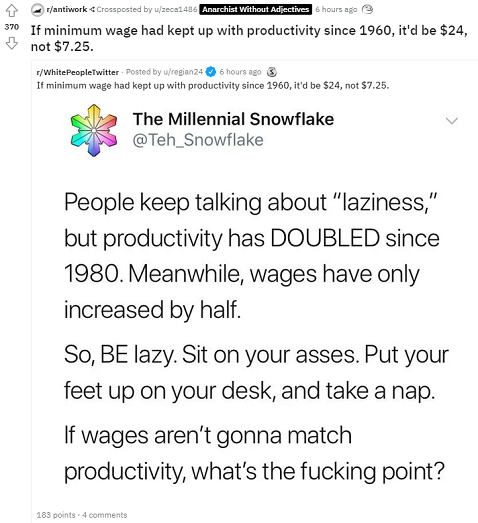
This brings me to my subreddit of the week, /r/antiwork. This subreddit has taken off in 2021, in concert with all the news stories about the “Great Resignation” and the labor shortage.

On /r/antiwork, the workers of reddit unite to commiserate over the awful conditions and abuses suffered by workers today. They post about the absurdities of our system, like costly health insurance that provides almost no benefit, and low salaries for jobs with high education requirement. They proudly tell stories about how they quit their last position, and encourage and praise union efforts.

Do reddittors really think we can reach a state where no one needs to work? Or is this subreddit simply a forum for venting about the miseries of living on the flattened curve of low compensation employment, where so many are stuck today?

I think that what this subreddit is really bringing to light is the pent-up demand for significant structural economic reform. A new generation with new priorities is in the workforce, and a new regime is required to meet their needs for an economy that provides fair rewards for work, and fosters financial security and not merely the opportunity for personal achievement.

Unfortunately, the only policy the U.S. government can come up with is to borrow and spend to keep the economy hot. While that might relieve the pain for some in the short term, it’s doubtful it will change all those economic indicators for the better in the long term, or quiet the dissenting voices of /r/antiwork. For that, major economic reforms would be needed, to transfer the value of labor back to the workers themselves. Maybe then they won’t mind coming to work so much.
Young Gen Xers bullshitting about work in the mid-1980s.
A Noir Sitcom

A Noir Sitcom

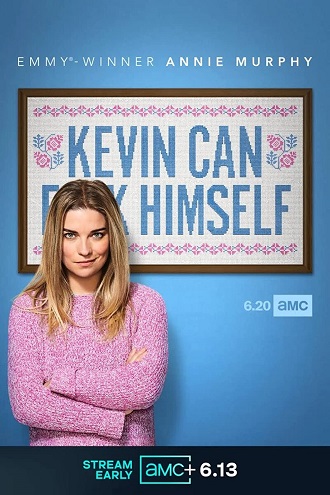
← My partner and I recently watched the first season of this intriguing show. We were drawn to it because it stars Annie Murphy from Schitt’s Creek, which is one of the best television shows ever made (I haven’t blogged about it before, but there you have it). Her new show is called Kevin Can F**k Himself, and is available on AMC+ streaming for all you cord cutters. Why she always ends up on shows with curse words in the title, I couldn’t tell you.

Kevin Can F**k Himself is a dark comedy and a parody of sitcoms that runs with the premise that a clichéd sitcom marriage is actually highly toxic. The wife and lead role, played by Murphy (b. 1986), is trapped in a living hell she is desperate to escape. The titular husband is played by Eric Petersen; I couldn’t pinpoint his birth year but I believe he is on the Generation-X/Millennial cusp.

The show uses an unusual contrivance to contrast “sitcom life” with “real life.” It takes some getting used to but I think the creators pull it off. It has good writing and excellent performances by the leads, as well as by Mary Hollis Inboden (b. 1986) in the supporting role of next door neighbor buddy.

Traditionally, sitcom television is “comedy of errors” humor deriving from misunderstandings/poor communication. Someone overhears something, misconstrues the meaning, and hijinks ensue. By the end of the episode everything is cleared up and back to normal (status quo ante). The characters are typically two-dimensional and stereotyped, foils for one another and fodder for repeated jokes.

In Kevin Can F Himself these tropes are twisted and the consequences become tragic. Kevin’s lack of communication skills and simplistic personality are a nightmare for his wife, Allison, who somehow is unable to break out of her own responsive patterns when she is in his presence. Miscommunication isn’t a fount of humor, it’s the corrosive destroyer of a marriage.

The characters are Millennials (technically geriatric Millennials), and the show explores themes that resonate with their generation’s experience. In particular: the relative immaturity of men relative to women, the difficulty of forming satisfactory relationships, and the lack of economic opportunity for the working class. As staples of sitcoms about married, suburban life in a gentler past, these themes might have provoked light humor, suitable for a laugh track. But for Millennials in the throes of late stage capitalism, these problems of the middle class have mounted to the point of being unbearable, and the humor has become dark in turn.

Kevin Can F**k Himself thus ends up blending genres. It’s a sitcom that bleeds into a noir show more in keeping with the times. Unlike what usually happens in a sitcom, it does not return to status quo ante at the end of each episode, but has an ongoing, developing story arc. Whether the show is a tragedy or a comedy actually depends on the final outcome, which hasn’t yet been determined. Season 1 left us with a major plot twist, and I’m hoping that the show gets renewed for another season. It’s an out-of-the-box creative effort that deserves a longer run.

Subreddit of the Week: insaneparents

Subreddit of the Week: insaneparents

WARNING: This post contains spoilers for the movie The Shining.

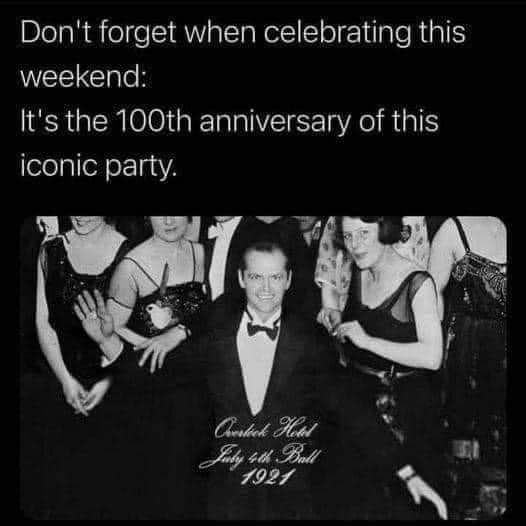
You may have seen the meme that Independence Day 2021 was the 100th anniversary of a famous fictional event: the 1921 July 4th Ball pictured at the end of The Shining. The event is depicted in a photograph that mysteriously features a younger version of Jack Nicholson’s character, Jack Torrance. In celebration of this anniversary, our family decided to watch the movie on the night of July 4th, even though we’ve all seen it multiple times, it being an excellent and iconic example of the horror genre.

The highlights of the film are Nicholson’s creepy, expressive performance, and the tense, suspense-building score which is artfully synchronized to the action. The camera work is great, too, and the film shows how much emotion can be generated just from pacing and music, with slow buildups to cathartic release. The strings slowly rise, and then the axe suddenly falls, and the viewer’s heart skips a beat. But frankly, the film is a little light on story, of which there is much more in Stephen King’s book. The sequel movie from 2019, Dr. Sleep, drawing more story from the novel which it adapts, is a supernatural horror action adventure with a much richer plot.

In The Shining, Jack’s son Danny is played by Danny Lloyd, who does a decent enough job of portraying a harried Gen X kid dealing with less than ideal parenting, not to mention bizarre otherworldly events. Here’s the scene from the end of the film where he escapes his deranged father. Note his inventive survival skills. That really marks him as a Gen Xer.

When I watched this scene, I couldn’t help but imagine how it would look as a post on the subreddit /r/insaneparents. Something like, “when I was a kid, maybe about 10, my Dad chased me through a snow-covered hedge maze with an axe – he really wanted to kill me, I’m not joking – but through some misdirection and careful hiding I managed to escape him. Never saw him again after that, I actually think he might have died that night. Can’t say that I miss him, but I will say that the experience really made me who I am today…”

If you don’t know about this subreddit, it is basically a place where people go to share the bizarre and unwholesome parenting behavior they have experienced. I imagine that most of it is Millennials calling out their Boomer and Gen-X parents; one can never be sure since reddit is mostly people posting anonymously. It is possible that older posters are bringing up their long ago childhood experiences, or that Homelanders (the post-Millennials currently in their early teens) are already sharing their own victim of parenting horror stories.

I imagine that this is mostly a subreddit for Millennials not only because reddit itself was founded by Millennials, but also because Millennials are champions of Internet reviews. It all ties into Millennials’ collective peer personality, which seeks rational consensus on the best choice. Here’s a post on LinkedIn that shows what I mean. More and more, choice in the marketplace is driven by communal decision making, rather than personal preference.

As this generation has risen into adulthood, they have helped drive the proliferation of reviews on commercial web sites like Amazon and on web directories which also function as review sites, such as Yelp. As students in higher education, they have access to resources to rate and review their educators – why shouldn’t they know ahead of time if a professor’s class is worth taking, or be able to give their feedback after taking a class? In a way, the subreddit /r/insaneparents is just a site for reviews – albeit anonymous ones – of parents.

Parenting, I believe, is the hardest job in the world. Everyone is expected to do it, but the only training anyone gets is a bad example. Since not everyone makes the strongest parenting choices, you get a subreddit like /r/insaneparents. So parents out there, do try to raise your children well, or you just might end up getting a bad review on the Internet.

An Emerging Values Consensus?

An Emerging Values Consensus?

You might look at that title – “An Emerging Values Consensus” – and think, are you kidding?? The Culture Wars and the partisan divide between liberals and conservatives (or the blue zone and the red zone) have been a fixture in our society for decades now. I’ve already written a series of blog posts on the topic, in which I concluded that we were experiencing a “Red-Blue” identity crisis as a society. Which way will we break? Or could we even break into two – split into two societies altogether, possibly violently? There is serious discussion of impending civil war out there.

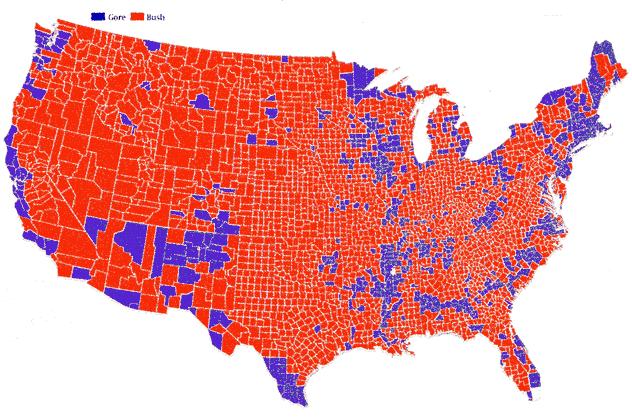
You’ve probably seen the above map before. It’s from the 2000 Presidential election, and shows the counties that voted for Bush in red and the counties that voted for Gore in blue. It’s around this time that the red zone-blue zone idea came about – the idea that there were two different “values camps” with competing visions of what America should be. Baby Boomers were in mid-life then, and their values-orientation dominated American culture. Their passion and moral zeal is what made the divide between the two camps so deep and so unbridgeable, damaging our political system to the point that many now wonder if it can be repaired. Just think of the events of January 6th this year to understand what I mean.

Back around that time, on an old fashioned web site that I built, I attempted to list out the differences between these two values camps. The list is a bit over-generalized, a bit stereotyped; I can’t deny it. I’m sure many people believe a little bit from column A, a little bit from column B. But to some extent these differences do define the partisan divide, and the thing is, as the partisanship has just worsened and worsened, it’s gotten to the point that it doesn’t really matter what your particular “nuanced” belief system is. The political struggle has become existential, and you have to pick a side and stick with it.

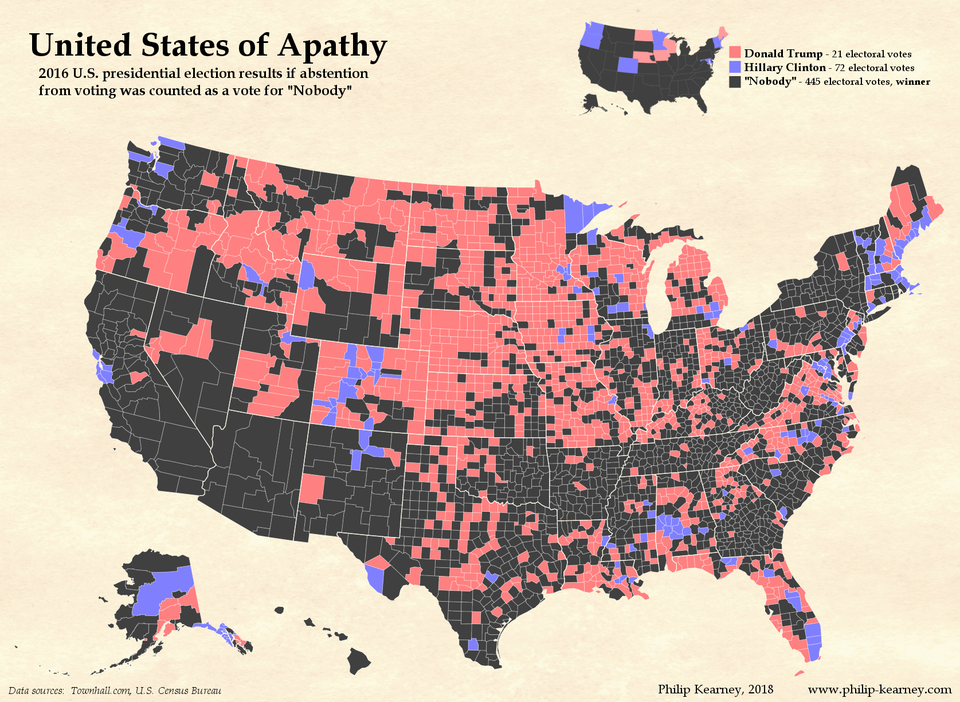
Or not, I suppose. You could just not belong to either side. I have a feeling that many of my generation, Generation X, are in that particular “values camp.” It’s the camp of people who mind their own business and just want to be left alone. As the map below show, if non-voters counted in the electoral college (I know, that makes no sense) then “Nobody” would have been elected President in 2016.

This isn’t to say that non-voters lack values or moral beliefs, just that they might be having trouble finding a political party to fit into. As I already suggested, most people probably take their beliefs a little from the red side, a little from the blue side. It’s even possible to show that the country isn’t so starkly divided geographically as the “red zone-blue zone” maps suggest, by measuring both Republican and Democratic votes per county and constructing a “purple” spectrum map like the one below.

Red v. Blue spectrum version from the 2016 Presidential election.

All I’m trying to say here is that the neat division of values into two columns doesn’t necessarily reflect how people think. And now that Boomers are aging out of mid-life, being replaced by Generation X, moral righteousness as a guiding principal of politics is losing its shine. As I already blogged, Boomer moralism has rendered politics dysfunctional. Younger generations yearn for a practical approach to politics, one that can solve the many thorny problems facing our society. It is perhaps unfortunate, then, that the current mid-life generation, Generation X, which is known for pragmatism, also eschews politics.

I’m just rehashing what I’ve already written about before, so back to the title of this post and the idea of a values consensus. Assuming America is not going to split into two societies, we’re eventually going to settle for some version of “a little bit of column A, a little bit of column B” that works for the majority of us. This will grow more and more apparent as the morally righteous Boomers, who pretty much can’t ever have their minds changed, age out of public life. Those who disagree with these values, who reasonably can claim that there is no “consensus” since they disagree, will be relegated to the sidelines of public life. In fact, you can already see this happening. Isn’t that exactly what hashtag movements, cancel culture, de-platforming are all about? Effectively, if unfairly, enforcing a majoritarian viewpoint?

So what exactly is the consensus that is emerging? I actually tried to predict what it might be way back in 2002 when I first created the red values v. blue values page. Then I tried again and again around the time of the 2016 election. How exactly am I doing this? Well, my admittedly non-scientific approach is simply to monitor discourse on major platforms on the Internet to see what’s going on. I check the reddit hivemind, since I really do think that is the premier site where Millennials are forging a consensus using the tools of social media.

Now maybe this puts me in a bit of blue zone bubble, since all the red zoners are moving to alternate sites like Gab and Parler (so I’ve heard). But doesn’t the fact that red zoners are shifting to less mainstream platforms tell you which way the consensus is going? Honestly, I think there are only two areas where the red zone’s view still has traction, and that is in the two most contentious points of the Culture Wars – gun control and abortion rights.

So here’s where I think we end up:

  • Pro-gun rights
  • Pro-marijuana legalization
  • Equal rights for LGBTQ
  • “Counter-culture” mainstreamed (everyone has a tattoo these days)
  • Pornography accepted
  • Continued restrictions on abortion, though it will never be fully banned
  • Justice and police reform
  • Reform to improve the lot of lower economic classes, even if it’s “socialism”
  • Pro-environmentalism policies to deal with climate change
  • A path to citizenship for “dreamers,” but immigration otherwise limited
  • Acceptance of a multicultural, multiracial, multi-religious society, to the chagrin of White Christian Nationalists

So now that this Culture Wars crap is out of the way, can we end the filibuster already and get some Universal Healthcare?

Subreddit of the week: murderedbyAOC

Subreddit of the week: murderedbyAOC

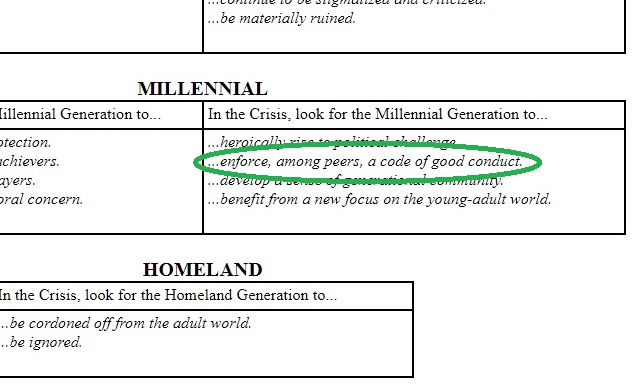
Years back, I wrote a blog post about how Millennials use social media for consensus building. I was tying into predictions based on Strauss & Howe generational theory on how the Millennial generation would behave as young adults in this era, the Crisis Era. One prediction is that they will enforce a code of good conduct.

Prediction about Millennials from The Fourth Turning.

Fast forward to today, and cancel culture is fully in place. Well, what is “cancel culture” if not an effort to enforce a code of conduct by ostracizing those who violate the code?

It seems that complaints about cancel culture come mostly from the political right. But before you call it a phenomenon of the left, I challenge you to go to a right-leaning site like parler and express support for President Biden. I’ll bet you get “cancelled” pretty fast.

Could the right’s problem with cancel culture just come from the fact that the left has been more successful at it? Perhaps that is because the left’s code of conduct better reflect’s the majoritarian view. Perhaps that is because the left didn’t choose a champion who is a criminal mountebank.

Or maybe the left really is just better at the culture game. We all know from reddit that the /r/TheRightCantMeme. And look no further than reddit to find a Millennial who excels at enforcing good conduct with her brilliant wit.

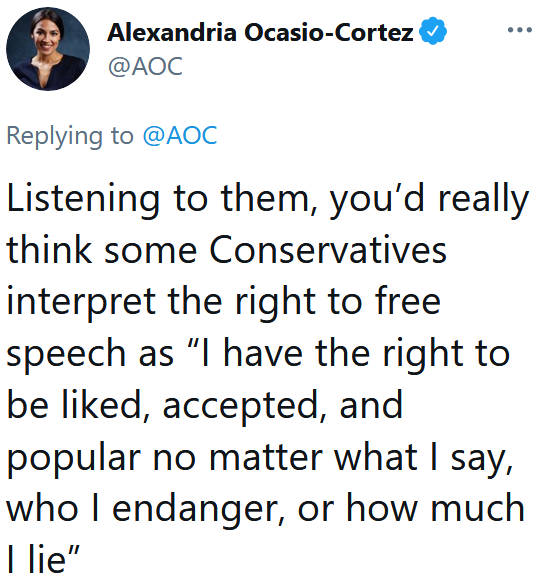
I mean Representative Alexandria Ocasio-Cortez, who has her own subreddit, dedicated to reposting the stinging comebacks to red zoners that she makes on social media. It’s a happy little bubble for a blue zoner to go and assure themselves of the superiority of their partisan viewpoint. And as a partisan blue zoner myself, I’m happy to declare /r/murderedbyAOC the subrreddit of the week.

2021 State of the Coup

2021 State of the Coup

If you haven’t seen any videos by YouTuber CGP Grey, then you should check them out. I highly recommend them for being engaging and informative, as well as amusing in that they are mostly stick figure animations. Grey is one of those Millennial “explainer” YouTubers; I’ve blogged about them before. What gives these folks the credentials to speak authoritatively about the subject matters they cover? Basically, being intelligent and educated and willing to take the time to do some research and thinking.

I bring up CGP Grey because of this remarkable video of his titled “The Rules for Rulers.” It’s a 20 minute long primer on how to stay in power under various forms of government, including a dictatorship. There’s even an example of a coup which shows a little stick figure mob storming a government building. This is obviously relevant today.

I can’t speak for how accurate Grey’s video is in terms of political theory, but it is certainly compelling. The description of the video indicates that it is adapted from the book “The Dictator’s Handbook“. One of the basic tenets of rulership as described here is that, as a ruler, one must retain influence over the “keys to power.” These are the people/social elements that let you get things done.

We can see in this video that the little stick figure dictator needs the help of other stick figure “keys” that look like they belong to three distinct branches of society: the military, the police, and the business elites. A wannabe dictator pulling off a coup needs these keys. Sending a mob to storm a building is a useful ploy, but only when these keys are in the wannabe dictator’s pocket. The mob itself is not a key to power.

And so you can see the fundamental flaw in the plan of a certain wannabe dictator. He has a violent mob, but he doesn’t have all of those keys in his pocket. He certainly doesn’t have the business elites; they have deplatformed and pulled financial support from him and his political allies. And he doesn’t have the military, as evidenced by the statement from the Joint Chiefs of Staff in support of the U.S. Constitution and the incoming Biden administration.

Now it’s possible, unfortunately, that the wannabe dictator has some support from the police. It’s been known for a long time that police forces in the United States have been infiltrated by white supremacists. Connecting this fact to a certain leader’s need for keys to power casts a whole new light on the protests against police brutality last summer.

A violent mob and a percentage of rogue law enforcement officers is not enough influence to install a wannabe dictator in power, but is still a danger to the public. We’ve all seen the threatening postings on social media. While the coup has failed, we’re not out of the woods yet.

So be careful out there. Be prepared for some disruption in the days to come. Domestic terrorists can do a lot of harm, but they can’t take down our Republic. Their blind rage alone is powerless to overcome us.

World Views on the Web

World Views on the Web

This is to follow up on my last post, where I revisited some Boomer generation founded web sites that were arguably cutting edge “new media” a decade or so in the past, but by now are being submerged by the flood of traffic to social media sites where everyone hangs out today. These Boomer sites are quite clearly split between “red zone” (conservative / traditional / Republican) vs. “blue zone” (liberal / progressive / Democrat) values.

I ended the post by speculating whether the same stark difference would be evident in the web sites founded by younger generations. On the one hand, younger generations aren’t as values-driven as the Boomer generation. On the other hand, they primarily derive their Weltanschauung from the vision of the Boomers, and so that vision should be reflected in their own culture.

Revisiting the sites which I had linked to back in 2014, my impression is that the sites decidedly shift from red to blue as you go from Gen-X to Millennial. However, I would say that the Gen-X red zone sites are less hysterically partisan than the Boomer ones. I mean, Matt Drudge is really a muckraker at heart, not a partisan conservative.

Here’s the list roughly in order from the oldest founder (Newsmax’s Christopher Ruddy, born 1965) to the youngest. Only the founders of Reddit are Millennials; the rest are Gen-Xers. In my judgment there is a shift from the red zone world view to the blue zone world view as you go down the age ladder.

This is true even though the site at the bottom, reddit, accomodates people of all views, in assorted safe spaces called subreddits. They are safe spaces because the admins of the subreddits can ban people who express opposing viewpoints. But, in my judgment at least, the majoritarian perspective on reddit is the blue zone perspective. You can judge for yourself by visiting the sites.

The Quiet Rage of Millennial Retsuko

The Quiet Rage of Millennial Retsuko

I recently finished watching Season 2 of the Netflix series Aggretsuko, which I recommend if:

  • You like anime.
  • You need a show with short episodes to watch during meals or whatever.
  • You want to see a show that captures the Millennial zeitgeist.

Yes, I really do think this show does the last thing on the list, which is a big reason why it fascinates me. Plus, all the anthropomorphised animal characters are just adorable.

Restuko at work.

Aggretsuko is an anime, full of the tropes of that genre. You have to watch it in Japanese, with subtitles. It’s main character, Retsuko, is a young single woman working an ordinary office job. She is self-conscious, anxiety ridden, stressed by the demands of everyday life, and feels pressure to fit in and appear normal from her peers and social media – in others words, a Millennial. She remains calm – if nervous – on the outside, while cultivating an inner rage that comes out in private moments.

It’s not only the peer pressure and the burnout that make Retsuko so Millennial. As her story develops and she grows as a person, she is able to adapt to the many aggravations coming from the personalities that surround her. She matures, and learns to own her rage, while remaining true to herself. And what she learns about herself is that she just wants a conventional life.

Aggretsuko is loaded with references to modern pop culture and social trends. It satirizes modern life, but there is no nihilism here. In the end, the ordinary aspects of life – a job, a family, friends – are celebrated and valued. And when Retsuko rages, she doesn’t rage destructively to take down society, but rather constructively to find her place in society. Now how Millennial is that?

Boomers Invented the Internet, but…

Boomers Invented the Internet, but…

As we all know, it was a Baby Boomer who invented the Internet. Al Gore, to be precise. Ha ha, I jest. But in all seriousness, it actually was a Boomer who invented the World Wide Web. Well, an Englishman the same age as the American Boomer generation. That was when the Internet skyrocketed into public awareness and use (it had been around for decades already in academia and government) and the Boomer generation was still relatively young, and was involved in the grunt work of technology research and development.

Now it’s younger generations who are on the leading edge of technology development and the Boomer pioneers are for the most part resting on their laurels. Steve Jobs has been deified and Bill Gates is busy spending his billions on humanitarian projects. Meanwhile, the Millennial generation has taken over Internet culture and formed a hivemind that is whimsical and heartwarming (doggy memes, anyone?), and also unforgiving in its enforcement of social norms (fear the hashtag). Generation X has been ghosted, and Boomers? – well, their cultural reputation on the Internet has not survived in very good shape.

For proof of this last assertion, all you have to do is get on Facebook and join “a group where we all pretend to be boomers.” It’s easy to do, trust me – I applied and got accepted right away. Here you will encounter the Millennial stereotype of what a Baby Boomer is – basically an old white Christian who supports President Trump, is hopelessly out of touch with modern values and, on top of that, embarrassingly clueless about how the Internet works. Boomers are always posting “MAGA” and “God bless America,” misinterpreting what they see younger people doing online, and going to church and to potlucks.

As for posting memes, well Boomers probably shouldn’t even try. Their memes are dated in style, atrocious in design, and express antiquated values. They should just stick to GIFs of the minions from Despicable Me, inexplicably a Boomer obsession. The idea of a Boomer meme is something you will also find on the subreddit TheRightCantMeme, where a lame meme by the political right is implicitly associated with the Boomer generation.

This stereotyping, of course, is unfair to the legions of Boomers who are on the political left. Not to mention those who are very savvy to the ways of the Internet. Perhaps these Boomers are not on Facebook so much; my guess is they are on Twitter instead. But this association, by a younger generation, between the Baby Boomers and the reactionary politics of Trump supporters (who are not all Baby Boomers, is my point) clearly marks the Boomer outlook as a fading thing of the past. The Internet – and thank you for it, Mr. Gore – belongs to a new generation.

Subreddit of the week: wholesomememes

Subreddit of the week: wholesomememes

In this social era one of the roles of young adult Millennials is to clean up the culture after a long period of decadence and degradation called the Unraveling (I’m talking “turnings” theory here). I submit that an excellent example of this phenomenon is the subreddit wholesomememes. Here you will find only happy and affirming thoughts, positivity and love. It’s the Internet’s biggest safe space.

I also submit that the subreddit acts as a forging ground of an emerging values consensus for the new order of the ages. If it fits into this subreddit, its acceptable values. That means that inclusivity is in, and religious moralism is out. All the weird culture that our society has generated over the past decades is in – as long as it serves to boost the esteem of others and bring us all together.

They have it on Twitter, too, if you like that.