Browsed by
Category: Coronavirus

In Search of Solidarity

In Search of Solidarity

I was in a thrift store the other day (there are tons around here where we live in semi-rural Pennsylvania) and noticed that it still had the spots on the floor for standing in line while social distancing. Stickers to mark where to stand so you kept apart from the other shoppers, to minimize the risk of spreading COVID-19.

Well worn, as they have been there since presumably 2020, trod on by countless bargain hunters ever since.

Remember the pandemic, and that for a brief period we took social distancing seriously, and everyone (mostly) wore face masks in public, people working together to protect one another’s health? I remember being impressed by how resilient everyone was, quickly adapting to new behaviors like standing in line a few feet apart, or picking up items curbside. I remember taking inventory when I went out to the grocery store early in the pandemic – we got to over 90% of people masking in public.

There were always a few die hards who refused to comply with the simple public safety mandate of wearing a face mask. I suppose they imagined themselves to be resisters of tyranny, but with everyone else masking what they really were was free riders, benefiting from a safer environment by taking advantage of other people’s willingness to make a small sacrifice.

It didn’t take too long for even that short burst of cooperative spirit to come to an end. The pandemic got pulled into the partisan conflict that roils our nation, exacerbated no doubt by the Trump administration’s feckless response to the disaster. I documented the phenomenon from ground-zero, seeing as we live in MAGA-land.

But it still sticks with me that even here in MAGA-land, for a brief period, there was solidarity among the people. We were willing to work together, to follow a consensus of what needed to be done. We were united against a common threat, experiencing the coming together in the face of danger that forges a sense of community.

As I stood in line at the thrift store, looking down at the worn stickers on the floor, I actually felt nostalgic for the pandemic era. Of course, I did have it better than others back then. As a stay-at-home nonessential worker, I benefited in many ways from the lockdown. I’m sure other people who didn’t have it so lucky are very glad the lockdown era is behind us.

But consider the following. In one of my 2024 election post-mortems, I linked to an article in The Guardian that offered its own explanation for Trump’s victory. It argued that voters ditched Biden-Harris in favor of Trump because of the shock of having the benefits of the pandemic welfare state pulled out from under them.

I propose a different explanation than inflation qua inflation: the Covid welfare state and its collapse. The massive, almost overnight expansion of the social safety net and its rapid, almost overnight rollback are materially one of the biggest policy changes in American history. For a brief period, and for the first time in history, Americans had a robust safety net: strong protections for workers and tenants, extremely generous unemployment benefits, rent control and direct cash transfers from the American government.

Trump may have bungled the pandemic in 2020, but then Biden bungled the post-pandemic during his term! People were finally enjoying having a government that looked out for them, and then that all ended and it was back to “normal,” Democrats having apparently forgotten that for a great many Americans, “normal” sucked.

How to get back to big, interventionist government taking actions that are broadly popular? How to restore that sense of solidarity, that feeling of being a people united to a common purpose? It’s clear to me from the initial pandemic response that we are primed as a society for this to happen.

Our current Mad King is not a good leader for inspiring public consensus. He is only sowing more disunity and chaos with his authoritarian crackdown.

Could the Resistance fight against him be that Solidarity movement? I get that sense – the energy is there. The people have risen up in response to the brutality and lawlessness of the ICE Troopers in Minneapolis.

I have been heartened by the sense of hope uplifting folks who share my cause, and by Democrats in the Senate who have drawn a line against further ICE funding. But there is still not a movement at the national level to stop the administration from ignoring the U.S. Constitution. Can you imagine a nation-wide general strike, possibly the only option left to save democracy? It seems so unlikely, given that this country is vast and disorganized, assailed by powerful forces working against the people.

There is too much apathy, too many heads in the sand. The Mad King still has his loyalists – I see their laughing emojis in my Facebook feed all the time. They actually think what ICE Troopers are doing is justified. We are a fractured nation, with large swaths of people living in different realities.

Ex uno plures.

We are still waiting for a common cause, and for leaders who can bring us together.

COVID-19 Retrospective

COVID-19 Retrospective

Do y’all remember that we had a pandemic? And that it was a seriously big deal, that had the world in a panic?

At the onset, there were overwhelmed health care systems. As it went on, overflows of bodies. Mass graves. People were scared. This new virus was killing at an accelerated rate.

I remember watching a dashboard of the spreading infection. Before it really hit the U.S., thinking – maybe they’ll do something to stop it. Maybe the authorities will figure their shit out and it won’t be so bad here.

Then the red dots started spreading on the U.S. part of the map. It dawned on me that no, there is no stopping this. I called my boss to tell him I wouldn’t come to the office any more, but would work from home (lucky me with my email laptop job), and hours later got a notification that was sent to the whole company: don’t come to work.

We were in lockdown.

Remember how we knew so little about how this “novel coronavirus” spread that we were spraying sanitizer everywhere? There was actually a rumor for a bit that people were becoming infected when they pumped gas. We kept gloves in our car for the gas station!

And the shortages as people stocked up. Supply chains were in crisis. Suddenly it was revealed that toilet paper was the essential commodity of civilized life. Medical supplies in particular were in short supply, to the point that the Governor of Maryland was hiding testing kits from the Feds. Can you believe that shit?

Was it all a massive overreaction?

That’s such an unfortunate word, IMO, because it implies there is some way to know what the exact correct reaction should have been. But of course there is no way to know that, just as there is no way to know what the outcomes would have been had we made different choices as a society.

What if there had been no lockdowns? There would have been different rates of sickness and mortality and different effects on unemployment and inflation. But would these outcomes have been preferable, even if one could come to agreement on preferences? One can speculate, form a theory, but one cannot test the theory because, by the nature of time and choice, the data are not there.

The simple truth is, leaders faced a high degree of uncertainty, and the glaring fact that, in the initial waves, COVID-19 was an extremely deadly contagion. It both spread easily and had a high mortality rate, and it’s no wonder we were all spooked.

Just consider this: in 2020, COVID-19 was the third leading cause of death in the United States, after heart disease and cancer. That’s insane for a disease that didn’t exist the year before. It’s hard to imagine what an “overreaction” would look like for such a thing. Please do click on that link and look a little closer. For one age cohort, the core of my generation, it was the leading cause of death in 2021. No wonder we drank so much.

I made this chart using our actual spending in 2020, I won’t deny it

I remember how much I blogged about coronavirus in those early years of the pandemic. As the emergency eased, officially declared over by President Biden in 2023, I mostly dropped the topic. In 2024, COVID-19 was no longer in the top 10 causes of death. Accidents and strokes had restored their respectable statuses under heart disease and cancer, the twin grim reapers awaiting us all in our advanced years.

But the disease is still with us, of course, and it is still dangerous. I caught COVID just last month, in fact. I immediately went on the antiviral PAXLOVID, because I do not want that nasty thing multiplying in my body.

SARS-COV-2, the coronavirus that causes COVID, is not like influenza or the common cold. It gets into your system and it does damage everywhere. Long term damage that could lead to long COVID, or to some other condition down the road that reduces your lifespan. As one substacker explains it, catching COVID is like smoking cigarettes – you can keep doing it over and over, but you will pay for it in the long run.

Is the pandemic over anyways? There’s no end date given on Wikipedia’s helpful page of deadly pandemics, so I guess not. There COVID-19 sits, nowhere near the death toll of the Spanish flu, history’s GOAT pandemic, but catching up to the slow burn HIV/AIDS.

Luckily, the U.S. is a world leader in medical research. Right? Oh no...

Entering 2024

Entering 2024

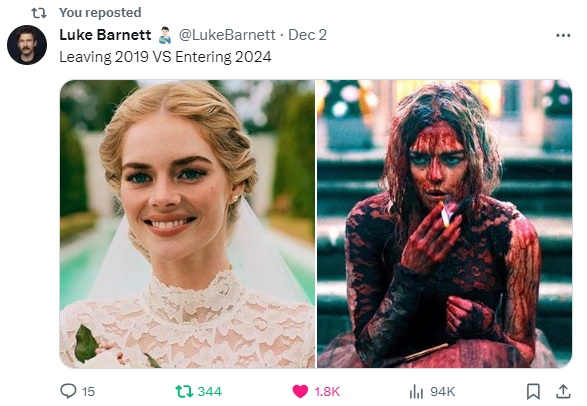
I heard a Lewis Black bit on the Daily Show where he said that 2023 was the first year since the pandemic that felt almost normal. In our world, what with the return of live theater, it does feel that way, though you still see some people in audiences wearing face masks, since the pandemic isn’t really over. The COVID-19 pandemic will possibly continue for the rest of our lives, as the AIDS pandemic has, and COVID has killed almost as many people as AIDS has cumulatively, in 10% of the time.

As for a return to normalcy, well, maybe, except I still worry about what will happen in this country on the political front. I do have a hope that our relatively high levels of prosperity will save us from a complete breakdown, though I have forebodings of a consitutional crisis to come. The first month of 2024 could be very eventful.

I’ve listed below the current ages of the living generations in the United States, as 2023 comes to an end. We are almost, but not quite, to the point where each archetype fills an age bracket. When that happens, we will be close to the end of the Crisis Era.

  • Greatest: 99+
  • Silent: 81-98
  • Boomer: 63-80
  • GenX: 42-62
  • Millennial: 19-41
  • Homeland: 0-18

Which means this era isn’t over yet, pandemic or no pandemic, normal or not normal. And people sense that, which is where memes like the one on the right are coming from.

So just be aware, and pay attention as these oh-so-interesting times unfold.

With all that said, I hope you and your family have a safe, prosperous, and happy New Year.

2023 Update

2023 Update

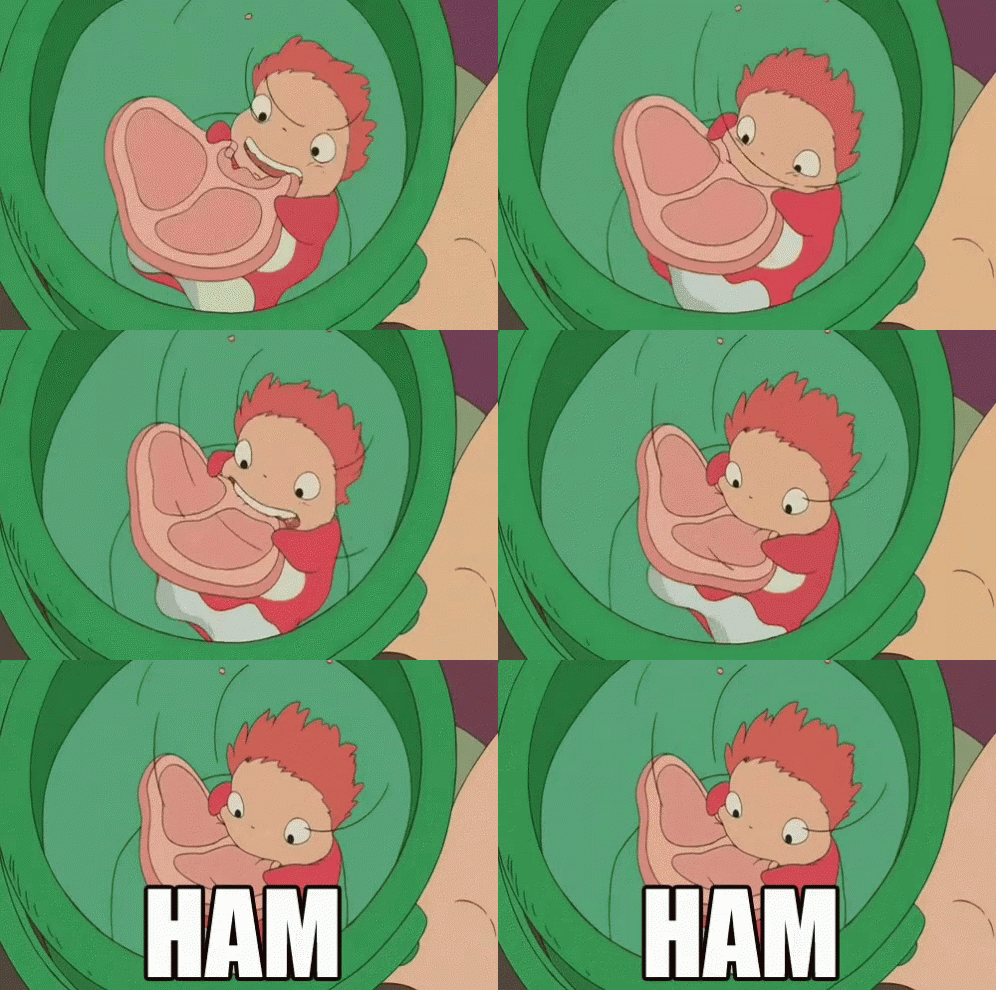
The cat is eating much better, presumably thanks to the anti-inflammatory medicine she is taking. It must reduce the pain and irritation in her mouth. She still is eating mostly mushy food, though we have found that she has a fondness for ham, so she sometimes gets pieces of that to eat. She really likes ham, reminding me of Ponyo the way she tears into it.

Thanks to eating more, Sashimi has gained weight. But she still drools a lot, meaning she must still have that growth on her tongue. It is comforting, at least, to know she is not in danger of starvation.

Nor, it seems, are we in danger of income starvation, as I have been offered, and accepted, a new position. It is the same kind of work I always do (software testing), and it is a 100% remote position with a company in Minneapolis. Pretty excited to be onboarding 100% remote; that will be a new experience for me. Right now I feel like a remote till COVID champion.

My 2022 Retrospective

My 2022 Retrospective

In world events, the two big stories of 2022 were clearly the Russian invasion of Ukraine, and the confluence of the Jan 6th committee hearings and midterm election results, which I will call the slow death of MAGA. I thought it was impressive that the Biden administration was able to rally the West in support of Ukraine, and also dodge the expected “red wave” repudiation of the executive term. Is this inching towards a “blue wave” consolidation, and a revitalization of the Western alliance, after the setbacks of the previous administration? Or is it just pulling the partisan tension ever tauter, in anticipation of a reckoning still to come? Either way, I would like to take this opportunity to extend a middle finger to all of the MAGAts in the Putin/TFG camp, and heartily wish them more failure and humiliation in the new year.

In my own life, the best new thing to happen to me was being hired to work on the end notes for the sequel to The Fourth Turning. I’ve been a fan of Strauss & Howe generations theory for 25 years now, nearly half of my life, and it’s an honor to be included in Neil Howe’s process of writing the much anticipated sequel to their 1997 book (Bill Strauss passed away in 2007, sadly). It has been a lot of hard work, and I am grateful for the opportunity to contribute and to prove myself (I’m pretty good at methodical information organization).

I say this is the best new thing to happen to me, because there is much to be grateful for in 2022 that is a continuation of past trends. I really am one of the luckiest people in the world. I get to work from home in a time of plague, and while the Covid-19 pandemic is about to reach its three year anniversary, my extended family and network has for the most part mercifully been spared the worst outcomes from the disease (though enough of us have caught it, Lordy). Our family is financially stable, even while our national economy is not. And though I have Boomer parents and Millennial children, I am not really “Sandwich Generation” in the sense of being responsible for caring for family both above and below me on the age ladder. My parents, thankfully, have retirement savings.

I’m also very lucky and grateful to be with my partner, Aileen, after almost ten years since we reunited at our 30th year high school reunion in 2013. We started off visiting each other frequently from our respective homes 400 miles apart, and ended up living together under one roof. Being in lockdown together tested our relationship – could we stand continuous contact for months on end? Turns out we could. Pandemic lockdown and moving in together have only strengthened our partnership, and I look forward to many decades together to come.

My big hope for 2023 is more opportunity for creative work, for myself and everyone else in the household. I know, it might seem crazy to wish for work. Didn’t I just enjoy a week off from that? But we Gen Xers are in our peak earning years, so it’s very good for us to keep that going at this point in our lives. I for one will be hitting the ground running next week, rereading Neil’s book while also swamped with work at my computer job. Aileen has had her contract at West Chester University extended, which is great because it means she will get one full year there to put on her resume. As for the young Millennials in our family, I hope for more opportunity to learn and grow, and figure out where they want to go in life. We will, of course, be there to support them.

To my readers, I say thank you for checking out my blog, and I invite you to keep visiting as I continue to chronicle these challenging times. We don’t know exactly what the future holds, but we can be sure there is significant change coming. I hope you have a foundation in your life like mine, because that will so helpful for getting through this crisis era. All the generations will need one another for a safe and prosperous New Year.

A Not So Fun Sandman Fact Check

A Not So Fun Sandman Fact Check

This post contains a mild spoiler about the Netflix series “The Sandman,” which we just started watching. If you don’t want a spoiler, don’t read any further! Stop now while there’s hope!

First I’ll just say that The Sandman on Netflix does an excellent job of capturing the spirit of Neil Gaiman’s comics, though I’m recalling that spirit through a very hazy fog of memory, since I read the comics decades ago. I am thoroughly enjoying the dark fantasy aesthetic of this new TV series, as well as the signature Gaiman storytelling style, which I would describe as forgivably clichéd.

While watching the first episode, I had a curious moment of synchronicity. One element of the story is the outbreak of “sleepy sickness,” or encephalitis lethargica, which occurred from roughly 1917-1927. In the fantasy show it is attributed to the imprisonment of Morpheus, the King of Dreams. Basically, if you mess with the immortal power behind sleep and dreams, you’re going to mess with people’s sleep cycles pretty hard.

My synchronicity experience was that I had literally just read an academic paper about this outbreak, earlier that same day. This article was examining historical evidence for sequelae (abnormal conditions resulting from a previous disease) to earlier pandemics which are similar to long COVID.

Here is a relevant quote:

The Spanish Flu Pandemic (1918-1919) and Encephalitis Lethargica

The long-term neurological effects of the Spanish flu pandemic
of 1918 and 1919 included Parkinsonism, catatonia, and
“encephalitis lethargica”. The term encephalitis lethargica
was first used by the Austrian neurologist Constantin von
Economo in 1917 after he identified an increased number of
patients in Vienna with meningitis and delirium during the winters
of 1916 and 1917. In 1918, disorders that were similar
to encephalitis lethargica were reported elsewhere in Europe
and the United States, with a peak in cases in 1923 and a decline
over the course of the decade. Ravenholt and Foege
showed that in Seattle, Washington, clusters of deaths from
encephalitis lethargica significantly increased a year after the
winters of 1918 to 1922. Importantly, they also showed that
in American Samoa, which largely escaped the 1918 and 1919
influenza pandemic, there were very few cases of encephalitis
lethargica. In comparison, in Samoa (formerly known
as Western Samoa), where 8000 influenza deaths occurred,
there were 79 deaths due to encephalitis lethargica between
1919 and 1922.

https://www.ncbi.nlm.nih.gov/pmc/articles/PMC7924007/pdf/medscimonit-27-e931447.pdf

In other words, sleepy sickness wasn’t the result of a supernatural mishap. It was “long Spanish influenza!”

It is understandable for this fantasy story to associate sleepy sickness with its main character’s fate, since there is such a strong thematic connection. But in reality, the disease is likely an effect of viral infection or exposure, a more mundane explanation but also one that is very relevant to us in these pandemic times.

There seems to be a wish or urge to put the COVID pandemic behind us, even though the virus is still circulating and still killing. The lesson of past pandemic sequelae is that the effects of COVID will be with us for years to come.

So You’re a Covidiot Now

So You’re a Covidiot Now

Early on during the pandemic I had these recurring dreams where I was out in public and then realized suddenly that neither I nor anyone around me was wearing a face mask. Shock and guilt would wash over me as I remembered that we were in a pandemic and that everyone was being irresponsible. What were we thinking?

Sometimes in these dreams I would be out walking around in a commercial district or in a city center; there would always be crowds. Frequently I would be at a gaming convention, sitting around a table with other gamers, setting up a board game. I was sure I missed the experience, and that’s where these dreams were coming from; we didn’t go to a board game convention after January 2020 for over two years. We went to one in Oaks, PA for one day this summer, and everyone (almost everyone) was wearing face masks.

And then we went to an annual con that I’ve been attending for over ten years, and spent four days in a hotel with a couple hundred people, most of whom were not wearing face masks. I mean, the pandemic is over, right? That’s what the President said.

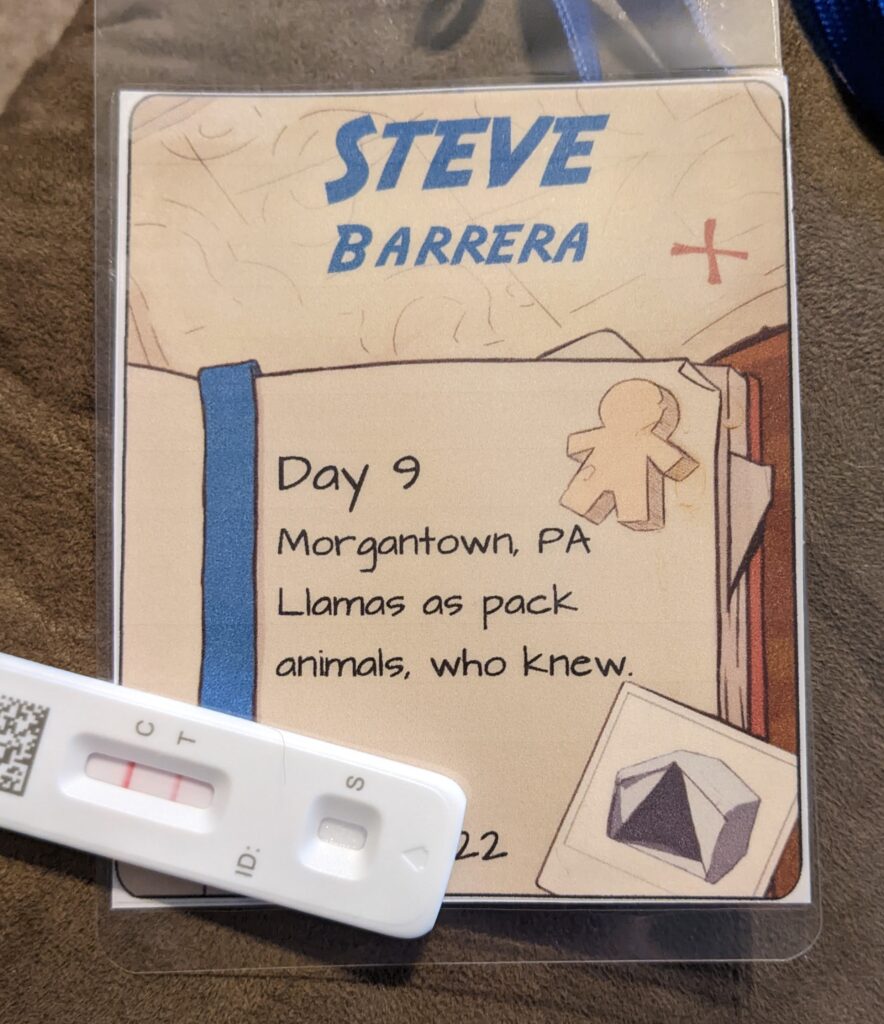
My dreams turned out to be prophetic, as when we returned from the convention, I tested positive for COVID. I was feeling crappy on the Sunday drive back, but attributed it to burnout from all the marathon board gaming. When I still felt sick on Monday, I took the rapid antigen test and got the positive result.

I suppose it was inevitable, given how contagious the virus is, and given that we pretty much stopped the non-medical interventions. Not such a good idea, I guess. Luckily Aileen did not get sick, possibly because she had already caught COVID in May (when I was the one who dodged the bullet). This is just how it goes in Pandemic Phase II.

I’m not the only one who got sick at the con, either. Turns out it was a superspreader event! After all the tut-tutting I have done over people not following pandemic protocols, I got all casual and went and caught the bug. As the proverb says, “there but for the grace of God go I.”

So it’s not too bad. The worst symptom is tiredness and sleeping a lot. In the pre-corona era I would have just thought I had a bad cold and taken a couple of days off work and slept it off. The worst side effect of having COVID is being isolated from the family. No more dinner together or TV night.

I was able to get a prescription for PAXLOVID. I mean, quickly. I called my doctor’s office, and they set me up with a Zoom consultation that felt like a formality. “You tested positive and you have hypertension which is a risk factor – ok, I’ll send over a script…” Within a few hours I had the pills (a housemate picked them up since I am isolating).

So we’ll see how it goes; hopefully I will be back to “normal” soon. Back to normal but very conscious of what non-medical interventions can achieve. I think I will be spending a lot of time at home, nose to grindstone, for a couple of months. I’ll still be risking exposure since Aileen has to go out for her work. Time for our second boosters?

The Informational Market State Culls the Herd

The Informational Market State Culls the Herd

In the early months of the Covid-19 pandemic I blogged about how the crisis was proving to be a “tempering test of the market state.” What I mean by “market state” is this concept by legal scholar Philip Bobbitt of a newly evolving constitutional order. It’s an order where government has less power and instead markets provide the decision-making and regulation. It’s also been called the “informational market-state” or the “neoliberal market-state.” More and more I’ve become convinced that while Bobbitt is correct in his broader theory of periodic changes in the constitutional order, with the “market state” he has really just identified the priorities of the market-driven social era of the late twentieth and early twenty-first centuries. In the new era, I would expect faith in markets to collapse and a return to government regulation to be in demand.

But let’s grant that the market state premise is correct. We are now in an individualistic, market-regulated constitutional order. In the earlier blog post, I framed the Covid-19 tempering test in these terms:

The Covid dilemma as it relates to this constitutional order is this: if the market state is supposed to protect the citizen while maximizing opportunities, what does it do when these goals are mutually exclusive? Simply put, an endemic disease that is highly infectious and lethal entails restricting economic activity in order to save lives, but that necessarily reduces economic opportunity

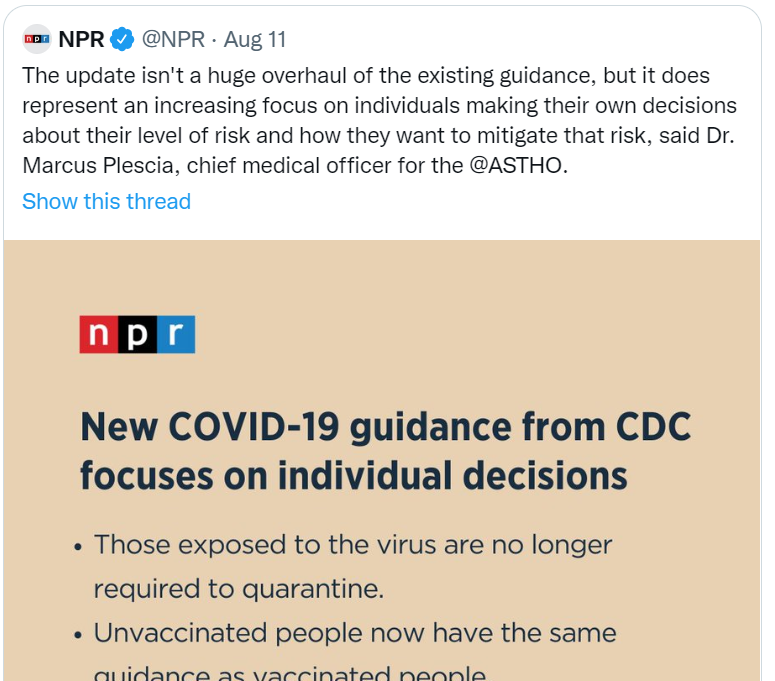
It would seem, based on the experience of the past year, that the market state’s resolution to the dilemma is simply to accept the loss of life. A premium in human lives must be paid in order to maintain the open society so vital to sustaining economic opportunity and generating financial wealth. The latest guidance from the CDC puts the onus on individuals to mitigate against the coronavirus as they see fit, certainly in keeping with the logic of the market state.

Some individuals have more leeway to make these choices than others, a fact not lost to many on social media.

I’ve seen a ton of posts like the one above, about how the CDC, and our society as a whole, have abandoned the vulnerable. It’s a brutal truth about our current state, where the government has essentially given up on the pandemic. It was just too big a creative leap to get out of our “normal” mode of an open society. And since we couldn’t get to herd immunity, we’re settling for herd culling.

How sustainable this will be, I do not know. Covid-19 is now the third leading cause of death in the United States, well ahead of vehicular accidents. And it’s even worse for certain age groups, and presumably also for the immunocompromised. It’s just a cold fact that if we keep going the way we’re going, then one fallout of this crisis era will be significant population loss. It wouldn’t be unprecedented in the grand scheme of things.

Living in the Land of the COVID

Living in the Land of the COVID

My partner is off this morning to work as a substitute teacher. She gets this sub work because the full-time teachers are always out…with COVID-19. But then school is probably where she caught the coronavirus. So this is where we’re at now in Pandemic Phase II: sending essential workers through a revolving door of exposure and contagion and 3-5 days of quarantine. Maybe for other workers it was like this in Phase I, but we were all lucky enough in our house to be in lockdown the whole time. I guess as a society we can’t stop doing this, because oh no, there might be a Recession!

Pandemic Phase II

Pandemic Phase II

Another housemate has caught the ‘rona. Amazingly, I am still testing negative (fingers crossed). Isolation protocols and masking indoors work. Now that we’ve reached this state in our household, when I go out with a face mask on I don’t feel so conspicuously out of place, even though I live in an area where 90% of the public is not masked. I realize that I need to mask because there is a chance I am an asymptomatic carrier.

When I’m out in public and the only one masked I’m not at all self-conscious; I just feel like I’m in on a secret. But it was never really a secret, was it?

With these new protocols in place – wearing the face mask in the house, taking a rapid antigen test before going out – it’s like we’re in a new phase of the pandemic. Are we riding out the next wave? Learning to live with endemic COVID? I don’t really know; I’m just telling my story here.