Browsed by
Category: Science Fiction

About those Other Realities…

About those Other Realities…

This past summer I watched a few recently made sci-fi movies and shows, all with stories based around the idea of alternate or repeating timelines. Their characters experience, voluntarily or not, different versions of reality that arise when different events happen. I enjoyed them all, with the caveat that I am a science fiction junkie, and also have a pretty low bar on what qualifies as good entertainment.

To summarize them without being too spoiler-y, one was the movie Redux Redux, an indie dark thriller with a cast you’ve never heard of; another was Good Luck, Have Fun, Don’t Die, more of a gonzo action comedy, headlined by a big star. And the last was the Black Mirror episode Bête Noire, which I thought was one of their better ones (though I liked the episode before it in Season 7 even more).

Each film has its own weird science explanation for how the timeline jumping works, the details of which are not important. “Weird science,” if you didn’t know, is a term for when fiction uses the tag “science!” to explain some technological device in the story, but unrealistically, in a manner not justified by what we know from actual science. In other words, weird science is just magic, except it’s not magic per se because then you would be watching fantasy, not science fiction. There was a famous statement by sci-fi author Arthur C. Clake, “any sufficiently advanced technology is indistinguishable from magic,” and sci-fi writers have generally taken it to heart.

I’ve been spoiler-y on the Black Mirror episode, sorry about that. The reveal comes late in the episode, and the timeline shifting is tied to quantum computing, a weird science shtick the show has used previously. I think the idea is that quantum computers are super-duper powerful and so they can compute anything? Not sure, exactly. One intriguing thought is that the Black Mirror writers are aware of how quantum physics is connected to the very concept of alternate realities, and are speculating along those lines about what might be possible with quantum computing.

What do I mean by that? It all comes down to one of the basic, most puzzling phenomena in quantum mechanics: the dual wave-particle nature of subatomic reality.

Subatomic particles cannot be measured precisely; there is always some uncertainty as to their exact position or velocity. In quantum mechanics, this uncertainty is translated into a “probability wave function” that expresses all of the possible states of a particle. During a measurement, the precise state is instantaneously determined, in what is known as “collapsing the wave function.” But no sooner than this is done, the probability wave expands once more and the state of the particle becomes unknown again.

The truly bizarre nature of quantum mechanics is apparent in some of the experimental results that are explainable by theorizing that particles sometimes behave not like particles, but literally like they are waves of probability. The most famous is probably the double-slit experiment, in which electrons travelling through a plate with two openings exhibit wave interference patterns when not observed as they pass through the openings, but spontaneously switch to acting like billiard balls if they are detected before passing through. This means that the experimenter can decide whether to make the electrons act like waves or like particles.

Wave-particle duality is also exhibited in the phenomenon of “quantum tunneling,” in which a particle’s probability wave allows it to pass through an otherwise unsurmountable potential energy barrier. This is not merely a curiosity of physics; it has practical applications and implications.

Physicists are stuck with the principles of quantum mechanics. They are verified experimentally, and our modern technology relies on them. The mathematics of the probability wave works out, but there is still the conundrum of how exactly the observer factors into the collapse of the wave function. Why should an electron care if anyone is looking at it or not?

In the standard interpretation of quantum mechanics, a particle is said to exist in a superposition of multiple possible states, until it is observed, at which point its state becomes a fixed, objective fact. This interpretation runs into a paradox when combined with material realism, or the idea that the standard model of particle physics, with its particles and forces, is all that is needed to explain reality – that everything else, including us and our consciousness, derives from it.

The problem is, how to account for the observer effect, the collapse of the probabilistic wave function. At what point does the experimenter cease to be a conglomerate of particles and forces, which theoretically only exist as a superposition of possible states, and then suddenly become an observer recording a measurement? Face it: a superposition of possibilities cannot of its own collapse into an actuality.

There are numerous other theoretical interpretations of quantum mechanics that have attempted to get around this paradox, most beyond the scope of this post. A perhaps better known one is the idea of hidden variables – that we simply haven’t fully figured out the deterministic math and the probability function is just a placeholder we use for now. This was espoused by the great Albert Einstein, who did not at all like the indeterminism in the new theories and famously declared, “God does not play dice.” Einstein didn’t live to see it, but hidden variables were eventually shown to be incompatible with quantum mechanics.

Another interpretation simply declares that there is no collapse of the wave function. Rather, each possibility in the superposition is as real as all the others. The act of observing determines not which possibility becomes a reality, but instead which reality the observer ends up in! This is the interpretation that ties into the shows I was watching, and why they reminded me of quantum mechanical theory. Maybe quantum computers could somehow tap into the wave function and do some weird science thing like reverse the polarity and thereby bounce around among the alternate universes.

There are some obvious problems with the many-worlds interpretation, as it is called. One is the insanely large number of alternate realities being proposed. Think about it: each subatomic particle has a superposition of possible states, multiplied by every other subatomic particle’s superpositions, branching out every fraction of a second. The total number of superpositions is staggering!

Of course, there is no reason theoretically to limit the number of universes. Most of them would be very hard to distinguish from one another, with only infinitesimally tiny differences. But theoretically every possibility could be someone’s reality. There is no way to disprove this theory, if there is no interaction among the alternate realities, which makes it scientifically untenable. That’s the biggest problem with this interpretation. In a sense, it’s a cop out.

Now, in the science fiction stories, the alternate worlds do intereact. Otherwise, the stories would be no fun. In one of my first posts on this blog, I wrote about one such story – All The Myriad Ways, by Larry Niven. In this story, alternate realities are proven to exist, and as a consequence people start lapsing morally and a crime wave ensues. The logic is thus: why not go ahead and follow your impulse to do bad things, since there will necessarily be some universe in which you didn’t anyways, plus if you restrain yourself, you’re just giving all the fun to some other version of you in another universe? The story, I concluded, is a parable about moral choice and its relation to the limits of reality.

This takes me, at last, to the real topic of this post. There is an interpretation of quantum mechanics that neatly resolves the paradox of the observer effect. That would be the Von Neumann–Wigner interpretation, which accepts the observer effect at face value and postulates that it is consciousness itself that is causing the collapse. This is a framework that has been expanded on greatly by Amit Goswami, perhaps my favorite quantum physicist.

Note an important implication of this interpretation: consciousness possesses agency. It is an ultimate cause. How can this be, if consciousness emerges as a property of complex conglomerates of subatomic particles, as theorized in material realism? Consciousness would only be another possibility in superposition, up until the moment of wave function collapse.

It must be that material realism is wrong in its fundamental assumptions, and that consciousness precedes material reality. Consciousness must, in fact, be the ground of being, with all that exists manifesting within it. When an observation is made, consciousness is choosing which of the possible states of the wave function becomes the actual state that is observed. This is why there is always an observer at the moment of wave function collapse.

The pioneers of quantum mechanics understood this. Erwin Schrödinger, he of the infamous cat, said: “The world is given to me only once, not one existing and one perceived. Subject and object are only one.” No objective reality exists without there also being a subjective observer. The two are inseparable.

But how, you might ask, is that going to work if my consciousness and your consciousness pick different possibilities of the wave function to collapse into reality? This is the so-called “Wigner’s friend” paradox. You might choose the cat to be alive and I might choose it to be dead. That poor cat!

The answer is simple. Consciousness is not a quality or attribute that you or I possess. It is the ground of reality, with you, I, and the cat all existing within it. The choice at the moment of wave function collapse is made by the singular cosmic consciousness that underlies all reality, and you and I see the same cat inside the box (hopefully, it sees us, too). You and I experience this as separate observers only because consciousness is identifying with our mind-body conglomerates in that moment and act of observation.

I reiterate: consciousness does not emerge as an epiphenomenom caused by the interaction of the material particles in our brains, as proposed by material realism. The material realist ontology cannot even explain what subjective consciousness is, even though it is something we all experience and therefore must be addressed by any complete scientific theory. At best, it can keep analyzing the brain and promising that the truth will be discovered eventually. But the brain is not where the subject resides! The subject in an act of observation is within cosmic consciousness, which encompasses the mind, and the brain, and whatever thing – whatever electron or chair or coffee table or computer screen – is being observed.

Comprehending unitive consciousness as the ground of reality gives us an ontology in which the subtle aspects of our inner experience are just as real as the material universe that surrounds us. Our thoughts and feelings are as real as material things made of atoms and molecules, the difference being that we experience them as fleeting objects in a personal space, instead of as fixed objects in a shared space. And anyway those “fixed” things are also “fleeting” – affected, as all matter is, by quantum uncertainty. The amount of uncertainty is just very small at human scale, so that we all observe physical reality similarly enough that we can agree on what is what.

Our thoughts and feelings, experienced as private and personal, amount to what the ancients called our psyche – which means soul.

You see where I am going with this. This intrepretation of quantum mechanics aligns with spirituality and mystic wisdom. Material realism is wrong. There is something greater out there.

Unitive cosmic consciousness is the Ground Luminosity of Tibetan Buddhism. It is that which is, beyond which there is nothing else. A being that has no greater being – a “Supreme Being,” if you will. It subsumes the whole of the universe, including space and time, which only exist in the context of matter and energy, anyway, per relativity theory. In other words, cosmic consciousness is beyond space and time; that is, it is eternal.

Let’s just take the leap: unitive cosmic consciousness is what religions mean when they refer to “God.”

We can go further. If consciousness is purposive and through its purposiveness manifests reality, by choosing the actual state of the universe from among its possibilities, then it can be said to be creating the universe. Just as the religions claim.

If purposive consciousness is creative and strives to manifest ever more complex forms into existence, then it is guiding evolution, just as the intelligent design theorists claim. If there is a purpose to evolution and a direction toward higher modes of consciousness, then in that sense we could say that cosmic consciousness is “creating us in its image.”

Finally, if consciousness is unitive and our sense of separate selves only arises because of our temporary existence as mortal creations, then just as the mystics claim, our souls are on a journey of self-discovery, striving towards God-realization.

It is just as it was sung by The Beatles:

And the time will come when you see we’re all one
And life flows on within you and without you

The lotus with a thousand petals, symbol of the crown chakra, which connects us to spiritual purpose

I know this is a bold assertion: an interpretation of the mysterious phenomena of quantum mechanics which proposes that there really is a spiritual dimension to our existence, and which conforms in many ways with the doctrines of religious systems. It is not generally a well-received interpretation, as far as I can tell, probably because people who are interested in the science of quantum physics also tend to be wary of religion, with its long history of dogmatic belief and atrocities perpetrated in the name of God.

So let’s be clear: dogmatic myths, like a God who is a bearded old white guy, are way off the mark. But that doesn’t rule out spirituality and non-material reality. Nor does the tragic history of religious conflict and persecution, since anyways humans justify their cruelty, bigotry, and violence on both religious and non-religious grounds.

The most profound takeaway from the idea of unitive cosmic consciousness as the ground of being is that consciousness has agency. Our choices truly matter.

All experience, the internal subtle experiences in our minds, and the external physical universe that we experience together as shared reality, occurs within unitive consciousness. In that sense, whatever choices we make, God is watching.

If consciousness collapses the quantum wave function and manifests reality, then with each choice that consciousness makes, the timeline is established. History is made. There is no alternate version of reality to pursue, no type of weird science that will allow us to backtrack or experience the outcomes of different choices.

Those science fiction stories are a hoot, but they are just that – fiction. In reality, our choices fix the timeline, and therefore are rife with moral consequence. It makes a difference whether we decide to follow our impulses to do bad things, or make the stronger choice to do good.

That’s why I called the many worlds interpretation of quantum mechanics a cop out. As Larry Niven’s story All The Myriad Ways informs, it offers us a way to escape the consequences of our choices.

But we can’t. Just as the mystics say, with each choice we make, we make our shared reality.

And God is watching.

And we are all God.


Thanks for reading this post. I hope you enjoyed it and found the subject interesting. If you want to learn more about how quantum physics can explain the spiritual nature of reality, I recommend these two books by Amit Goswami: The Self-Aware Universe (ISBN 9780874777987), and God Is Not Dead (ISBN 9781571745637).

Namaste.
Wrapping up My Top 10 Games

Wrapping up My Top 10 Games

This post wraps up my top 10 games list, as I have completed the GeekList about the top 10 games on my BoardGameGeek user profile. As already mentioned, I have created this list as part of a project to capture for posterity details of my board gaming life. This includes digitized versions of beat-up old customized rules and accessories, much of it up on my personal gaming site: A Real Live Gaming Workshop. Presumably these sites on the Internet will outlive me, at least for a little while.

Here is the final GeekList: My Top 10 Games.

And here are the last two entries not yet published on this blog:


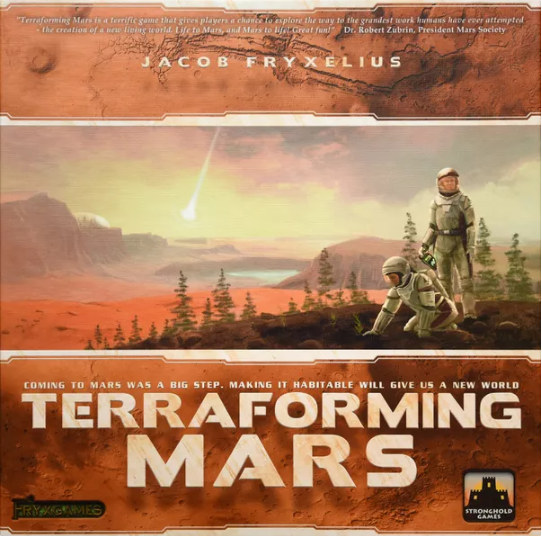
#1: Terraforming Mars

If you know me, you’re not surprised to see this game at the top of the list. You might think this is the only game I ever want to play! I was hooked the moment I first played it at a convention, which I’m pretty sure was on the year it came out (2016).

Terraforming Mars hits all of my favorite board game marks. It has a rich science-fiction theme. It’s super-crunchy with lots of calculating for optimization. It has patient engine-building in the early game that pays off in the later game without the game rushing to an end, as so often happens with engine-builders. It has a huge deck of cards where every card is unique, possibly my favorite feature in a game. And it also has a board with fiddly bits, and tile layout with a modest degree of pattern matching.

I think the game plays great with every expansion; they each add extra dimensions of game play, and also new unique cards for the deck. I also like that you can pick and choose which expansions to use, and have a good game with any combination. And I think the game plays well with any player count, including 2-player and even solo!

I own all the official expansions, and some fan-made ones as well (though not all the fan-made ones). I own the ‘big box’ upgrade which has a larger game box and 3D printed components to replace the original cardboard ones. It’s somewhat absurd how much I’ve invested in this game, but what can I say except that a hobbyist needs no excuse?

 I’ve played solo a lot, and I’ve found that solo games make for great storytelling session reports; here’s one of my favorites: “You nuked Mars!” – a solo session with Aphrodite that begins with negative points.

I also will note that as much as I enjoy this game, I do not think there is a future for the human race in terraforming the red planet. The challenge is extraordinary and there is no payoff for the insanely high costs. I enjoy the idea as science fiction, but like all science fiction it is not realistic. It is space fantasy.

Here’s another way to think about it – if it’s worth it to terraform Mars, why haven’t we put in the effort to “terraform” Antarctica? Surely that would be much easier. Antarctica is so much less hostile an environment than Mars. For that matter, so is the ocean floor. But we don’t have any colonies in those places.


#11: Through the Ages

That’s right, my top 10 list goes to 11.

Through the Ages is a medium-to-heavy weight game with a theme of advancing civilization from ancient to modern times. I wouldn’t say that it’s my favorite civilization game; I prefer one’s like Avalon Hill’s version (already on the top 10 list), because they actually have a map of the world where your civilization spreads out and comes into contact with other players. This game is a bit more abstract in its implementation.

I will say that it has a very elegant design, with exactly enough complexity for its theme. It has a limited deck of unique cards, but they interact in so many ways that each game plays differently. You’ll often see new combinations of effects you haven’t seen before even if you’ve played scores of times already. I have a lot respect for the designer, Vlaada Chvátil – all his games are good. Even if you are not a big gamer, you might have encountered one of his more popular designs – Codenames.

Through the Ages game makes it onto the list because it has a special place in my board game biography. Ever since the pandemic back in 2020, I have had fewer opportunities for in person gaming than in the past. But some of my old friends and I have been playing this game online, more or less continuously, for four years. So I get to scratch my itch for a medium-heavy game, even though it’s really hard to actually get one to the table these days. Czech Games Edition‘s online version lets you play with no time limit on the turns, so it’s very casual playing with trusted friends.

I have spent countless hours of my life playing board games. And while not as many hours in the current stage of my life as in my past, I do have this ongoing digital game to keep me connected to the hobby, and to my good friends who share it with me.


Welcome to “Black Mirror”

Welcome to “Black Mirror”

Or, When Life Imitates Sci-Fi

As a sci-fi fan, it always fascinates me when events in the real world look like something out of a science fiction story. This happens because the authors of science fiction are paying attention to trends and making rational projections about what the future will be like – and sometimes they get it right. They also get it wrong a lot. As I’ve noted in a previous post, sci-fi has been way too optimistisc about one particular trend: the extent of human space exploration. And sci-fi authors in the cyberpunk genre way overestimated how stylish and cool our near-future dystopias would turn out.

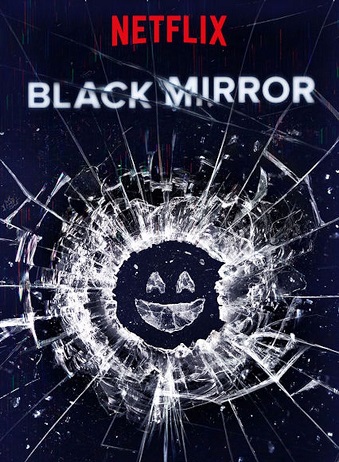
I thought it would be fun not fun to list out some stories from recent and recent-ish sci-fi television and film, and then find examples in real life of their speculations about technology actually coming true. I will start with Black Mirror, the dystopian anthology series from Netflix, and go episode by episode. Black Mirror pretty obviously gets a lot of story ideas from how tech currently intersects with our lives, so it’s not surprising that I found so many examples.

NOTE: I’m including synopses of the episodes which might be spoiler-y.

Black Mirror episodes

S1: E3 The Entire History of You: In the future, everyone has a device in their head that records their experience. A couple quarrels over suspicions of infidelity, and the recording provides the proof. The idea of having a device implanted in your brain or eye that records your life experience was also explored in the 2004 sci-fi film The Final Cut, which I like, if only because it stars Robin Williams. While we are nowhere close to achieving implants that record subjective experience, we do carry around records of our lives with us wherever we go. I’m talking, of course, about the feeds on our smartphones. Our devices pester us with “memories” of what we were doing one, two, or ten years ago, and scrolling through our social media profiles and chat histories reveals a lot about who we are and what we’ve been up to. Show me that phone in your pocket, baby!

S2: E1 Be Right Back: A woman purchases an android replica of her deceased husband, crafted to look just like him, with a personality created by scrubbing his online profile. We certainly don’t have anything like natural-looking humanoid autonomous robots; at best we have utilitarian bipedal bots, and human-like robots that are deep in the uncanny valley. But we do have the ability to digitally recreate people! Deepfake technology, using artificial intelligence, can create passable images, videos, and even audio imitating a specific person. The potential for abuse and fraud is frightening. And AI models can be trained to mimic individuals, just by interviewing them for a couple of hours. So you could clone your loved ones, if only in text conversation form.

S3: E1 Nosedive: A young woman’s social climbing aspirations are thwarted when her social rating plummets in a spiralling series of mishaps. How do you think you would rate on a 5-star scale if everyone around you constantly rated you and the ratings averaged out? Think you would get into the high 4s because of how awesome you are, or get stuck in the mid-3s because you’re basic? You probably wouldn’t act like a jerk all the time and let yourself sink below a 3 – like what happens to the main character in this episode. Luckily, you don’t have to worry about the value of your social rating – unless, that is, you live in China. In China, the government has implemented a social credit system that monitors its citizens, and yeah, your social credit rating affects things like what housing and services you have access to, and where you can travel. Think about that the next time you use an app that hosts its servers there.

S3: E4 San Junipero: A dying woman explores a simulated reality where she can exist after death, in a kind of virtual afterlife. This is actually one my favorite episodes, because of its poignant love story and its 1980s nostalgia. But I don’t have a match for it in real life, because I don’t believe that it’s premise is at all realistic. It is not possible to “transfer” consciousness because consciousness is not a property of the human brain that can be extracted or copied – it is the fundamental ground of reality within which our brains and minds exist. This is a philosophical point which I bring up because so many Black Mirror episodes feature consciousness created by simulation and that is just not a thing. But those episodes are fun, because sci-fi is still fun even when it’s way off the mark. Also, if you like this premise, you might enjoy the show Upload on Amazon Prime Video.

S3: E6 Hated in the Nation: A disgruntled tech guy programs a bunch of miniature robot bugs to fly around and kill targeted people using facial recognition technology. This is a scary one to have come true, and I’m afraid I have to report that it has. The Israeli army has been using artificial intelligence and machine learning to build target lists of Gazans who are deemed likely to be Hamas operatives, and then using those lists to direct their bombing campaigns. The project pre-dates October 7, but it has been used extensively in the current Gazan war. The algorithm is fed all kinds of data, not facial images, and the Israeli strikes aren’t as precise as killer bees, but the carnage is just the same.

S4: E5 Metalhead: A small group of possibly burglars encounters a robot guard dog at a warehouse and are relentlessly hunted down by it. You might have heard of Ukraine’s extensive use of drones in their current defensive war against the Russian invaders. There was actually a battle in which the Ukrainians used exclusively robotic and unmanned equipment, meaning not a single one of their personnel was at risk. This is the future of warfare right here, so you probably won’t have to worry about the draft coming for your boys – so long as you’re not from Russia or North Korea.

Her

Her is a  Spike Jonze film from 2013 about a man who develops a relationship with an artificial intelligence, inspired by the AI chat technology that existed then. Now, the ability to have a text conversation with a computer program actually goes way back. A chatbot called ELIZA was created in the 1960s, intended to simulate a therapist, and is famously the first program to be able to attempt the Turing test. In the movie Her, the main character falls in love with the AI, whom we presume by the film’s premise is an actual sentient being. Real life AI chatbots are not sentient; rather, they are computationally intensive algorithms that regurgitate passably human conversation, and may well be able to pass the Turing test. And – here’s the tie-in – you can have one for a girlfriend or a boyfriend if you’d like, thanks to a plethora of sites that offer that as a service. I am not comfortable linking to any of these sites, but a web search will quickly uncover them.

Minority Report

In the 2002 film Minority Report, based on a Philip K. Dick story, a “Precrime” police department uses precognitive psychics to identify crimes just before they happen, then intercedes and arrests the soon-to-be perpetrators before the crimes actually occur. It’s an interesting premise that raises legal and moral questions, which we probably won’t have to deal with since we don’t have reliable psychics to work with in our world. But wait – we do have AI, and wouldn’t you know it, they’re working on using it to predict when crimes could be imminent, based on behavioral and environmental factors. You could also think of this trend as yet another job (security guard) eventually being replaced by AI.

The Peripheral

In this book by cyberpunk pioneer William Gibson, sinister corporate powers from a far future use a kind of time travel to influence a near-future timeline for their own nefarious purposes. The book inspired a TV series that is only kind of faithful to the story, and doesn’t quite capture the enormity of what they are doing (maybe just because it was canceled after one season). When these time meddlers influence the past, they create a branching timeline, and so are unaffected in their own timeline by what they do. They use their advanced knowledge and tech to wreak havoc on the world economy, essentially crashing civilization in an alternate reality just for a small advantage in their own reality. Wait – does that sound anything like what’s going on now with Musk and DOGE? Could he be from another timeline? Yikes! This post for entertainment purposes only.

A Really Cool Sci-Fi Game in My Top 10

A Really Cool Sci-Fi Game in My Top 10

Time for another installment of my top 10 games on BGG.

#3: Race for the Galaxy

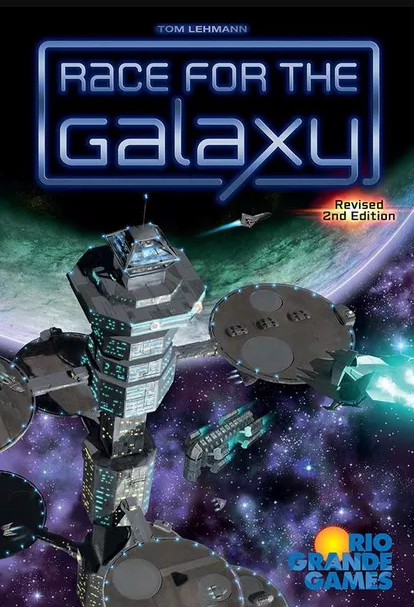
When Race for the Galaxy first came out I was instantly addicted. It has a theme of galactic-level advanced civilization, as well as a design that is mostly straightforward, but just complex enough to provide a mutli-faceted experience, with lots of strategic choices and multiple paths to victory. It has secret role selection, a mechanic I like a lot, since it creates tension and the opportunity to second-guess and bluff. It also has a rich variety of cards, with each card being unique (mostly), but all of them interacting in a myriad of ways – a feature I always appreciate in a game.

Another thing I love about this game is that it incorporates sci-fi concepts that come from the venerable traditions of the genre, going back to earlier generations. It’s pretty obvious where its Rebel v. Imperium theme comes from. Then there’s also a mysterious vanished Alien race, which looks like a callback to Frederik Pohl’s Heechee Saga, and the Uplift idea, straight from Dave Brin. One card, Terraforming Engineers, reminds me of the planet designers from The Hitchhiker’s Guide to the Galaxy.

The game does have iconography that can be confusing at first, and one drawback it has is that it requires a learning curve to familiarize oneself with the card set. A player who knows the cards has a decided advantage over a complete novice. Luckily for me, there were plenty of other gamers in the late 2000s/early 2010s who also loved this game and developed the expertise to play it. It got a ton of plays back then. I was even logging plays on BGG at the time (which I don’t do any more), and this game has the most plays of any on my list, at 191 total. This game was also the subject of a couple of early session reports, including this fun one: RftG is baptized.

The game has been expanded a bit, and I love all of the expansions. The first expansion arc is a must have, and I prefer to play with all three of its sets, and all the complexity they add. And even though they are a bit more fiddly, so to speak, I also enjoy the Alien Artifacts and Xeno Invasion expansions. When I bought them, I also bought a new set of the base game to go with them, since the set I had already was mixed with the original expansions, and is well worn from being played so much.

The game has also been reimplemented, and I have tried a couple of its reimplementations. I liked the Puerto Rico-esque board game version, New Frontiers, a lot. Roll for the Galaxy I thought was well designed, though dice versions of board games are not really my thing, and I don’t much hanker to play it. I still haven’t tried Jump Drive, which is sort of a simplified version of it to my understanding.

Alas, all those old Race for the Galaxy gamers are not in my sphere any more. Everyone’s moved to different parts of the country (including me). It seems that no one at conventions wants to play, like it’s really fallen in popularity. And it’s a hard game to bring to new players, especially given that there are so many easier to learn options out there these days.

I still play, though, against the AIs, as there are several exellent digital implementations. I mostly play the Steam version. I must have a thousand plays by now, and there are so many combinations of cards that every game is unique, and it just never gets boring to me.

Out of my way, I’ve got a galaxy to conquer!

Are We at the End of Time *Already*?

Are We at the End of Time *Already*?

I stole this off a book cover because I liked the art – just like generative AI does

There is this really cool sci-fi trilogy written by Michael Moorcock, called The Dancers at the End of Time, which takes place far, far in the future (warning: mild spoilers ahead). Human technology has advanced to the level implied by Arthur C. Clarke’s famous dictum, “any sufficiently advanced technology is indistinguishable from magic.” There aren’t many people left on Earth, but those people live like gods. They wear power rings attuned to their minds, and can alter the physical world in any way they want with a thought.

The rings they wear tap into these huge machines in the center of the planet that draw on vast energy sources. It’s like the matter replicators from Star Trek, but on a planetary scale. Sometimes the machines generate images instead of actual matter, like the Star Trek holodeck on a planetary scale. I suppose this is to conserve energy.

So for example someone in this distant future might decide they want to live in a fancy castle, and then just dream it up, and the machines will make it for them. They can create any kind of landscape around it, maybe a lake of rainbow colored water with crystal mountains all around – why not? They can change the color of the sky and add a few moons. If they get bored with their castle and landscape, they can disintegrate it and imagine up a new one. All with a wave of the hand.

The denizens of the end of time are a frivolous and wanton people. After all, their tech level makes them immune to any consequences for their actions. They can’t even die; if they do, the machines recreate them from backup information. Their existences are pure recreation and socializing in a world where everyone lives like an insanely wealthy elite.

How is this matter-altering technology even possible? That is irrelevant to the story, which is an exploration of morality and its connection to the material limitations of existence. At least, that’s what I got out of the trilogy. It’s been ages since I read it, but I’ve been reminded of it lately when reading about the technology of our time.

You see, as part of the plot in the sci-fi books, aliens come to Earth to ask the humans to kindly stop their machines, because as it turns out their energy source is wormholes to the far reaches of space, and they are using so much energy that they are accelerating the end of the Universe. Humanity is sucking the cosmos dry just to have fun. Naturally, the humans brush the E.T.s off and continue with their careless lifestyle.

This is kind of happening already, here in the real world of actual technology. The advent of digital cryptocurrencies has incentivized computationally-intensive processes which require huge amounts of electricity. For example, one estimate is that a single bitcoin transaction uses as much power as it takes to run a household for 36 hours. Generative AI, which for whatever reason has been integrated into every major platform on the Internet, is also a significant consumer of power and has a major environmental impact.

Yes, we are accelarating climate change and causing lasting environmental damage, just for a little amusement. It’s a similar story to the one in the sci-fi books. We’re not destroying the whole Universe with our latest and greatest Internet technology, just the planet. But that’s all the Universe we realistically have, so it amounts to the same thing, from the perspective of our puny civilization.

We didn’t get to the stage of mastery of the physical laws of the Universe so we could live like gods, but a few of us got rich from speculative bubbles and we generated massive amounts of creepy images and canned text. All while cooking the Earth dry. It’s really quite pathetic.

If we keep it up, we just might reach the end of time.

I mean our time, on Earth.

Please Don’t Stick That in My Brain: Some Thoughts on the Past and Future of Cyberpunk

Please Don’t Stick That in My Brain: Some Thoughts on the Past and Future of Cyberpunk

I’ve recently enjoyed a little foray into cyberpunk fiction. I watched the Netflix anime series Cyberpunk: Edgerunners, and also read the book on which it is ultimately based. Technically, the TV series is based on the video game Cyberpunk 2077, which is itself based on the tabletop RPG Cyberpunk. But the creator of the RPG has acknowledged that he was heavily influenced by the book Hardwired, by Walter Carlos Williams, which is the book I read. I could definitely see the influence, traced all the way back through this pop culture pedigree – in concepts, style, and even a little bit in content.

Typically, a story in this genre features protagonists who are marginalized outcasts, and also stylish and cool (that’s the “punk” part). They make a living as outlaws, and probably party hard in their free time (that’s the “edge” part). They have expertise with advanced technology, and interface with it using direct neural connections (that’s the “cyber” and “hardwired” parts). Their adversaries are powerful corporate conspiracies in a futuristic setting where multinational (or even multiplanetary) corporations have eclipsed governments. Think Blade Runner. It’s something about the zeitgeist of the time period when cyberpunk began (the dawn of the Reagan era) to imagine corporations replacing governments as the rulers of Earth. You might even think of it as sci-fi authors being characteristically prescient.

The anime series Cyberpunk: Edgerunners has all these genre features, in a slick, stylized package with a kind of pastel-colored 1980s aesthetic. To me watching it felt very much like sitting in on RPG sessions where a motley crew of adventurers go on missions, collect loot, and buy ever more powerful upgrades to their fancy cybernetic enhancements. In that sense it’s a fitting adaptation of the tabletop game and video game that are its ultimate source material. That’s not to say there’s no bigger picture or meaningful plot; there is an over-arching story and there is depth to the show. It’s very well executed, making it both an artful and an entertaining series. I should warn you, though, if you plan to watch it, that it depicts extremely graphic violence, as one would only expect from a roleplaying game (I’ve RPG’d a lot, and trust me, gamers love to live out their violent fantasies around the gaming table).

The signature element of the cyberpunk genre is undoubtedly the cybernetic implant – some sort of machine enhancement of the human body. Maybe it’s a weaponized appendage. Maybe it’s enhanced senses, like eyes that can see infrared. Or maybe it’s a chip in the brain that let’s you interface directly with computer systems, hacking into them in a virtual reality mode where you become a digital avatar travelling through cyberspace. In the original cyberpunk tradition, you typically have ports, in your skull or perhaps at the base of your neck, where you jack in to cyberspace by plugging in wires. These stories were all dreamed up before there was ubiquitous wifi, so it makes sense that writers would assume that was how to connect to a network. It’s like how in 1970s sci-fi people in the far future are using computers with monochrome CRT monitors. You could always argue that a direct wired connection would be faster and more reliable than a wifi connection, so it would still be desirable to have a USB port in your head, even in a cyberpunk future saturated with wifi networks.

In Cyberpunk: Edgerunners you have all these kinds of cybernetics. The specific ones that a character uses define a sort of character class for them; whether they are combat oriented – which could mean being strong and fast for hand-to-hand combat, or just very accurate with long range weapons – or a computer hacker, sneaking into the corporate networks while the combat characters watch over them or create a distraction. Sometimes drugs are needed to work with these cybernetics; specifically, in this anime, a character has to take immunosuppressants to prevent his body from rejecting his implants. In the book Hardwired, the characters took a stimulant drug which helped their nervous systems to interact with their hardware.

This sort of transhumanist idea of replacement cyborg parts has been around for decades now, but how close are we to neural implants in real life? We really only have implants which provide minor electrical stimulation for medical rehabilitation purposes; they sort of help an organ by giving it a little kickstarting jolt. Implants directly into the brain have been used to treat neurological or mood disorders, but all they are doing is alleviating symptoms with a tickle of electricity. They are a far cry from science fiction human-machine interfaces that link the mind to digital space. For that, we still have to rely on our old-fashioned senses, and put on a set of VR goggles. As for cybernetic body parts, well, the closest we have is myoelectric prostheses, which can pick up electric signals from the muscles, thus enabling the user to control the prosthetic. But this signal is picked up from the surface; no implant is needed.

The idea of direct neural connection to electronics, merging human consciousness with machines, remains a far-fetched sci-fi fantasy, like sentient androids or colonies on other planets. But it’s one which science fiction keeps revisiting. You may have encountered it recently in episodes of the anthology series Black Mirror, where people have devices in their brains or eyes which record everything that happens to them, or interface them with an augmented reality social network. These are simply used as vehicles for plots involving crime, troubled relationships, or people struggling for social acceptance. These stories could have been told without including imaginary technology, but the point is to look at modern life by extrapolating from current trends.

Today we engage with social media platforms on our pocket computer devices; will we someday be doing it via chips implanted into our brains, with a thought and a flick of the eye instead of a swipe of a finger? I’m going to say no, no we will not. But I guess it’s not impossible. Just not going to happen in our lifetimes, if ever. And if something like that did become available in our lifetimes, I would have to say nope, no thank you. I do not want a chip in my brain.

I do think it’s interesting how cyberpunk dystopias in the Blade Runner style – where edgy, marginalized protagonists use their cybernetic implants for leverage in high stakes, high risk adventure stories – have evolved into a style more like Minority Report, where boring dystopia participants meander through garish commercial hellscapes, desperate to find meaning in their existence. The awesome short video Hyper-Reality, reminiscent of a Black Mirror episode, captures this milieu perfectly:

This isn’t the dystopia I signed up for.

I see this new kind of cyber-setting as a reflection of the overall shift in the zeitgeist – away from the free-wheeling times of my Gen X youth and toward the Millennial era, with its emphasis on group participation and consensus-seeking networks. It’s a friendlier, if more banal, kind of cyberspace. The stories are no longer the picaresque adventures of original cyberpunk, but instead Kafkaesque social commentaries, where the individual is stripped of all agency, and the audience is invited to gaze in horror at the bland nightmare that modern society has become.

The setting of Cyberpunk: Edgerunners could be seen as a holdover from the early days of cyberpunk, a place where some kind of individual achievement is still possible, like the video game worlds that are increasingly the domain of older generations. If only in our imaginations, technology can make us better. But even this anime has a warning about technological hubris, about which I won’t elaborate lest I spoil the show. I’ll just make this statement, though it is a cliché: if we rely too much on technology to enhance our capabilities, we risk losing touch with our true selves.

Finding Yourself in the Internet Age

Finding Yourself in the Internet Age

Do you remember life before smart phones? I sometimes have a hard time imagining what it was like. I mean, I was there; I should know. We had to write down the directions to drive places, since we couldn’t just bring it up on our phones. We had to have our music collections in some sort of recorded format, like tapes or CDs, and keep them in the car. You couldn’t just look up any fact you wanted to know in an instant. But you did know a lot of other people’s telephone numbers.

My BFF tells me I’m too dependent on my phone now. My little pocket assistant. I get lost driving without it. I’ve tried to navigate on my own; to challenge myself to get somewhere without using Google maps. Usually that doesn’t work, and out comes the smart phone to rescue me.

It wasn’t always like this, but through the fog of time it’s hard for me to remember those ways of life, from even just fifteen years ago.

One thing I do remember is that back in the mid-2000s, when Web 2.0 was still new, I had a pretty good Internet presence, if I do say so myself. Granted, it was a Web 1.0 presence: a static vanity web site, a blog. I did a little bit of manual search engine optimization, editing the metadata on my static HTML pages in my text editor. It was good enough for us back in those days. A Google search of my name ca. 2006 would have had my pages on the top of the search results; I kid you not!

Today, that’s not likely. My Internet presence is lost in a sea of like named people, because everyone has a smart phone and multiple social media accounts now. I’m no microinfluencer, not even a nanoinfluencer. I never realized how many people with my name there are out there; I thought it was kind of unique. I was used to being the only “Barrera” in whatever social milieu I was in, outside of my family. Now that my social milieu is all of humanity on the Internet, I’m discovering that my name isn’t so unique after all.

It’s the same with usernames. Technically, I was on the Internet as far back as the 1980s, since I had user accounts and email addresses at Virginia Tech, where I went to college. I remember my email address was “sbarrera@vt.edu.” For a long time after that, I was used to being “sbarrera” or “stevebarrera” whenever I signed up with a new account somewhere. But no more; those usernames are always taken on any major site. I have to come up with something clever, or settle for a username with a string of numbers at the end.

As the global population continues to soar and the Internet continues to gobble up civilization, how will we have usernames for everyone? We’ll all end up named with numbers at the end, like in a dystopian sci-fi society. Like THX 1138. The future is here, I guess.

Don’t get me wrong; I love the Internet. I spend most of my waking time there. I’ve been fascinated by computers since I was a teenager, and chose computer work for my professional life. I’ve been on the world wide web since the beginning, and always had fun with it. The Internet is where I live; it’s surely where I’ll die. It’s always in our pockets, part of the background of life.

Subreddit of the Week: aboringdystopia

Subreddit of the Week: aboringdystopia

I’m sure you’ve heard of the science fiction genre known as cyberpunk. I’m not talking about the recently released video game; I mean science fiction that is high-tech and futuristic in its setting, and politically and socially dystopian in its outlook.

An early example in film was the 1982 movie Blade Runner, based on a Philip K. Dick novel from the 1960s. It was a real trendsetter for the cyberpunk aesthetic – bleak and dark, but also slick and stylish. Like how everybody dressed in the nineties. It promised a future of brutal corporate rule and film noir cool. Did it get that future right? Not really. But as I broke it down in a review of the film and its sequel, science fiction is just modern mythology. Most of it is fantastical and completely unrealistic in its extrapolations; the real point of it is to explore the human psyche and the meaning of life.

Cyberpunk took off in the late 1900s, but as the world turned and the real cyberworld evolved, it looked less and less like the jaded, punk settings of the fictional genre. Going into the twenty-first century, cyberreality was becoming helpful and consumer-oriented. A more accurate depiction in dystopian fiction of the world to come was captured in the 2002 movie Minority Report, also based on a Philip K. Dick story. It was quite prescient in its forecast of a society under continuous surveillance and evaluation. The world it envisions even includes targeted advertising, and self-driving cars. The big thing it gets wrong is that, instead of psychics, we use machine learning algorithms to predict human behavior.

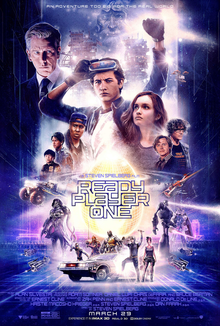
Now that we’re one-fifth of the way into the new century, and deep into the Crisis Era, the luster has come off of the consumer-oriented market society. Concerns about wealth and income inequality, and the plight of the underprivileged, have come to the forefront of popular dystopian science fiction. In the 2018 movie Ready Player One, a powerful tech company dominates society and a permanent underclass can only find respite in virtual reality. Sound anything like your life?

In the even higher stakes story of 2013’s Elysium, the Earth inhabited by the poor is almost unlivable, and the privileged middle class has taken to an orbital space habitat, where they enjoy vastly superior lives to those on the planet surface. Clearly this society has not dealt successfully with either climate change or the rising cost of healthcare. As far-fetched as the techonologies may be in the film, the allegory of an elite class that has completely abandoned any sense of social responsibility is unmistakeably relevant.

What kind of harrowing, high-tech dystopia do we actually live in today? That takes me to the title of this post and the subreddit /r/aboringdystopia. Here the teeming digital masses chronicle all the petty injustices and cruelties of the modern world, all the ways the megacorps keep us under their thumbs, all the ways that late stage capitalism is failing us. We did manage to get to a dystopia of oppressive corporate rule after all, it’s just not futuristic or cyberpunk.

Somehow we became an oppressed underclass without keeping any sense of style. We’re sitting in our sweatpants and binge-watching Amazon Prime video, not running around in cool leather jackets like Neo and Trinity. But in our own sad way, we’re jacked in to the Matrix and trapped in a dystopia.

Space Force: A TV Show for the Age

Space Force: A TV Show for the Age

The family and I really enjoyed watching the Netflix comedy series Space Force. It’s a great vehicle for Steve Carell, with his gift for playing lovable losers. Though in this show he is not so much a loser as “the man for his time and place” who “fits right in there,” to quote a mysterious stranger. In the case of Space Force, the time is now and the place is at the head of a brand new branch of the United States military. And Carell’s character, General Mark R. Naird, has the right stuff for this challenging job.

One thing I like about the show is that it is very topical. It is the only consciously Trump Era fictional television series of which I know (still waiting for a COVID-19-conscious sitcom). The President is even a character, though we only know him in the form of texts and Tweets from “POTUS.” General Naird has just the right mix of sincerity and guile to handle this unpredictable boss, as well as his peers in the other military branches, and the competitive space efforts of America’s great rival, China.

To balance against Carell’s typically understated performance, John Malkovich provides a more animated supporting character, Chief Scientist Dr. Adrian Mallory. If you are a fan of Malkovich, which we are, you will enjoy him in this role. Since this is on streaming video, there is ample opportunity for him to exploit his propensity for foul language. Just another example of how TV has changed since my childhood. The rest of the supporting cast also provides solid performances.

Space Force is completely farcical and makes no effort to be realistic in terms of the science or engineering of space exploration. There’s an irony to the depiction of the easy accomplishments of this fictional organization, in contrast to the actual state of the U.S. space program. It’s like the show is satirizing what the ignoramus-in-chief thinks the Space Force is capable of doing. Like it’s set in his imagination.

I suppose you could argue that the TV show Space Force normalizes the current administration and its feckless ways. Maybe it’s even a little sympathetic to it, so as not to alienate Trump supporters, who surely make up a substantial portion of Netflix subscribers. Arguably the show also normalizes the idea of inevitable Sino-American conflict. These are dangerous times, and perhaps we shouldn’t be making fun of these things.

With that in mind, it’s no surprise that no one has announced a new comedy TV series set in the COVID-19 era. But I would welcome one. Humor is cathartic, and helps us to process the difficult realities of life.

So check out Space Force and enjoy the show. One season is available on Netflix, with no word yet of a second season.

A slow noir sci-fi show that’s perfect for bedtime

A slow noir sci-fi show that’s perfect for bedtime

If, like most of us in this day and age, you enjoy a good binge watch of streaming video entertainment, then I’m sure you are familiar with this pattern: you start to watch an episodic series, and you get pulled in. Each episode ends with a plot twist or cliffhanger and when it’s over your appetite is whetted, and you can’t help but watch the next episode. Before you know it, it’s after midnight and you are regretting staying up too late yet another night in a row.

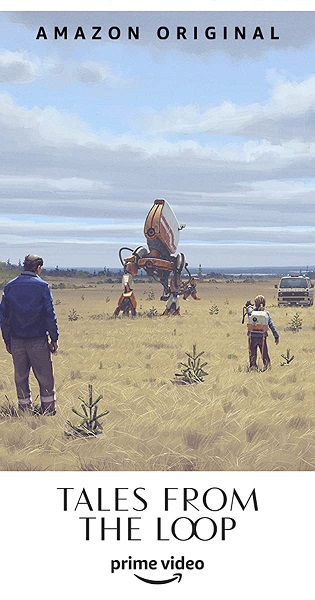
If this is a problem for you, then you might be interested in checking out this show that my BFF and I recently finished. It’s called Tales From The Loop. It’s an anthology sci-fi series, and it is *so* slow paced that getting through an episode is like a slog through a swamp.

That’s not to say it’s a bad show; it has interesting stories and characters, and a really cool retro 1970s aesthetic. It’s contemplative and sad and a bit dark. The episodes make me think of Ray Bradbury short stories; they are thoughtful and personal, using sci-fi as a background to tell a story that is ultimately human. Interestingly, Bradbury had his own anthology TV show, but unfortunately it wasn’t that good.

Tales From the Loop also reminds me of an earlier sci-fi show that had a similar premise – that somewhere in America there’s a small town where all kinds of secret weird science research is going on. That other show was called Eureka, and was more of a fun adventure series with slapstick comedy. Tales From the Loop is serious and dark, which fits the current social mood and the new noir age in film and television.

What’s great about the slow pace of the show is that by the time an episode ends, you will be ready to go to sleep. That makes it perfect for watching at the end of the evening when you just want a little entertainment to wind your day down, and don’t want to get caught up in binge watching. I think it deserves its own subgenre name, to cover the fact that it is both quiet and contemplative, as well as dark and despairing. Let’s call it calme noir.

Tales from the Loop is available on Amazon Prime. I hope you enjoy it as much as we did.