Browsed by
Category: Boomers

Book Review: It’s Even Worse Than You Possibly Could Have Imagined
Book Review: It’s Even Worse Than You Possibly Could Have Imagined

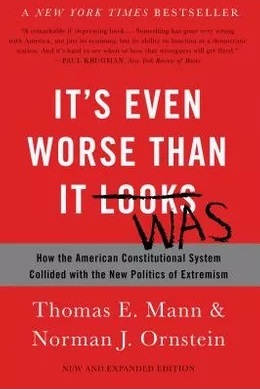
I just finished this quick read – It’s Even Worse Than It Looks, by Thomas E. Mann and Norman J. Ornstein. Here’s my review on goodreads:

The Boomer generation is one whose scholars and thinkers (and they are a thinking generation rather than a doing generation) tend towards pessimistic outlooks and dire prognostications. They are also the most politically destructive generation in living memory. The destructiveness the Boomers have wrought in American government is the subject of “It’s Even Worse Than It Looks”, a collaboration by two of their own cohorts. While the book isn’t explicitly generational history, the story it tells, of government becoming increasingly partisan and conflict-oriented rather than coalitional and achievement-oriented, clearly coincides with the Boomers’ rise to political power.

The authors trace the beginnings of this trend all the way back to 1978, when Newt Gingrich first took office in the House of Representatives. Before reading this book, I had not realized how far back the inception of the Gingrich Revolution was, or how long it took to come to fruition. It was predicated on a strategy of confrontation and disruption, and of questioning the legitimacy of existing institutions: the Boomer modus operandi since the days of the student movements of the 1960s. By the time of the Obama administration, when this book was first published, the strategy enabled a Republican minority to hold the United States government hostage.

The fundamental problem which Mann and Ornstein diagnose is that parliamentary style political parties do not mesh well with a system of separate branches with checks and balances. A minority party can easily exploit one branch’s power to limit another’s and prevent any governing from happening at all. This suits the ideology of the Republican party, which holds that government is actually undesirable altogether, and their asymmetric use of this strategem against the Democratic party has defined politics in the United States in our time. Generation X politicians in the GOP, like the “Young Guns” of the 2008 election cycle, have been happy to take up the banner of obstructionism in the name of anti-government principles. This alliance between Boomer and Gen X conservatives has wielded considerable power, and clearly marks a generational shift in U.S. politics.

Again, the authors don’t explicitly make a generational point. What they do is break down the problem in terms of specific factors and offer some possible remedies. Foremost is improving voter participation and shifting away from winner-take-all electoral processes, which prevent moderate politicians from winning elections. Campaign finance reform is another possible remedy at the electoral level. At the institutional level, reducing the use of the filibuster to obstruct legislation and executive nominations is key. Finally, improving the culture overall is required, to restore public trust and recreate a sense of public space.

The authors released an edition in 2016 with the title updated to “It’s Even Worse Than It Was”; this is the edition I read. In the afterword, Mann and Ornstein acknowledge that nothing improved since 2011, that all the trends of hyperpartisanship and extremism and lack of compromise have worsened. And this was before Trump won the election; I can only guess that a third edition published now would be titled “It’s Even Worse Than You Possibly Could Have Imagined”. The disastrous inability of the government to address the Covid-19 pandemic clearly demonstrates the damage that the insurgent Republican party has done to our political system.

Overall this book is a quick and easy read, and an eye-opening work of political analysis. It explains the changes that have occurred in government since Boomers and Gen Xers have come to dominate in office, and how the confrontational style of parliamentary politics has rendered our constitutional system dysfunctional. It understands that restoring the functioning “normality” of the past, with parties that are adversarial but able to work together, will be difficult. Informed by generational theory, we must recognize that it will take future generations of politicians to get us there.

I’ll just add that, despite the pessimistic title I gave to this blog post, I feel like we might soon be over with this period of hyperpartisanship. I think the worst of the extremists are being discredited, and are being marginalized in the public sphere. Trump’s hopes of a coup of some sort are fading, and Trump supporters are heading for the shadows.

Obviously a lot is riding on the transition to the Biden administration and its first few months. Like all of us, I will watching intently to see if it finally starts getting better.

Trump’s Legacy for Good

Trump’s Legacy for Good

While I personally detest President Trump, I’ll give him some credit for what he achieved in his bid for power. It can’t be denied that he has shaken up American politics. Thanks to him, the electorate has become more engaged than at any time in my memory. President-elect Biden is the first candidate to have received over 80 million popular votes. But Trump himself actually holds the next record, beating out Obama’s previous one from 2008. He could actually be proud of this, instead of dwelling on the fact that he lost the 2020 election, especially since he sees Obama as his nemesis.

Trump also forced the Republican Party to confront the fact that its platform does not conform to the needs of the American people. He hijacked the party, and you could say he made it into his own cult, but he also energized a right-wing populism that is likely here to stay. If Trump had been a more competent leader, he might have entrenched that version of populism in power. Instead, he simply gave a pass to the Democrats to attempt a return to the Obama era.

The left-wing version of populism, spearheaded by Bernie Sanders, was not so successful. But now that Covid-19 has taken over daily life, Biden can’t simply turn back the clock to 2016. So by energizing and engaging the populace, and by bungling the pandemic, Trump has had a big impact, which could shake us out of our neoliberal dream and actually take us to a brighter future for all Americans.

The Old New Media

The Old New Media

Ages ago (2014), on my rickety old Web 1.0 site which I still maintain, I published a list of prominent web sites by generation. The idea was to show how different generational archetypes produce different kind of content. The gist of it: Boomers make stuff that is ideological and righteously free-thinking, GenXers like sarcasm and muck-raking, and Millennials create consensus-building groupthink sites. The premier examples are probably HuffPost, The Onion and reddit, respectively.

Since it’s been a few years now, I thought I’d revisit the older sites, just the ones from the “Boomer” category. See if they’re still up and running. Consider that when they were created, ten or twenty years ago, these sites were cutting edge “new media.” Their Boomer founders were pioneers in a new form of communication. Now that social media has taken off, old fashioned web sites are losing influence (everyone’s going to “Parler” I hear).

As it turns out, all of the sites I originally listed are still up. I put them below, grouped into “red zone” and “blue zone.” The selection is somewhat arbitrary and I don’t feel like hunting more web sites down. It’s my little non-scientific study, but the sample size is enough to show how the red and blue zones really are in different reality bubbles. Two entirely different narratives of what is going in the U.S., particularly in regards to the election.

The Boomers, the Prophet generation in Strauss & Howe terms, is the generational archetype that rules over vision and values. So it makes sense that their cultural artifacts reflect these two dominant visions. But what about the web culture of the younger generations? Is it also split between these two visions? You can follow the other links to judge for yourself. One thing I’ll say is that so long as the Boomers, the values leaders, persist in their competing visions, we will probably remain as two separate generational constellations.

RED ZONE

BLUE ZONE

Boomers Invented the Internet, but…

Boomers Invented the Internet, but…

As we all know, it was a Baby Boomer who invented the Internet. Al Gore, to be precise. Ha ha, I jest. But in all seriousness, it actually was a Boomer who invented the World Wide Web. Well, an Englishman the same age as the American Boomer generation. That was when the Internet skyrocketed into public awareness and use (it had been around for decades already in academia and government) and the Boomer generation was still relatively young, and was involved in the grunt work of technology research and development.

Now it’s younger generations who are on the leading edge of technology development and the Boomer pioneers are for the most part resting on their laurels. Steve Jobs has been deified and Bill Gates is busy spending his billions on humanitarian projects. Meanwhile, the Millennial generation has taken over Internet culture and formed a hivemind that is whimsical and heartwarming (doggy memes, anyone?), and also unforgiving in its enforcement of social norms (fear the hashtag). Generation X has been ghosted, and Boomers? – well, their cultural reputation on the Internet has not survived in very good shape.

For proof of this last assertion, all you have to do is get on Facebook and join “a group where we all pretend to be boomers.” It’s easy to do, trust me – I applied and got accepted right away. Here you will encounter the Millennial stereotype of what a Baby Boomer is – basically an old white Christian who supports President Trump, is hopelessly out of touch with modern values and, on top of that, embarrassingly clueless about how the Internet works. Boomers are always posting “MAGA” and “God bless America,” misinterpreting what they see younger people doing online, and going to church and to potlucks.

As for posting memes, well Boomers probably shouldn’t even try. Their memes are dated in style, atrocious in design, and express antiquated values. They should just stick to GIFs of the minions from Despicable Me, inexplicably a Boomer obsession. The idea of a Boomer meme is something you will also find on the subreddit TheRightCantMeme, where a lame meme by the political right is implicitly associated with the Boomer generation.

This stereotyping, of course, is unfair to the legions of Boomers who are on the political left. Not to mention those who are very savvy to the ways of the Internet. Perhaps these Boomers are not on Facebook so much; my guess is they are on Twitter instead. But this association, by a younger generation, between the Baby Boomers and the reactionary politics of Trump supporters (who are not all Baby Boomers, is my point) clearly marks the Boomer outlook as a fading thing of the past. The Internet – and thank you for it, Mr. Gore – belongs to a new generation.

Where the Baby Boomers Led Us

Where the Baby Boomers Led Us

When we went to the Women’s March in Washington D.C., just after the inauguration of President Donald J. Trump, we took the metro into the city. The station and the train were crammed with protesters and their signs. I remember one woman on the train, older than us, who was holding a sign that read “THIS ABOMINATION WILL NOT STAND.” I believe she was from the Baby Boomer generation, the generation that came before mine and that shook American culture apart in the Sixties, in a wave of youth protest. And here she was, elderly and still protesting, fifty years later, which is as long as I have been alive.

The abomination to which her sign referred was the election to the highest office in the nation of a man who stands for everything which she had fought against her whole life. A man who epitomizes entitled, obnoxious, and abusive white male power. A self-confessed serial sexual predator who thinks women should be grabbable at a rich man’s whim. A racist whose instinct is to treat non-whites like criminals – or worse. A lying corporate crony motivated by profits over people.

And yet here he was, propelled into the Presidency by the support of millions of ordinary Americans who were duped by his demagoguery and worshipped him as their savior. It was the raging apotheosis of the backlash against the Sixties that was behind the rise of the Republican party, a backlash by people resentful of an America that was more open, diverse and tolerant. More non-white and non-Christian. The backlash had just put into power a man the same age as this protesting woman, but an ignorant and crass bully – the worst of her generation, empowered by madness.

When we arrived in the city the station was so crowded that it took an hour to get to the street. A huge mass of sign-carrying people slowly made its way through the turnstiles to exit the metro, and finally we were in the open air. We found our way to the mall and suddenly were swept up into a throng of protesters, streaming from where the speeches had been made (speeches we had missed, since it took so long for us to reach the city) towards the White House. The chanting, roaring energy was indomitable. It was the backlash against the backlash.


But would it last? As of this writing, more than nineteen months have passed. Trump has proven to be as awful a President as anyone predicted – corrupt, cruel, a threat to the republic. His supporters are entrenched in their belief in his legitimacy; they voted for him, and his faults seem invisible to them. Meanwhile, the President’s opponents have adopted the language of resistance, like freedom fighters in an occupied nation.

Trump has captured the reactionary right because he is the champion of their agenda: to keep out the Hispanics and the Asians and the Muslims, to stop free trade with China, to restore America to its pre-Sixties greatness. In their minds, this agenda is a much-needed course correction after decades of American decline. And undeniably it is motivated by fear, a fear summarized by one simple headline: Fewer Births Than Deaths Among Whites in Majority of U.S. States.

It is sad that fear has overtaken a large minority, and that they have rallied around an unworthy man. But he was the one who spoke their language. As I write, his fortune is crumbling, and his supporters will no doubt stand by him to the bitter end.  But in the long run majoritarian opinion and demographic pressures favor the resisters. The blue wave may have hit a red wall, but it can become a blue tsunami and take that wall down. We just have to stay resolved.

On the day after Donald J. Trump’s inauguration, we marched down the mall in the nation’s capital, until the streaming throng took us to the White House. There the crowd thinned out, as some people left, while others lingered. Some tables were set up and people held signs urging or promising the impeachment of a President who had been in office for all of one day. It was like a court being held, condemning him on his own front lawn. This was the site of the Boomer generation’s last stand, and they were as riotous, and as judgmental, and as destructive as ever. And this was where they had finally led us.