Browsed by
Author: Steve

I live and work in the Philadelphia area. I am an ETL software tester by profession but I also enjoy writing, tabletop gaming, reading and thinking about history, binge-watching Netflix, and traveling with my BFF. We especially like going to the Big Apple to catch a show.
A rough life for migrant workers in any era

A rough life for migrant workers in any era

I watched The Grapes of Wrath (1940) last night, and thought it was interesting the way the federal government, in the form of the Department of Agriculture, is portrayed as benevolent heroes. In their government-run camp, they uphold the rights of the migrant workers from Oklahoma against the depredations of the local California law enforcement. This contrasts with what we have today, 80 years later, where the local governments of California protect migrant workers (sanctuary cities) from the depredations of the federal government (Trump-empowered ICE).

Or, alternately, today’s feds are protecting the rights of natives against the crime of migrants who have immigrated illegally. The federal government has the responsibility of protecting the rights of citizens of the United States when state governments fail to do so, and with cruel logic natives could claim to have a right to have no illegal immigrants among them. That is what Trumpistas claim, and so we have a swing from the left to the right across these 80 years, with an added racist tone. In The Grapes of Wrath, the opposing sides are both white, though you could consider them to be different ethnicities using the “11-nation” model: the Okies are Greater Appalachians and the Californians are Left Coasters.

So maybe we are seeing an evolution from fractured groups of whites (the immigrant upheavals of the early 1900s) to unified whites against the browns. The Trump white nationalist model.

Just some thoughts for this fine morning at the end of 2017.

Zero Tolerance Reaches The Workplace

Zero Tolerance Reaches The Workplace

In Turnings theory, one characteristic of the era we are currently experiencing is that the young adult generation benefits from a renewed focus on improving the workplace. This continues the pattern from their childhood of being protected and nurtured more intensively than the generation that came before them. The Millennial generation in childhood was the benefactor of “Zero Tolerance” policies to keep drugs and violence out of schools. The recent uproar over sexual harassment in the workplace can be thought of as this same spirit of zero tolerance following the Millennials, as they age, into a new sphere of life.

We could think of each generation’s experience with sexual harassment when they were young adults entering the workforce as tracking the changes in the social era. For the Silent generation, sexual harassment was out in the open and normalized (think Mad Men). For Boomers, there was a push back in a new age of feminism and women’s rights. When Generation X was young, sexual harassment went underground, but was tolerated for the sake of career advancement.

Now, in the Millennial young adult era, the harassment of the past twenty or thirty years is being exposed, to the ruination of the careers of many powerful older men. There will be no more tolerance of it during the rise of the new young generation, in which our society has invested so much.

Today’s Workout Album – Born This Way

Today’s Workout Album – Born This Way

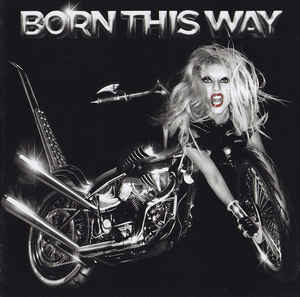
Thanksgiving week has come and gone and now it’s time to work off some of those calories. I’ve been listening to a lot of electronica in my workouts lately, but for today it was Born This Way by Lady Gaga, which I suppose is only straying from electronic music and not abandoning the genre altogether. Discogs calls the album synth-pop, but if sounds like rock and roll to me, especially my favorite track, You and I, which could have stepped out of a smoke-filled bar in 1979.

Lady Gaga is famous for her extravagant and absurd performance art, which you can get a taste of in the music video linked above, a postmodern train wreck of bizarre costumes and choreography that only barely connects to the meaning of the song. But if you close your eyes and just listen, you will hear a tightly composed, absolutely blistering rock anthem. I just think she is a very talented songwriter and singer.

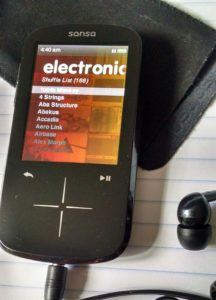
Finally, here is some evidence that I am actually working out when I listen to these albums, and not making “fake posts” 🙂 Took the picture in the car so as not to violate fitness center etiquette.

Today’s Workout Album – Puppy

Today’s Workout Album – Puppy

For today’s workout, more electronic music, from a relatively obscure 90s band, Fluke. This older stuff is a staple for a Gen-Xer like me. Their 2003 album Puppy has a lot of driving, churning beats to keep me spinning that cycle. And it’s nice and long, too; I almost listened to it in its entirety during my routine.

If you listen to the album, you might recognize one track. That’s because you heard it before here:

Thoughts on Living and Working in America

Thoughts on Living and Working in America

The latest audio book I have for driving in the car is the provocatively titled White Trash by Nancy Isenberg. It is very well written with knowledgeable and intelligent historical analysis. Basically it is about class structure in America and how the United States was never intended to be an egalitarian society. The founders were creating their own class-based society applying principles of Enlightenment philosophy, but certainly not abandoning the idea that some men were inherently better than others.

So over the centuries, different understandings of the nature of the underclass were prevalent. And different derogatory terms were used to denote them, from the phrase that title’s the book (originating in the nineteenth century) to today’s “deplorables” who elected the current President. Interestingly, an earlier President, Andrew Jackson, was also seen as a champion of the underprivileged who were despised by elite political society. His time’s equivalent of “deplorable” was “cracker.”

Another interesting fact of history is that in colonial times America was, for England, a dumping ground for undesirables. “Transportation” was an official policy to purge the homeland of criminals and debtors by sending them across the Atlantic. As the American colonies grew, each one took on its own unique character. The one where I currently reside, North Carolina, was considered an utter backwater, sandwiched between the more prosperous plantation colonies of Virginia and South Carolina. It was thought of as a “Lubberland” filled with worthless and indigent people.

At some point during the discussion of this time period, the book quotes a source declaring that, in contrast, the poor of Pennsylvania were hard working. As someone whose life currently straddles North Carolina and Pennsylvania (specifically the Philadelphia area, which was really all Pennsylvania was in the colonial era), it certainly feels like life up North is busier, more industrious than the South, though not necessarily to its benefit. I have lived in the South my entire adult life and enjoyed its laid back feel, not to mention affordable cost of living. And sometimes I have felt a bit like a “lubber.” Hey, what’s wrong with Plenty and a Warm Sun?

I recall once, way back in the 1990s, I flew to California for a job interview. Yes, I came this close (holds thumb and forefinger together) to moving to the Silicon Valley area. The hiring manager who interviewed me was middle-aged, with long, graying hair (think old hippie) and told me that he had moved from out East after his children were grown. He thought of the East Coast as having a quieter pace of living than the West Coast – it was ideal for raising a family, whereas out West was where you went to make money.

Just some thoughts on the long reach of the past and the different reputations that parts of the United States have. The South has not had a great reputation, but I have certainly enjoyed living here, and have found the Southern people to be decent and respectful as much as anywhere else. Honestly, everywhere you go people are the same, and there is always a vast underprivileged class.

Looking forward to finishing this book during my next long drive.

Today’s Workout Album – Robot O Chan

Today’s Workout Album – Robot O Chan

An old-timey “mp3 player” from the pre-smartphone era.

My usual choice of music for a cardio workout is some EDM, or Electronic Dance Music – what we old-schoolers call Electronica. It’s kind of monotonous and repetitive, to match the very nature of cardio, but with gradual changes to keep you interested. The tempo changes from fast to slow and back so you can have bursts of intense activity followed by cooling down periods. I have my entire collection on a small device, which I can bring to the fitness center and keep tucked in a pocket while I work out.

Today’s choice for an album was Robot O Chan by Prometheus, which, if you follow the link, you will see is an alias for a solo artist. So, a general rule is that an EDM recording act is just a guy from England, or maybe two guys from England, or sometimes a guy from Finland. The music is all synthesized, so you don’t need a band or anything, though some EDM artists will record guest musicians playing a normal instrument and mix it in.

This is my favorite track from the album, one of my favorite EDM tracks of all time:


Reddit Thread of the Week: American Healthcare Horror Stories

Reddit Thread of the Week: American Healthcare Horror Stories

Las Vegas shooting victims struggle to afford mounting medical costs
byu/speaktodragons innews

Lots of kvetching about the mess of a healthcare system in the United States, with some comments from other countries for comparison. The number one takeaway on surviving healthcare in the U.S. – don’t ride in an ambulance if you can help it.

This is all comes down to the basic American principle of self-determination – otherwise known as, “if you can’t take care of yourself, then fuck you!” Also the ethos of Yankee ingenuity, or how to make a buck off of your fellow citizen. On this thread, you can just see the nation’s stature slipping away.

Today’s Workout Album: Audio Elastique

Today’s Workout Album: Audio Elastique

So you go to the fitness center to work out but you don’t want to listen to the music they play there. What to do? Well, easy, in this day and age. You bring your smartphone, some ear buds, and pull up your streaming music app.

This morning’s album was Audio Elastique by De-Phazz. At 53 minutes it’s the perfect length for one of my workouts, which generally is 15 minutes of strength training, half an hour of cardio, and some cooling down time. It has enough tempo changes to accompany the cardio well, and it has the most important quality for a workout album: I like the tracks enough to keep wanting to hear the next one, which gets me over the hump when I start the cardio and it quickly wears me down.

I’m no hotshot, just a middle-aged guy trying to keep his body from falling apart. But like Baby, I need my musical inspiration to stay on task.

Blade Runner 20-whenever

Blade Runner 20-whenever

Science fiction often portrays a vision of a not-too-distant future, but a vision colored by the familiar elements and trends in thought of its own time. My favorite observation about the future as shown on the sci-fi screen is that hairstyles are going to be the same as whatever they were at the time the movie or TV show was made.  When watching an older movie about the near future it’s always fun to see where they got it wrong when that future finally rolls around.

Blade Runner, released in 1982, is set in Los Angeles in 2019. Not the real 2019, of course, but an alternate one where the technology looks like it did in the 1970s and the atmosphere is like a 1940s noir film. It’s a wonderful movie, dark and moody, well written and well acted, and featuring a gorgeous Vangelis soundtrack.

I understand that the point of it is the story and the imaginative vision and that it’s silly to compare it to our time period. Nonetheless, I will. Here are some out of date elements in the scenery, compared to the real 2019:

  • Big honking CRT monitors
  • Neon signs
  • Everyone is smoking in public

Of course, how could the people of 1982 predict that by 2019 smoking would be banished from public spaces (at least where I live; maybe it’s different in L.A.)? And that there would be LEDs, and flat screens, and the one thing that absolutely no pre-2007 sci-fi ever anticipates – smartphones?

To be fair, Blade Runner does get a couple of future technologies right:

  • Voice recognition software
  • Video calls

And then there are the predicted technologies that it might have been natural to assume would be coming in our future, but that our pathetic civilization has yet to achieve:

  • Flying cars
  • Off-world colonies
  • And – oh yeah – Replicants!

It always strikes me how optimistic mid-twentieth century conceptions of the future of space travel are. Back then, it hadn’t been that long since the first orbital launches, and the U.S. space program was still prestigious. But what, no moon colony by 1999? No manned mission to Jupiter in 2001? Well, at least it’s not too late to get that warp drive invented, even if we do have to wait for some time traveler assistance.

As for the artificially created humans, well, they are the crux of the story of Blade Runner, and a sci-fi obsession going back to Mary Shelley’s Frankenstein. But their presence in the story is not a realistic extrapolation of technological progress.  The closest thing we have to replicants today is artificial hamburgers. Our real world robots are dumb machines, and our real world ‘AI’ is the power of  the Internet to collect and process vast amounts of data.
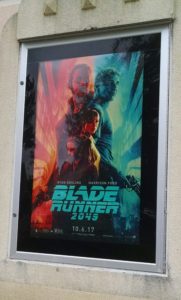
So I went to see Blade Runner 2049, and first I will report that it is just as good as the original. It has the same feeling of ominous wonder created through beautiful visual effects and an atmospheric soundtrack. It manages to take advantage of the 30+ years of advancement in film special effects (in the real world timeline, I mean) without detracting from suspenseful and meaningful storytelling. If you like science fiction movies in general and Blade Runner specifically then you will love this film.

I don’t want to give too much away, but I will say that it is set in the same timeline as Blade Runner 2019, so there absolutely is no point in waiting until real 2049 to verify its predictions. In the movie’s version of 2049, there are still replicants, and off-world colonies, which is where you’d rather live, because Earth is still a mess, although the color palette of its dreary desolation has been updated a bit.

The 1970s look and feel of much of the technology is still there, which is neat, but here are some additions that reflect modern awareness:

  • Drones
  • Self-piloting flying cars
  • Touchscreens!
  • What if instead of growing a replicant, you programmed a virtual person into a computer, you could call it something else…

I will finish with some thoughts on the subject of artificial intelligence, which is huge in sci-fi film these days, in tandem with news feeds about the growth of the AI industry (which in the real world is building advanced information processing algorithms, not sentient beings).

In the original Frankenstein story, the monster confronts his maker, seeking acceptance, and the scientist creator laments that he has unleashed a destructive force. Both themes are prevalent in subsequent science fiction retellings, reflecting humanity’s yearning to understand its purpose in the universe, and fear that its technological progress has unmoored it from its origins. With Blade Runner (either one) you get all this, along with modern forebodings about overpopulation, ecological catastrophe, wealth inequality, and unbridled corporate power, artfully crafted to satisfy your need for continued myth-making.

Quick Movie Review: From X to Millennial

Quick Movie Review: From X to Millennial

I had an impromptu movie night some days ago and watched two movies which exemplify perfectly the transition from Generation X to Millennial in attitudes about risk and individuality.

The first one was 2008’s Wanted, starring Gen-Xer James McAvoy as a bored office drone who gets recruited into a super secret league of assassins.  As in earlier Gen-X movies that start the story the same way (Fight Club, The Matrix), the protagonist ultimately finds his destiny by breaking out of conventional society and embracing a singular role. It also has a lot of graphic, bloody violence.

Wanted is a cusper movie, and by the end of it the main character has crafted a career for himself which is not unlike being in a real world first person shooter. McAvoy is a late wave Xer, but I imagined he was living the dream of the video game addicted Millennial beta male – perhaps the target audience.

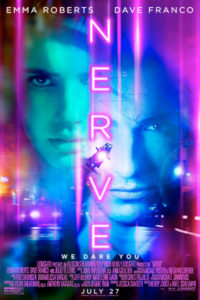
I followed that by watching 2016’s Nerve, in which Millennial Emma Roberts is a shy high school student who decides to court notoriety by joining an underground Internet game of truth or dare – really just the dare part with obligatory smartphone recorded proof. It’s an action movie like the previous one but not murderously violent, rated PG-13 instead of R.

In Nerve the lure of a high-risk, action-packed life isn’t a call to destiny but a trap, and the characters must ultimately test rivalry against loyalty in their quest to find a way out. I also thought it was the better of the two films, with more likable characters and a more sure-footed plot. It belongs in the ranks of films based on juvenile literature in which Millennials band together against a hostile externally imposed system (The Hunger Games, Divergent, The Maze Runner), but with the notable twist that the system isn’t some sci-fi dystopia but rather a plausible creature of our own social media-driven times.

In summary, they’re both flashy action flicks, but in attitude and message represent the difference between the brassy, individualistic Gen-Xer and the group-oriented, approval-seeking Millennial.