Browsed by
Author: Steve

I live and work in the Philadelphia area. I am an ETL software tester by profession but I also enjoy writing, tabletop gaming, reading and thinking about history, binge-watching Netflix, and traveling with my BFF. We especially like going to the Big Apple to catch a show.
Subreddit of the Week: antiwork

Subreddit of the Week: antiwork

You may have seen a chart like the one on the right, which I took from Wikipedia’s page on workforce productivity. It shows labor productivity growth compared to wage growth since the end of the Second World War. What’s remarkable about it is how the two statistics track one another for a period of two decades or so, but then suddenly veer off, dramatically so for non-managerial workers. Workforce productivity starts growing much faster than nonsupervisory workforce compensation, as the latter curve flattens out.

What this means is that for a good couple of decades (the length of a generation), after 1948, as output per hour of work improved, so did the compensation for that work. The improvement in the value of labor was transferred to the workers themselves. But suddenly, in the early 1970s, gains in output were no longer matched by gains in wages. The improvement in the value of labor benefitted only those managing or employing the labor. This trend continues to this day, and is at the root of what is wrong with the economy, with its massive income and wealth inequality, and lack of economic opportunity for the working class.

There are actually a slew of economic indicators that shifted dramatically in the early 1970s, along with political and social indicators. They are all captured on a site here. This shift can be seen as the start of a new economic regime.

So what caused this shift to a new regime? Arguably, a shift in social priorities and the rise of a new generation into the workforce. In the early 1970s, that generation would have been the Baby Boomers. They brought a new inner-world, moralistic focus into American life. For Boomers, work was a personal mission, a matter of defining the self, not a matter of bargaining for rights and responsibilities as part of a collective.

Consequently, union membership declined as this generation entered the workforce, yet another indicator shift to join the ones on the site I linked above. Boomers were pursuing their own individual agendas through their work, not participating in building any kind of functioning system, as their union-joining forefathers had done. Boomers gave us the concept of the workaholic, someone for whom the work itself was the reward. Success in work became a status symbol for the inner-driven, wealth-obsessed yuppies of the 1980s – a sign of individual merit and self-worth.

By the time Generation X started working, labor rights had become completely passé. Gen Xers entered the workforce with an attitude of self-determination, as free agents, always looking out for the best deal for themselves. They gave us the concept of the perma-temp, the employee with no benefits or safety net, who drifts from employer to employer. As a Gen Xer might have put it, “it’s just a job.”

Gen Xers were the young adults of the boom times in the 1990s, when economic growth was high and productivity growth was on the rise. But in the new opportunistic economic regime, economic growth no longer acted as a rising tide to lift all boats. Instead, it was like a wave that some successfully rode, and others did not. Workers separated into economic winners and losers, with far more of the latter. Today, Gen Xers are middle aged, and one has become the richest person in the world. Many others have utterly washed out.

Now Millennials are the young adults in the workforce, doing much of the nonsupervisory production work which has experienced so little gain in compensation compared to the actual value it provides to employers. The “slackers” of Generation X, raised with low expectations, may have been willing to tolerate these circumstances. They may even, like Kevin in 1984’s Repo Man, have seen opportunity in them (see the video clip below). But not so Millennials.

Raised with high expectations, in a structured environment that rewarded following the rules, Millennials have not taken well to the free-for-all job market they have inherited from Boomers and Xers. Many Millennials have gone into massive debt for a college degree, only to discover that the jobs which a college degree opens up don’t pay well enough to justify the cost. Milestones of financial and personal success, such as buying a first home or starting a family, are elusively out of reach for Millennials, given the economic disparities that have grown over the course of the meritocratic, “neoliberal” regime established by Boomers and Xers.
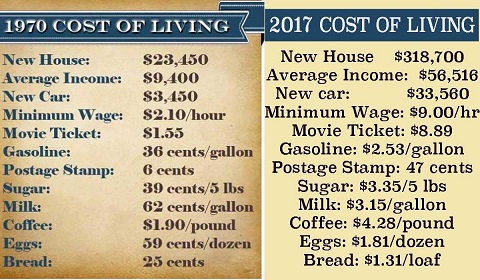
Millennial disappointment with this state of affairs is visible in the many memes that fill social media feeds, comparing the economic circumstances of their generation with those of past generations and highlighting their disadvantages. Talk of “late stage capitalism” and enthusiasm for progressive politicians such as Bernie Sanders and Alexandria Ocasio-Cortez point to disillusionment with the current economic system. Could Millennials even be willing to embrace – gasp! – socialism? Red zone pundits would certainly like you to think so.
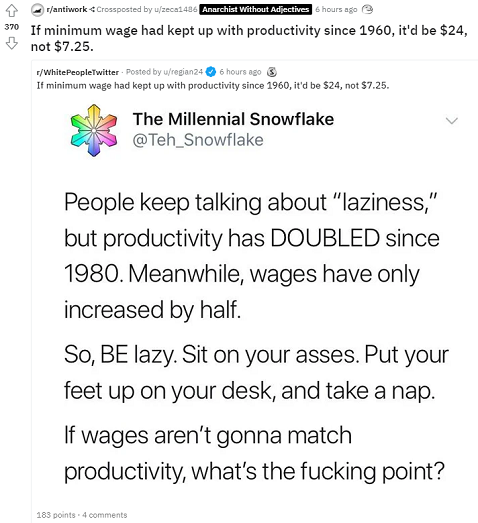
This brings me to my subreddit of the week, /r/antiwork. This subreddit has taken off in 2021, in concert with all the news stories about the “Great Resignation” and the labor shortage.

On /r/antiwork, the workers of reddit unite to commiserate over the awful conditions and abuses suffered by workers today. They post about the absurdities of our system, like costly health insurance that provides almost no benefit, and low salaries for jobs with high education requirement. They proudly tell stories about how they quit their last position, and encourage and praise union efforts.

Do reddittors really think we can reach a state where no one needs to work? Or is this subreddit simply a forum for venting about the miseries of living on the flattened curve of low compensation employment, where so many are stuck today?

I think that what this subreddit is really bringing to light is the pent-up demand for significant structural economic reform. A new generation with new priorities is in the workforce, and a new regime is required to meet their needs for an economy that provides fair rewards for work, and fosters financial security and not merely the opportunity for personal achievement.

Unfortunately, the only policy the U.S. government can come up with is to borrow and spend to keep the economy hot. While that might relieve the pain for some in the short term, it’s doubtful it will change all those economic indicators for the better in the long term, or quiet the dissenting voices of /r/antiwork. For that, major economic reforms would be needed, to transfer the value of labor back to the workers themselves. Maybe then they won’t mind coming to work so much.
Young Gen Xers bullshitting about work in the mid-1980s.
The Demand for Order in the Age of the Social

The Demand for Order in the Age of the Social

I see a lot of complaining about how evil Facebook is and how much they’ve abused their power. But how can this social media company have any power at all? It’s really simple and obvious how to destroy Facebook – all its users simply have to stop using it. Then it will vanish and never plague us again. What does this platform provide that is in any way essential, such that its users are compelled to use it? Where is its power coming from?

A couple years back I wrote a post about when I first joined Facebook, mentioning how it had connected me to people from my past, and how it continues to connect me to people in my present. This need to connect, to have a place of gathering and belonging, is what drives the demand for platforms like Facebook. In this crisis social era, that demand is high. It’s why we all can’t just quit social media.

Remember at the end of 2020 when, after the election went to Joe Biden, Red Staters were announcing on Facebook how they were leaving for a new platform? They weren’t quitting Facebook to go off and be by themselves. They wanted to have their own social media platform for people like them, who shared their view points.

The mission statement of the Facebook company (now called “Meta”) is, in fact, to build community and togetherness. And a primary complaint people have about the Facebook company is the ways it has failed at this mission, and instead caused divisiveness. Or, if not caused the divisiveness, at least irresponsibly permitted its platform to be used by others to promote discord and even violence.

A related complaint about Facebook is that the platform allows the spread of misinformation. Never mind that different factions in our society have different ideas of what constitutes correct information. I wonder: is it more that people want the platforms they use to reinforce, rather than contradict, what they want to believe?

This complaint does raise the question of why the platform should have any obligation to be responsible for the veracity of its content. What I mean is, if such a site is simply a social gathering place, why shouldn’t people be free to post nonsense and lies? Not to say that harm hasn’t been done by misinformation on social media, but why is it the social media platform’s obligation to control the information? If I tell a lie on a street corner, does the town the street is on get blamed for it?

Now there is the argument that misinformation spreads much more rapidly on social media then it ever could by word of mouth. But even here, without some specific platform available, another could surely be found. If we did destroy Facebook in the way I suggested (on the count of three, everyone delete their account…1..2..), couldn’t people still spread their lies via, say, email chains? That’s how we did it back in the ’90s, and I’m pretty sure email providers are off the hook for whatever content is sent through their servers.

My point is that it’s not really the technology behind these phenomena, it’s the people. People are spreading the misinformation, as they always will, and just happen to be using the means that are available today. Putting the onus on a social media company for policing its content is understandable, and a popular stance, but it speaks as much to what people want from these platforms as it does to how they are run as businesses.

We want a way to gather safely, and we expect the providers of such places to exercise some authority in keeping those places safe. That’s the demand curve of this social era. The problem is, social media companies are profit-making enterprises that derive revenue from user engagement, however it can be acquired (“Attention Merchants” is what Tim Wu calls them). So long as this tension exists, where private enterprises maintain our public spaces, we will have reason to mistrust Big Tech and the platforms they provide us, even though we couldn’t conceive of leaving them.

The New Religious Wars Thread

The New Religious Wars Thread

This is a Twitter thread I posted comparing todays Culture Wars to the Religious Wars of the Reformation Era. I’ve only dabbled with posting Twitter threads (chains of linked Tweets) because I honestly don’t get much engagement on that site.

This post is meant to capture the same text onto my blog since whatever I tweet technically belongs to the Lord of Twitter, whoever he is – one of the lesser known of the Great Technocrats. The numbers followed by the slashes at the end of each block are to keep track of the order in which the tweets are meant to be read, since by the nature of the platform, that information can be lost. Here are the 6 tweets:


Reading up on the Tudor Era in England has me thinking about the Culture Wars today and the irrational beliefs people are willing to stake everything on, just as in the Reformation Era 500 years ago people were willing to kill and die over minor points of theology. 1/

To me it seems absurd that people were once martyred over their beliefs about the doctrine of transubstantiation. Will future generations think it absurd that people today are dying over their beliefs about COVID-19? 2/

People are keen to know The Truth and once a belief is formed it is cherished and hard to release. 500 years ago this was a matter of faith; today we describe the same stubborn clinging to belief in psychological terms like “cognitive dissonance.” 3/

We call today’s conflict Culture Wars, not Religious Wars, but either way at the heart of it is differences in belief about what values should define how we live. Where political power is concerned, it’s not germane that those beliefs may not make complete sense. 4/

Just as in the Reformation Era, the set of beliefs to which one is committed ties one to a faction in a political conflict, and to recant those beliefs is a dishonorable betrayal of one’s group and one’s identity. 5/

And so we’re stuck in these Religious Wars between the Church of Woke and the Cult of Maga, with people as fanatically committed to their sects as the Protestants and Catholics of half a millennium ago. 6/

The Tudors Then and Now

The Tudors Then and Now

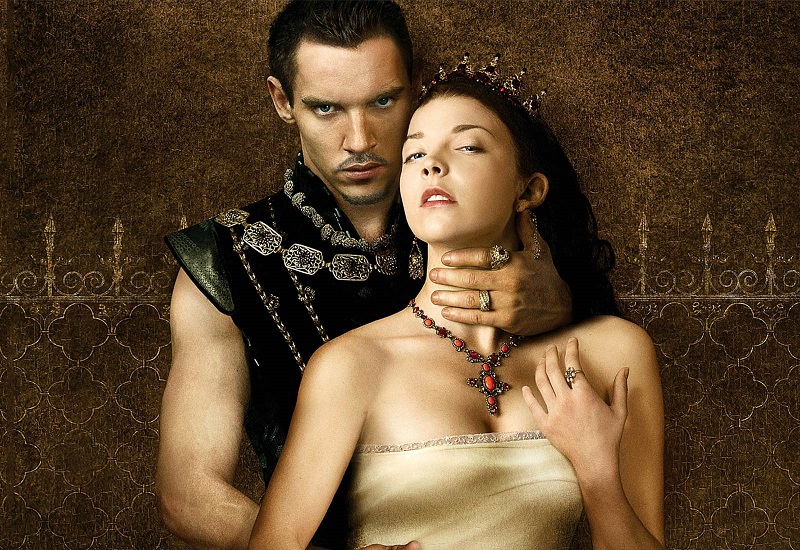
Inspired by our recent trip to see SIX on Broadway, we’ve been watching The Tudors, the old Showtime network series that ran in the late 2000s. Aileen already watched the show all the way through, but I only saw it previously up to Anne Boleyn’s beheading (oops – spoiler alert). Aileen has DVD box sets of all four seasons, so we didn’t even have to look for the show on streaming services.

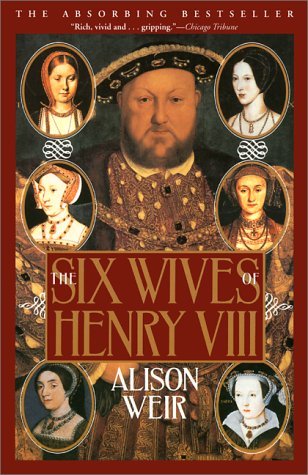
At the same time, I have been reading Alison Weir‘s book The Six Wives of Henry VIII, also courtesy of Aileen. It is a very well written history of the King and his marriages. So much of what I’m reading in the book happens in the show, that I wonder if it wasn’t used as a writing source. But of course, there is much that was spoken and done in that time period that is recorded and appears in multiple sources, and that has since become well-known. And there are events on the show that I haven’t read about in the book, so even if this particular book was used, so must other sources have been as well.

The show calls itself The Tudors, but it really is just about Henry VIII and his wives. To me that’s a pity, because I would love to see a TV series that actually covered the entire history of the dynasty. It could start with the Battle of Bosworth Field and Henry Tudor defeating King Richard III, then progress to Henry’s reign and his consolidation of power around the Tudor name. Then it could move on to the reigns of his son, Henry VIII, and subsequently the reigns of all three of Henry VIII’s children: Edward VI and the Protestant reforms, Mary I and her attempt to reverse them, and at last the long reign of Elizabeth I. That would cover the foundation of a dynasty, England’s elevation to a true Renaissance kingdom and the origins of her Imperial destiny, the long and bloody struggle to determine her religious identity, and then finally one of the most glorious periods of her history, featuring victory over the Spanish Empire.

I guess that’s too ambitious for a TV show, so instead Showtime gave us the real juicy part – all the sex and drama in the court of Henry VIII, and surrounding the King’s six marriages. And there’s plenty of sex on this show, too, so much that sometimes it seems like we’re watching soft porn. The characters are cast younger and hotter than they really should be, which must just be the Showtime brand: giving audiences what they crave.

Don’t get me wrong; I like the guy who plays King Henry. I think he does a fine job of capturing Henry’s volatile temperament, which could swing from indignant fury to sweet sentimentality. But it’s undeniable that the actor is too young and too skinny; it would be nice to encounter the fat, balding Henry of the history books. But not on this show; no one wants to see that naked, so we get this inaccurately painted portrait of the man, instead.

The book I’ve been using to fact check “The Tudors.”

Having Weir’s book handy means I can compare all sorts of details in the television show to what really happened (I’m putting faith in Weir’s research, here). When I want to point out either a similarity or a difference, I tell Aileen, “In your book, it actually says…” and she replies, “you know, I didn’t write the book…” – it’s become a running joke between us.

There are always differences because the show does a lot of, shall we say, streamlining in its narrative, and I know this is because it wants to avoid dragging things out, and having too confusing a cast of characters. There are constraints of time and budget. So timelines of events get compressed, and some people do things which historically were done by others.

For example, Henry’s two sisters get combined into one, whose biography becomes a weird mix of the two lives it is based on. At the start of the show, the Dukes of Norfolk and Suffolk are both prominent characters, but at some point Norfolk just disappears. Suddenly Suffolk is doing all this stuff Norfolk did. It hardly matters, since most of it is related to decisions Henry VIII has made.

Other details are just plain wrong. Did you know that Katherine of Aragon was a redhead? That Anne Boleyn wasn’t particularly pretty? That Jane Seymour was a lady-in-waiting in Katherine’s court as well as Anne’s, well before Henry ever noticed her? After watching The Tudors, you still wouldn’t know any of this.

But you would get to enjoy drama and intrigue that captures the spirit of the time, and the gist of what happened during Henry’s reign. You would also see a lot of sumptuous costumes and jewelry (honestly the highlight of the show), much of which matches descriptions I have read in the book. The scenery and interiors are lovely and authentic-seeming as well, though much of it was filmed in Ireland, and the panoramic shots of London are obviously CGI.

The production design and high caliber actors make the show, despite its many historical inaccuracies. As I already wrote, it gives the gist of the history. It’s the Tudor era through the haze of time, distilled down to the important events and the memorable moments and quotes. It’s the familiar story of a King and his six wives, done in steamy Showtime style, and by focusing on the wives, it underscores the point made by the Broadway show SIX: that we remember the man because of his women. After all, even the signature act of Henry’s reign – the break from Rome – was done for want of a wife.

As for all the sex? Well, in that era, sex and politics were inextricably entwined. How could they not be, when the fate of kingdoms and dynasties depended on marriage alliances and the production of heirs? The Queen’s bedchamber was, in a way, a branch of the government. It’s that confluence of passion and power that makes the stories of the King and his Queens such compelling stuff, and has made these historical figures the icons that they are today.

History for Everyone

History for Everyone

We went to see SIX on Broadway recently (whole other story) which is about the six wives of Henry VIII. The point of the show is that the history of the King is really the herstory of the Queens, and that they are the reason why he is famous. Also, in the production, the actors cast in the roles of the six Queens are not ethnically accurate to the original wives. This is in line with the same trend as seen in Hamilton. “Color blind casting” is what some people are calling it.

Now you could argue that if the goal is to create cognitive dissonance by casting ethnic mismatches (“an African-American George Washington??!”) then the casting is not actually “color blind.” If Hamilton were truly cast “color-blind,” then there would be a white George Washington in one production and a black one in another. But that’s not how it’s being done in this new wave of theatre. A more accurate term which is also currently in use is “nontraditional casting,” to reflect a conscious choice of casting outside of ethnic expectations to make a point, or impact the overall piece.

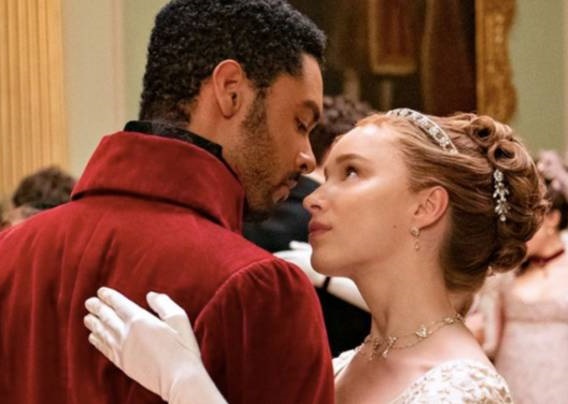
Bridgerton: we’re here for the hotties, not the history.

You may have seen this kind of casting in some recent streaming TV shows like Bridgerton on Netflix or The Great on Hulu. The former is set in regency England (Jane Austen’s time period) and the latter is another version of the often told story of the rise of Catherine the Great. Both are completely fictional, and quite enjoyable and well done shows. But there’s something incongruous, absurd even, about the casting, in the sense that race relations in that time period were so much different than they are today, and therefore it makes no sense for a black guy, however suave and debonair, to be a Duke in a Russian or English court in the late 1700s.

I’ll just put it bluntly: in that time period, black people were not in high positions of power in Europe, and except for rare instances noted in history, not engaged in courtly intrigue with them, as their peers. In portraying black and white people together as equals, something which makes sense in a story set in modern times, you might say that these shows are erasing history – trying to cover up or forget the shame of the racial injustices of the past. These shows are creating a fictional version of history that ignores a glaring aspect of it.

Alternately, you might say that, since these shows are simply recreating history, then by incorporating modern values about race into the narrative they are promoting inclusivity and empowering previously marginalized people. Some of these old history stories are rousing stuff, and why shouldn’t black people get to play these amazing roles? Is it so different from a woman playing Hamlet, as happened long ago? George Washington is a towering figure of American myth – why should white people get to own him forever?

I fret about the erasure of history as I write this, but then I have to wonder: is it so bad if future generations forget about the racial discrimination of the past, so long as it never returns? Maybe it’s possible to take the old adage about forgetting history too literally.

Let’s say some young person in the future is watching Bridgerton and is completely unaware of the impossibility of black and white people all dancing together at an upper class ball in regency England, unaware that back then the races did not mix like that, or be treated as equals. It’s not like we don’t routinely botch history in our many recreations of other eras. If someone then made them aware that black people were treated poorly, as a lower class of human, in that time period, their reaction might be an incredulous, “Really??! How could people have tolerated that? That is insane!” Maybe we could achieve a future where racial discrimination seems absurd and an obscure fact that needs to be dug up in old history books.

The problem, though, is that racial discrimination is still a thing of the present. So a show which pretends that discrimination didn’t exist in the past might lure us into forgetting that it exists today. It might help us ignore a glaring aspect not of history but of our own time. It might just be a distraction on TV, posing as proof that we have finally ended racial discrimination.

We need our distractions, so maybe the best thing is to think of these shows as escapist entertainment, fun and playful. Meanwhile, we continue to seriously look at racial issues in our society. We have nontraditional casting on the one hand, and critical race theory on the other, both tools in our struggle to repair race relations. Wouldn’t it be something, if some day, a mixed race cast in a period piece was not a politically charged choice, but merely a curious anachronism.

Theater Breaks through to the Light

Theater Breaks through to the Light

Last weekend I went with the whole family to see a moving one-man show called “A Shadow that Broke the Light,” performed by Charlie DelMarcelle, and co-created by him and his brother Adam. It’s about their brother Joey, who died of an overdose, but really it’s about the overdose epidemic in our country that is impacting so many lives and families. We saw it at West Chester University, where the creators are workshopping it now, as it is undergoing some changes (more on that below).

The show was first produced by Simpatico Theatre at the end of 2019, as a performance installation that ran continuously for 24 hours at Troy Foundry Theatre in upstate New York. I didn’t get a chance to see it then, though my partner Aileen did, driving the 4+ hours to get there. She was excited to go because she has known Charlie for a long time, and worked with him before. He is a brilliant actor, as I got to see last weekend.

After Covid times came, the piece wasn’t performed again until just recently. And, because of Covid times, it had to change, so Charlie is actually workshopping it right now, at the University where he works. I don’t want to say too much about why it has had to change, but just consider how overdose deaths have increased since the pandemic began.

Charlie’s performance was strong. He engagingly told stories about his brother, but also about other people whom Adam has interviewed about their own experiences with loved ones dying from overdoses. Charlie really shows his acting chops when portraying other characters. There was a good deal of humor to leaven the serious, grief-stricken and sometimes angry tone of other parts of the narrative. When reminiscing about loved ones, even though they might have come to tragic ends, it’s heartening to remember the funny moments.

The short piece felt like it ended too soon, but there then followed a period where the audience was invited to share their own stories. I talked about my cousin Sammy, who died of an overdose in 2001. Then there was outpouring of stories from audience members. It seems that half the attendees must have come up to talk. It was amazing and painful to see just how many people have been impacted by drug addiction. Many tears were shed in a very emotional and revealing hour, and Charlie himself expressed amazement at the audience response.

The plan is to create a touring production of the show, but for now you can see it at West Chester University through Oct 29, 2021. There is no admission fee. If you can’t make it, maybe because you don’t live in the area, Simpatico Theatre has posted a few videos of Charlie telling some stories about his brother Joey (see links below). Though it would be better to see it live if you can.

https://www.simpaticotheatre.org/astbtl2020.

2021 Halloween Scene

2021 Halloween Scene

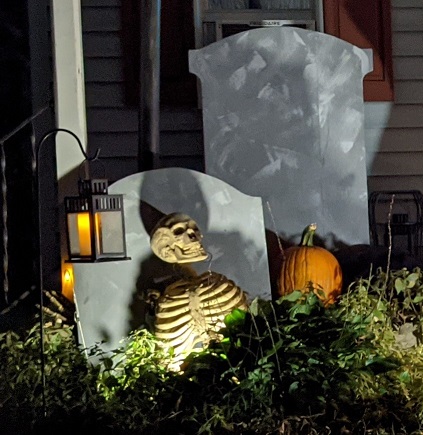
We wanted proper Halloween decorations this year, and this is what we ended up creating. I say “we” but it was really the rest of the family. Mostly I just fetched stuff, and wrote this chronicle. The background behind this fantabulous scene: it’s largely made up of set pieces from Aileen’s theater productions of the past. She has a storage building out back full of set pieces and bins of props and costume pieces.

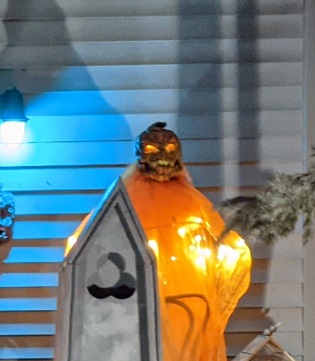
The head in the center is a set piece from the Wizard of Oz. It was donated to Aileen’s theater company from another production, though she never used it. I did help with digging it out and transporting it (it’s huge and quite heavy), as well as securing it with bungee cords. It makes a great centerpiece; I think it looks like some mad scientist supervillain.

The gravestones/tombstones are made of styrofoam and were used in Aileen’s production of Dracula in 2016. The urns in front are also styrofoam and may or may not have been used in a set. Those pieces all came out of the attic, where a part of Aileen’s huge costume collection is kept (a lot more is at the theater where she works).

The skeleton on the left was in the storage building, and the reason you only see part of it is that it was a bit decayed. Another frightening fact about it is that when Aileen went to retrieve it, she unleashed a swarm of wasps! Some type of paper wasp had constructed a nest inside that was attached to the spinal cord. She fled the building, then after a bit sprayed the nest, and a day or two later we gingerly retrieved the skeleton and removed the paper nest (the wasps were still in the building, clustering on a nearby window).

The skeleton on the right was a new purchase; it has red LED eyes! The lights in the center were also a new purchase. The flood lights, however, have been with Aileen’s theater company for ages. They are outdoor flood lights, so safe to keep in front of the porch, and it’s a good thing they are, because it has been raining a lot lately. The candles you can see here and there are battery powered and are a staple in Aileen’s productions.

The best part of the tableau is the pumpkinhead guy in the back. That was put together by Aileen’s son Tiernan, who used a mask he wore in a previous Halloween costume, and some orange fabric. It’s sitting on a top of this weird lamp that has plastic strands or tubes lit up by LEDs; I don’t know what to call it. Two of the tubes are twisted up and inserted behind the mask to light up the eyes. The lamp was used as a fairy tree in a production of Midsummer’s Night Dream. Now it’s a spooky pumpkin tree!

I hope you enjoyed this detailed look at our 2021 Halloween scene, which you can see in person if you ever drive through Morgantown, Pennsylvania this month.

Have a safe and happy Halloween!

Our Recent NYC RETURN where We “Get Down” with SIX Wives

Our Recent NYC RETURN where We “Get Down” with SIX Wives

This is a post about going to see SIX on Broadway, a very popular musical which has just begun performances post-COVID. Tickets are in high demand and very expensive and it was only by good fortune that my partner and I were able to go.

GETTING THERE

Since the show opened in previews on September 17, I had been entering the Broadway Direct lottery to get tickets. I don’t know all the details of this program, just that tickets are offered for a very low price to certain extremely popular shows that might be priced out of the range of many theater goers. But it’s a lottery; you sign up for the next day’s show and some small number of winners are offered tickets at a steep discount. I had entered the lottery for Hamilton every day for a very long time, before we finally went to see the show in Chicago a couple years ago. Every day I would sign up in the morning, and in the evening would get an email wishing me better luck next time. I started doing the same for SIX, expecting the same fruitless results.

Imagine my excitement when an email came informing me that I was on the waiting list. If I was chosen (presumably because another winner had missed or passed up their chance to buy the tickets) I would get another email, after which I would have 60 minutes to purchase the tickets. I waited expectantly and not an hour later a second email came. I had won the tickets! It was two tickets (the most you could sign up for) and they were $30 each. I quickly paid for them, and bragged about it on social media.

Next I had to reshuffle my work schedule, since it was such short notice. I honestly never thought I would win and that this would ever come up. I had won the tickets for the Thursday, September 23rd performance at 8 PM, but I had obligations at work that would normally have kept me late. There was no way to keep these obligations and make it to the show. But I was able to get other team members to take them on for me, so I could work a half day and we could leave as soon in the afternoon as possible.

The next day Aileen and I left at about 3:00PM, driving to New York City. Parking had already been arranged. It was raining heavily, which slowed us down. It took us over three hours to get there, and by the time we parked and made it to the theater we were soaking wet, despite having thoughtfully brought umbrellas with us. We had hoped to eat some dinner first, but it was already after 7 and there just wasn’t anywhere appealing to even grab a quick bite. We decided to get in line and eat out of the concession stand in the theater.

SAFETY CONCERNS

We were concerned, of course, about COVID-19. This concern had kept us from attending other events, and generally limited our going out to do anything lately. But I guess the lure of getting such a huge discount on tickets, and of seeing a show that is the current hype, was too much. Plus they had COVID-19 protocols in place – you had to be vaccinated, had to have proof of such, and were required to wear a face mask in the theater.

In line, everyone was indeed wearing a face mask. Not much of an intersection between the anti-masker crowd and the Broadway theater audience crowd, perhaps. There was a friendly young man who had a badge on identifying him as a COVID safety officer, who examined our ids and our proofs of vaccination. I had the original card they had given me at the drug store when I got vaccinated, and Aileen had a photocopy of hers. We were given the all clear. We had to wonder, though, if anyone might have showed fake evidence. It wouldn’t be too hard to rig up a fake card, especially if a photocopy or a picture on your smartphone were acceptable.

Once in the theater, we discovered that our tickets were in the front row. This was another fun twist. It also made us a little more comfortable from a COVID perspective, because we had room in front of us. The extra room also helped with the drying off bit. I got us some very expensive pretzels and candy from the concession stand and we sat and waited for the show to begin.

THE SHOW

SIX is an hour and a half long show that is basically a rock concert ostensibly performed by the six wives of King Henry VIII. The idea is that they’ve come back from the dead to entertain the crowd with their stories. So since they’ve come back from the dead, they aren’t required to be historically accurate. Their costumes are kind of half way between renaissance dress and glam rock or pop from modern times. It’s an all-female cast, including the musicians, who are also on stage. It’s also cast color-blind, in that the wives are not cast with ethnic accuracy to the original wives: they are black, white, brown and one is Asian. Each wife sings a solo about her own story, and these songs are bookended by ensemble numbers that set up the show and wrap it up with a message of female empowerment.

The Broadway 2021 production is energetic and a lot of fun. The singing is expert, the lyrics catchy and clever (with a lot of historical facts mixed with anachronistic references to the present), and the boots, according to my partner, are “freaking sweet.” Sitting in the front row helped draw me into the celebrity worship aspect, as I sat (and later stood as requested), staring raptly at the performers. I even got a flirtatious glance from Katherine Howard during her number (I think).

Henry VIII is arguably one of the most famous monarchs in history. The play references his fame a lot, and the subsequent fame of his wives and their personal reputations. The wives spend the bulk of the play arguing with one another over who was most maligned by the portly Prince. SIX also questions whether it was Henry who made his wives famous, or the other way around. Although the play (at just around 80 minutes with no intermission) seems short for a Broadway outing, the snarking of the queens feels like it goes on a bit too long. But once it gets to the meat of WHY the queens are famous, it finishes well. These women are, after all, the original “Real Housewives of Hampton Court,” and just as much celebrities as their shared spouse.

Even though the musical is short, it has lingered with us long after those 80 minutes. Since last week, we’ve been really interested in the six wives and their impact on history – which is epic, really, when you think about what happened to England because of their relationships with Henry. The Tudors were arguably one of the most impactful families of that, or any time. So we decided to watch The Tudors Showtime series again, and I started reading a book Aileen has about the six wives.

Well, I can assure you from reading the book that the Showtime series is no more accurate than this Broadway production. But that’s not the point, right? These shows are fictionalized recreations of well known historical figures and events that use facts and invention equally, as convenient. These aren’t really the six wives of Henry VIII, these are celebrity rock star versions. The program for SIX even mentions the specific pop stars after whom each queen is modeled. We’re supposed to treat them like divas.

Is it weird or wrong to worship celebrities? If it’s an all-consuming part of one’s life, I would say that’s not healthy – but for the short duration of an 80 minute diva rock roast, it feels like silly fun to pretend. Theater is a mutual relationship between performer and audience. Each needs the other to generate the emotional tension and catharsis that is the heart of theater and SIX relies on it.

The celebrity worship aspect is also, I suppose, part of why the ticket prices for this show are so high. Young women everywhere are reveling in these empowering tunes right now. That and the simple fact that it’s the current hot thing. If you try to book front row seats for an upcoming performance right now, you’ll find they are going for $500. I can’t imagine paying that much; it’s not that good. I’m not sure that any show is worth $500 to me, frankly. But it was certainly worth the price we paid, even a bit more, and that’s with all the hassle of getting there in the pouring rain. I would love to see it again, but from the back where I could get a better appreciation of the choreography and blocking and those “freaking sweet” heels.

(Full disclosure – Aileen helped me a lot with this one, because she is a theater reviewer. Soon she will be uploading her own blog posts here, so look for that!)

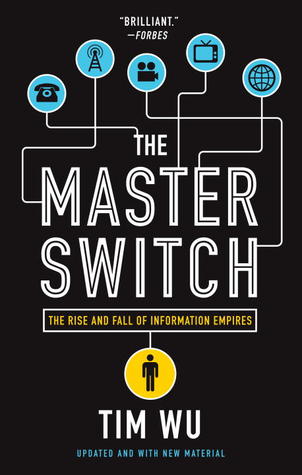
Book Review: The Master Switch

Book Review: The Master Switch

My latest reading escapade has me perusing The Master Switch: The Rise and Fall of Information Empires, by Tim Wu. He is a law professor who is currently an official in the Biden White House, specializing in technology and antitrust. He is also, in fact, the coiner of the term “net neutrality,” which is just the legal concept of a “common carrier,” as has been applied to telephone communications, but extended to the Internet.

In The Master Switch, Wu analyzes technological and industrial development in the fields of telephony, radio, film, television, and computer networking. He identifies what he calls “the Cycle,” in which monopolist companies consolidate control over particular information technology markets (the empires), only to be challenged when new technologies emerge in periods of “creative destruction,” borrowing a term from Joseph Schumpeter. But whoever comes out on top in the new technological era simply replaces the previous monopolist. A good example is the telephone overtaking the telegraph, with the once powerful Western Union (powerful enough to decide Presidential elections) taken down – if not out – only to be replaced by a new dominant monopoly, in the form of AT&T.

The cycle as Wu describes it reminds me of the technological waves from Debora Spar‘s book Ruling the Waves, which I have already reviewed in a series of blog posts. They are very similar concepts, although to my knowledge neither author has ever recognized the work of the other. Despite the similar concepts which are their subjects, the two books are different in structure. Spar focuses on one technology at a time, whereas Wu jumps around between the technological fields, sticking to an overall chronological narrative. Either way, both authors end up in the Internet era, though Wu arrives ten years later. I noted in my review of Spar’s work that it would be great to get her opinion on how the Internet wave looks now, seeing as she was writing at the end of the dot com era (just around Y2K), but I don’t think she pursued the subject any further. Wu has followed up with additional books, though I haven’t read any of them.

In addition to the Cycle, Wu identifies what he calls “the Kronos Effect”, wherein an established monopolist uses its power, and usually its close relationship with government, to suppress new technologies, just as Kronos in Greek myth devoured his own children for fear of being replaced by them. A good example is how the NBC/CBS duopoly of radio broadcasting networks successfully prevented the development of television until the technology was firmly under their own control. This is why TV started with the “Big Three” networks already established in radio (ABC split off from NBC in 1943), not because there was any natural reason TV couldn’t have developed differently. There were independent television companies throughout the 1930s, but they were unable to grow their markets, because of the anticompetitive actions of the established radio companies.

I didn’t know much about the early days of television until I read this book, and it gave me a good overview. The story is just one of the many things I learned about the history of technology and of the people who were intimately involved with the invention and development of so much that we take for granted today. Wu’s book is well written, and with short chapters is a quick and easy read. The jumping around between the stories of different technologies can be a little confusing, but it’s made up for by the overarching narrative of “the Cycle” and the efforts of powerful interests to suppress it.

Interestingly, Spar didn’t include the dawn of television in her history of technological waves. When I read her book, I found it odd that she skipped from radio in the early 1900s straight to satellite television in the late 1900s. But I speculate now that it this was because she couldn’t fit the early history of television into her wave pattern. Like Wu, she identifies the invention and entrepreneurship phases of new technologies. But unlike Wu, she doesn’t cover the scenario where entrepreneurship is suppressed by a powerful entity maintaining its information empire, destroying competitors before they can even arise. The mid-1900s, a staid and conformist social era, was precisely such a period in the history of information technology.

Concern for this pattern of anticompetitive economics imbues Wu’s book. It’s particularly concerning for information technology, because the corporations who dominate it control not just how we access information, but also what information we access. For instance, during the so-called “Golden Age of Hollywood,” private interests, via both the vertically integrated industry of the studio system and the privately conceived and enforced censorship of the Hays Code, controlled the nature of mass media content available to filmgoers for a solid two decades or more. Eventually both the industry and the social constraints were broken down, but conceivably much creative potential was stifled and lost forever in the interim. Conceivably, political orthodoxy was enforced; it is not a coincidence that the McCarthy era in politics occurred at the same time.

Similarly, the dominance of “Big Tech” in today’s Internet economy means a small number of corporations might end up becoming the gatekeepers of what news and opinion is available for consumption by Internet users, if they haven’t already. What is cancelling and deplatforming in today’s social media environment if not another version of a private sector censorship committee controlling what is considered acceptable free speech? Is a Twitter mob much better an arbiter of what is morally correct than was the National Legion of Decency? And if it is a better arbiter, because it represents a majoritarian viewpoint, then are we not living under mob rule, as Paris was during the French Revolution?

That raises the question of whether the impetus for controlling and shaping information is supply-side – driven by profit-seeking corporations and power-seeking governments – or demand-side – driven by a social need for consensus and conformity. I think it could be both. If there is a demand for order and regulation from below, it would only make it easier for those providing the supply from the top. And if the demand from below is for the loosening of regulation, it would be easier for the spirit of entrepreneurship to flourish. In other words, there might be a social cycle working in conjunction with an industrial cycle.

This is not something Wu addresses directly, being as he focuses on corporate actions and law, as befits his expertise. But he does hint at it in his narrative, recognizing how loosening social morality contributed to the decline in compliance with the Hays Code (compliance with which was always voluntary – as in not coerced by law). The idea of connecting the social cycle with the technological cycle or wave deeply interests me, and is what I have attempted to do in these series of posts looking first at Debora Spar’s book, and now at Tim Wu’s. Both authors recognized the same pattern, which must be deeply connected to human nature and human needs.

To conclude the book review, this is a very good read with a lot of fascinating tidbits about the development of information and communication technology, including biographical information about key players. You always get this human element in these narratives about the invention and commercialization of technology; personality is part of how technology empires are created. As already mentioned, patterns in economics and industry are connected to patterns in social mores and social needs, and in any social era there always seems to be someone poised to take advantage of social and technological change. A “man for his time and place,” so to speak.

In The Master Switch, Wu worries about the tendency for entities like corporations to arise and establish monopolistic control of new information technologies. Writing in 2011, he wonders if it will be different for the Internet, since by its nature it encourages openness and interoperability. From the vantage point of 2021, I think he would agree with me that the new monopolies have formed; we don’t have the term “Big Tech” for nothing. There may well be inexorable forces of history and human nature at work here, driving us collectively toward this state. This means a big challenge for Wu, in his official policy role, guiding the President on technology and competition, but it doesn’t mean that it isn’t worth the effort to mitigate against the downsides of information empires, or even try to stop them from forming altogether. I wish him the best.

Dee Em Vee

Dee Em Vee

This is the story of my recent visits to the Pennsylvania Department of Transportation (PennDOT) in an effort to acquire a valid driver’s license that meets Homeland Security’s Real ID security standards.

It all started when I moved to Pennsylvania and got my PA driver’s license, back in 2018. This license was set to expire in September of 2021, which of course is now, and had the address of my apartment in West Chester. Then there was a pandemic, and I moved to Morgantown. Being a good citizen, I let PennDOT know. When it came time to renew my license, they sent me a “camera card” with my new address. I was supposed to take the camera card to a PennDOT location to get a new photo taken and have my new license printed up. I put the camera card in my wallet, with my license, so that I had proof of my correct address with me when I was driving.

I delayed getting this done for a few weeks, but time was running out. My camera card was only valid until the end of September. I decided to get my new photo and license this Monday, during my lunch break. I had two locations to choose between, and I decided to go to the one that I figured would be less crowded. That morning after I awoke, I took a shower and put on a nice shirt. I did a load of laundry, then went to work (meaning upstairs in the home office). As it got close to noon, I logged off and got ready to go. I was so excited!

I had this vague idea that I would see if I could get a Real ID while I was at it, and I knew that required me to bring my birth certificate and my SSN card, both of which I had. My SSN card is really old and worn out; it’s from when I was a child. I got them together, and my checkbook in case I needed it to pay because they didn’t take cards, but where was my wallet? I realized that I had left it in my pants when I did the laundry! It had gone completely through the wash, and my camera card was in there!

I extracted the still damp camera card and stuck it between two paper towels. It still seemed legible to me, despite the ink being smeared. Maybe I would be OK. I took all the plastic out of the wallet, including my expired license, and with this pile of documents I headed out to Pottstown.

My maps software helpfully guided me to the PennDOT location, which was right in the middle of town. It was a small building. A sign on the door implored, “please wear a face mask,” which of course I was doing since the pandemic is not over. Inside the building there were two rooms I could enter; and since the one on the right had the camera setup, that seemed like the obvious choice. Maybe a dozen or so people were already there, most of whom were ignoring the mask sign. There was a dispenser to grab a ticket with a number on it, so I took my number and sat on a chair against the wall.

It appeared I was in the right place, and shortly my number was called. There was just a young guy behind a desk who took my ticket, and a woman who was behind a nearby counter doing most of the work (both employees were masked). I showed the young guy my laundered camera card and explained the situation. He made a little of fun of me for washing my wallet, then gave the card to the woman, along with my driver’s license. She tried to scan the card, but it wouldn’t read. She told me that she wouldn’t be able to help me. I would need a new camera card, but they had no way to get me that here, though I might be able to go across the hall and get one, or go to a “full service” PennDOT location.

So I went across the hall. It was another small room, with two employees behind a counter, neither one masked, but at least they had plexiglass set up. Each one was busy with a customer. Both of these customers had some super complicated thing to do involving tag or title transfer, and I stood there waiting for a good while. It was hot and stuffy, because the AC wasn’t working, which I overheard one of the employees mention. Behind me, a line started to form. I was the only one with a face mask, and feeling uncomfortable.

At one point the same employee who had commented on the AC not working called out to the people in line, to tell them that if they were here to get a photo taken, they were in the wrong room. She wanted to make sure they knew to go across the hall. I took advantage of the opportunity to engage her, even though her customer was still at her counter. I told her I was here to get a new camera card. She said that would be possible, but I wouldn’t get it right away. It would be mailed to me.

That was of no use to me, so I left. I drove back home, feeling cranky. Trying to keep a sense of humor, I joked to my housemates that our supposed advanced civilization doesn’t even have the capability to scan a camera card just because you decided to send it through one cycle in the washing machine. You couldn’t even do one cycle in the washing machine without the whole system breaking down! My BFF gently reminded me that it was my own fault and I should own the responsibility.

I went online and looked at what my options might be. I found the DL-80 form to get a new camera card, but it had to be notarized. So I couldn’t even conveniently request the card from home and just sit on the problem for another week or so; I would have to go out again. I resolved to go to the alternate location in Reading, which I believed was probably a “full service” PennDOT. I would leave first thing in the morning. It opened at 8:30 AM. I let work know I was going to be offline in the AM the next day.

So on Tuesday I woke up early, showered, and put on the same shirt. I had a cup of coffee and a protein bar, and headed out as soon as I could. I got to the PennDOT location at 8:45 AM. There as a huge line of people in front of the building, at least thirty or more. But I was resolved. I approached the building, and discerned that there were multiple lines. A man in a guard’s uniform was there, and when I went up to him he asked me what I was there for. I tentatively replied that I wanted to get a Real ID, and he directed me to the proper line.

Luckily, it wasn’t too hot out yet. Also, most, though not all, of the people in line were wearing face masks. The crowd’s mood was generally positive, and slowly but surely the lines advanced into the building. It seemed they were letting in one person from each line on a rotating basis. In about 45 minutes I was in the building, in a consolidated line at the entrance. It was a very large room, with rows and rows of seats with people in them on one side, and a row of counters on the other. Two different gentlemen were processing the newcomers at the entrance.

Suddenly I saw the same young guy who had first taken my number the previous day, walking right by me. He was working at this location today. I called to him that I recognized him from Pottstown, and excitedly told him that I was having a DMV adventure this week. He gave me a quick sideways glance and slight smile, then hurried off.

One of the two gentlemen in front summoned me up to his counter with a hand wave. He asked me what I wanted and I told him I wanted to get Real ID, and also that I had a camera card that had gone through the washing machine. He made a little fun of me for washing my camera card, then told me I would be able to get a new one here, and listed what I needed to get Real ID. Birth certificate; I had that. Social security card, had to be the real thing, not a photocopy; I had that. Two proofs of address. Oh oh. I hadn’t brought that.

Not to fear, he assured me. The camera card had my address, so that was one. And if I had a vehicle registration or proof of insurance card, those could work, too. Those were in the car, I told him, and he had me run out to get them, then come immediately back to him. I ran out, clutching my precious bundle of documents, added the registration and proof of insurance to the pile, then returned. He was seeing another customer, but as soon as he was done, beckoned to me again.

The vehicle registration had my current address, so I was in luck, although the insurance card was old and did not. He gave me a ticket with a number and had me go sit down in the rows of chairs. I picked a corner, as far away from other people as possible. Waiting here, though, wasn’t as bad as it had been at the other location the previous day. Here, the air conditioning was working. The building was much more spacious, and almost everyone was wearing a face mask.

My number was called over the PA system, along with the number of the counter I was to go to. A woman there took all my documents and listened to my story and my request. She made gentle fun of the fact that I had washed my wallet. She also told me that, unfortunately, I would not be able to use my camera card as one of the two proofs of my address to get a Real ID compliant license, since it was associated with my old driver’s license which had my old address on it. I pointed out that the camera card itself had the new address on it, but she insisted that was not how it worked. If my driver’s license was current, with my current address, I would be able to use it. But not as things stood.

So wait, I continued, attempting an argument. I had everything I needed to renew my license, right? The answer was yes. And once I had a new license, with my current address, I would be able to get the Real ID, right? The answer was yes. So why not just let me get the Real ID with what I had, since it was the same information? That wasn’t how it worked. It was the federal government, you see. Very strict. But I could get my renewed driver’s license and come through again for the Real ID? Absolutely. She told me to do that, and just come directly to her after getting my license.

The path before me was now clear. The woman behind the counter printed me up a new camera card, which cost me 5 bucks. I returned to my seat to wait for my number to be called again, and when it was I was directed to one of the counters where the photos were taken. A woman there directed me to sit in a chair facing a camera. I set my pile of documents, now in disarray, down on the counter and then did as instructed. I did my best to smile cheerfully at the camera. Calm blue ocean. She snapped my picture, then had me come up to the counter to go through a brief questionnaire on a touch screen. It was hard for me to read, and I kept having to shift my glasses to see it properly. One of the annoying things about growing old.

Once that was done, I grabbed my document pile, seated myself near the photo section, and waited some more. My name was called, and I was given my license, which I had to verify and then sign for. I immediately went to the other counter where the first woman was, and hovered until she beckoned me forward. She processed me again, scanning all of the documents that proved to the federal government that I was who I said I was. She gave me yet another camera card, and charged me 60 bucks this time. She also gave me a new number for getting my photo taken.

Back to a seat to wait. I had been at the building for over two hours now. I looked around, wondering if I would recognize any faces of customers who had been there when I originally showed up. I saw one. This wait ended up being the longest, or maybe it just felt that way, since I was so close to the finish line. After half an hour, I was getting nervous. Maybe my new number wouldn’t work, because the woman at the counter hadn’t entered it correctly into the system. I was getting close to getting up to ask her if there was an issue, when a number very close to mine got called.

That gave me hope. There was light at the end of the tunnel. A little while later, my number was indeed called. I rushed up to the photo counter. It was the same one I had gone to originally. I couldn’t tell if the woman there recognized me from before. She just processed me like I was any other customer. Smile for the camera. Fill out the questionnaire, eyes squinting to read the questions. This time, that was the last step. My Real ID compliant driver’s license would come in the mail, and would be good for eight years.

The saga was complete. It had come to a fairy tale ending. Not only was I Real according to the federal government, I was going to have a driver’s license (if not eyesight) that was good until 2029! And I had a valid one in my wallet at the very moment. As a bonus, I had my amusing tale of hidebound bureaucracy and its cumbersome processes, which I told several times to my housemates and friends, and have now shared with you, dear reader. In all truth, PennDOT did a wonderful job, and bless them for keeping up with their work in this time of corona.

And now for some Primus.